Showing posts with label UDB. Show all posts

Wednesday, April 11, 2018

The Urban Development Boundary in Miami-Dade County: again, and again, and again ... by gimleteye

Mayor Carlos Gimenez is like a hungry dog on a bone with his plan to extend SR 836 into the last remaining farmland in Southwest Miami-Dade.

This holy grail of developer insiders at County Hall -- many of whom have fallow investments for a decade, since the financial crash -- is being sold as a "cure" for traffic congestion that should have been fixed generations ago on the county commission. Like for instance, when Gimenez was a county commissioner.

In the late 1990's, money from a transportation bond was frittered away plugging budget holes elsewhere. Developers -- mainly interested in keeping infrastructure costs low -- and county hall insiders opposed every measure where transit planning could pre-empt cookie-cutter subdivisions in low-cost wetlands or farmland.

This week, the Planning Advisory Board recommended to transmit to the full county commission the highway expansion project which will, naturally, lead to more pressure to transform lands beyond the UDB to suburban sprawl. Because that is who we are. Because that is what we do.

No journalism entity in Miami has written and published as much on the Urban Development Boundary, transit and environmental issues as Eye On Miami. (Click this link, for an archive.)

Our interest in the UDB is on several levels, but in general this artificial line -- created by politicians -- separates the areas that receive urban services (fire, police, water and sewer) subsidized by taxpayers from those that don't. The UDB, moreover, is a point of conflict. And points of conflict always highlight the values of a society. To me, that is what holds my interest in the UDB. It tells the story of South Florida better than any other.

Jim Morin's most recent UDB cartoon 
That explains, too, the interest of Miami Herald, award-winning political cartoonist Jim Morin. We've collected a number of Morin cartoons on the UDB over the years. Many years. He is our fellow chronicler and, after all we've published on the UDB, a picture is still worth a thousand words.


Friday, January 05, 2018

The UDB Line in GREAT PERIL. By Geniusofdespair

On the local front, a Task Force put together by Mayor Carlos Gimenez ( to advise the County Commission) is winding down and about to vote on the movement of the Urban Development Boundary. The group's composition* is strongly weighted towards expansion. At the last meeting the Environmental side was in the majority near the end of the meeting (miracle) and a motion was made. The Rock Mining Queen, must have realized her side was under-represented, and said she had to go. The Planning Dept. said please don't go, we will lose the quorum. She sat down but another wise guy jumped up and left - quorum gone. Her signal to her side worked.


Twenty minutes later the wise guy was seen outside in the hall on his cell phone. He had no pressing matter as to why he had to leave, he just was afraid of the motion put forth by the minority side. What this man did was illegal. You cannot avoid a vote. But who is going to do anything about it? There is no penalty, so even though it is against the law, they can't do anything to the guy, he is just a real creep and you can see how very serious they are about manipulating the outcome.

They meet today at 1 pm. They usually meet way South -- so most people can't attend unless they are willing to fight massive traffic jams. Today they are meeting West, different traffic jams.

The Urban Expansion Area Task Force Agenda:

I might go just to hear Michael Pizzi. The presentations are meaningless, they all already know how they are going to vote.

Meanwhile, there is another push going on by MDX out West for the expansion of the Dolphin Expressway 836.  We are doing all this as the REAL threat of sea level rise engulfs us from the West as well as the East. Makes no sense.

 *This is a list of membership for the Task Force:

1000 Friends of Florida
Tropical Audubon Society
Urban Environment League
Nova Southeastern Shepard Broad Law Center
Sierra Club
Agricultural Practices Advisory Board
Redland Citizens Association
Rock mining representative
Builders Association of South Florida
Latin Builders Association
Florida East Coast Chapter of Associated Builders and Contractors, Inc.
Florida Home Builders Association
Homestead Air Reserve Base Representative
Property Owners’ Representative – Eastern Urban Expansion Area
Property Owners’ Representative – Western Urban Expansion Area
Community Council 11
Community Council 14
Community Council 15
Florida Nursery Growers & Landscape Association
Tropical Fruit Growers of South Florida
Dade County Farm Bureau
Latin American Business Association
Biscayne National Park
Everglades National Park
Urban Land Institute (Southeast Florida/Caribbean Chapter)
Friends of the Everglades
Miccosukee Tribe of Florida

Tuesday, October 31, 2017

Say Goodbye to the UDB: The Urban Expansion Area Task Force. By Henny Penny

Long range planning, has yet another stupid  public group:
The members present - A lot of these folks are development interests and rock mining interests

The Urban Development Boundary is in jeopardy in a couple of areas -- what they call the expansion areas --- and no one appears to care.  One area being considered is near SW 8th Street, North--- but they won't move the meeting North for that area. The Long Range Planning Department of the County is holding hearings with this task force,  that has members assembled by Mayor Gimenez. Everything is voted by majority and guess what interest holds the majority? Development.

It is a good bet that when Bill Loser Losner and James Humble are on the same committee you will never get good results.  They dominate the proceedings and speak out constantly.

The meetings are being held far, far, South so it is easy for these guys to attend - they live there. It is not so easy for other members who have to travel far, far, south. For example, Richard Grosso travels from Mid-Broward.

The dark side controls the votes.  Good luck with getting a good outcome on this. I think it will serve to give the County Commissioners cover for a vote to move these areas into development.

You would think that this shortage of acreage for viable farming alone would protect the farmland left. You would hope it could stop the "workforce housing" that many are talking about at the meeting.

Meanwhile, as the long ranger planning lumbers on at the task force, there is another application to amend the exisiting CDMP designation outside the line for approximately 45 acres located on the Southwest corner of SW 312th Street/ Campbell Drive and SW 137th Avenue to fit the property. The amendment proposes to change the designation from Agriculture to Business and Office.

The application will be heard by the Planning Advisory Board (PAB) on November 6 and by the Board of County Commissioners on November 8, 2017.


Tuesday, September 12, 2017

From Jim Morin, former Herald cartoonist from May, 1985 ... by gimleteye

Jim Morin, Miami Herald, May 1985
We've been here before. First, the stress of waiting for the storm. In Irma's case, MASSIVE. Second, the storm. IT FCOULD HAVE BEEN WORSE Third, the anxiety about life and property and struggling for news without the benefit of electricity. WHEN WILL THIS END?

The heat, the boredom, and the stress of waiting for electricity to return. Get the kids back to school! OK. Right now it sucks to be almost anywhere in South Florida, but it is a time for gratitude. Thankful for law and order. Thankful we are not the devastated Caribbean. There is light at the end of this tunnel.

Businesses are suffering. Millions will be without electricity for a number of days or weeks, but soon life will return to chaotic normal. The streets, the yards, and debris will be cleaned. The lights will go on. The lights on the interweb machines will blink again.

And soon Floridians will forget that only a few days before Irma hit, the storm was the strongest ever recorded in the Atlantic, for the longest duration, and but for the interference of Cuba, might have maintained strength straight into Miami.

Maybe it is too early to pose the only question that matters in relation to a future hurricane or disaster like sea-level rise: will we learn anything from this exercise, or, just meander down the same road we've always taken in South Florida? More growth, more development in low-lying lands, more justifications to move the Urban Development Boundary.

Based on the past and present behavior -- primarily from Tallahassee and Washington, DC -- the answer is "no". Katrina, Wilma, George. We can't actually learn anything because learning would require reaction and reaction would jeopardize the profit models that have turned democracy into a form of infotainment the Founding Fathers would not recognize.

That's why it is so hard for one political party to acknowledge how man-made climate change is adding fuel to our recent, immense hurricanes in the Atlantic and spreading the seeds of economic chaos around the globe.

Consider former Herald Jim Morin's cartoon from 1985 (above) before the Russia debt implosion. Before the dot com boom. Before the Greenspan-Bush era mortgage and bank blowup. Before the 2007 financial bubble. Before Katrina, Wilma, George and Irma.

Draw your own conclusions and please, please vote accordingly in 2018.


Saturday, September 09, 2017

Strong piece in Politico by Mike Grunwald: "A Requiem For Florida: The Paradise That Should Never Have Been"

Mike ends his piece: " Most of us came here to escape reality, not to deal with it." He's right. We try to deal with reality, at Eye On Miami. Urban Development Boundary, anyone? ... Gimleteye


A Requiem for Florida, the Paradise That Should Never Have Been

As Hurricane Irma prepares to strike, it’s worth remembering that Mother Nature never intended us to live here.
By MICHAEL GRUNWALD September 08, 2017

ORLANDO, Fla.—The first Americans to spend much time in South Florida were the U.S. Army men who chased the Seminole Indians around the peninsula in the 1830s. And they hated it. Today, their letters read like Yelp reviews of an arsenic café, denouncing the region as a “hideous,” “loathsome,” “diabolical,” “God-abandoned” mosquito refuge.

“Florida is certainly the poorest country that ever two people quarreled for,” one Army surgeon wrote. “It was the most dreary and pandemonium-like region I ever visited, nothing but barren wastes.” An officer summarized it as “swampy, low, excessively hot, sickly and repulsive in all its features.” The future president Zachary Taylor, who commanded U.S. troops there for two years, groused that he wouldn’t trade a square foot of Michigan or Ohio for a square mile of Florida. The consensus among the soldiers was that the U.S. should just leave the area to the Indians and the mosquitoes; as one general put it, “I could not wish them all a worse place.” Or as one lieutenant complained: “Millions of money has been expended to gain this most barren, swampy, and good-for-nothing peninsula.”

Today, Florida’s southern thumb has been transformed into a subtropical paradise for millions of residents and tourists, a sprawling megalopolis dangling into the Gulf Stream that could sustain hundreds of billions of dollars in damage if Hurricane Irma makes a direct hit. So it’s easy to forget that South Florida was once America’s last frontier, generally dismissed as an uninhabitable and undesirable wasteland, almost completely unsettled well after the West was won. “How far, far out of the world it seems,” Iza Hardy wrote in an 1887 book called Oranges and Alligators: Sketches of South Florida. And Hardy ventured only as far south as Orlando, which is actually central Florida, nearly 250 miles north of Miami. Back then, only about 300 hardy pioneers lived in modern-day South Florida. Miami wasn’t even incorporated as a city until 1896. And even then an early visitor declared that if he owned Miami and hell, he would rent out Miami and live in hell.

There was really just one reason South Florida remained so unpleasant and so empty for so long: water. The region was simply too soggy and swampy for development. Its low-lying flatlands were too vulnerable to storms and floods. As a colorful governor with the colorful name of Napoleon Bonaparte Broward put it: “Water is the common enemy of the people of Florida.” So in the 20th century, Florida declared war on its common enemy, vowing to subdue Mother Nature, eventually making vast swaths of floodplains safe for the president to build golf courses and Vanilla Ice to flip houses and my kids to grow up in the sunshine. Water control—even more than air conditioning or bug spray or Social Security—enabled the spectacular growth of South Florida. It’s a pretty awesome place to live, now that so much of its swamp has been drained, much better than Boston or Brooklyn in the winter, and, for the obvious economic and political reasons, much better than Havana or Caracas all year long.

But Mother Nature still gets her say. Water control has ravaged the globally beloved Everglades and the rest of the South Florida ecosystem in ways that imperil our way of life as well as the local flora and fauna. And sometimes, as we’re about to be reminded, water can’t be controlled. Hurricanes routinely tore through South Florida even before hundreds of gleaming skyscrapers and thousands of red-roof subdivisions sprouted in their path. Our collective willingness not to dwell on that ugly inevitability has also enabled the region’s spectacular growth.

I was thinking about all this on Thursday while evacuating my family from our home in Miami to my mother-in-law’s home near Orlando, which, incidentally, one Seminole War veteran called “by far the poorest and most miserable region I ever beheld.” Our house is about 17 feet above sea level, which is practically Everest in South Florida terms, but we were still in a mandatory evacuation zone, because nothing in this part of the world is safe from a killer like Irma. Over the last century, we’ve built a weird but remarkable civilization down here in a weird and unsustainable way. This weekend, history’s bill might come due.

***

More than a half-century before the Pilgrims landed at Plymouth Rock, a Spanish adventurer named Pedro Menendez de Aviles landed in North Florida, and began preparing for battle with French Lutherans who coveted the same territory. Then a hurricane destroyed the French fleet on the open seas. Menendez took this as a sign from God, and gleefully slaughtered the rest of the “evil and detestable Protestants” in an inlet he proudly named Matanzas, Spanish for “massacre.” He went on to create St. Augustine, America’s oldest permanent settlement, an enduring reminder that Florida’s history was forged by storms as well as blood.

Menendez dreamed of colonizing the whole peninsula, but he made no progress in the backwaters of southern Florida; as his nephew reported to the king in 1570, the entire region was “liable to overflow, and of no use.” And it stayed that way for the next few centuries. That’s because it was dominated by the Everglades, an inhospitable expanse of impenetrable sawgrass marshland, described in an 1845 Treasury Department report as “suitable only for the haunt of noxious vermin, or the resort of pestilential reptiles.” White men avoided it, because they viewed wetlands as wastelands. As late as 1897, five years after the historian Frederick Jackson Turner declared the closing of the Western frontier, an explorer named Hugh Willoughby embarked on a Lewis-and-Clark-style journey of discovery through the Everglades in a dugout canoe. “It may seem strange, in our days of Arctic and African exploration for the public to learn that in our very midst, in one of our Atlantic coast states, we have a tract of land 130 miles long and 70 miles wide that is as much unknown to the white man as the heart of Africa,” Willoughby wrote.

But white men began to realize that South Florida had real potential if they could figure out how to drain its “monstrous” swamp. Governor Broward vowed to dig a few canals and create an instant “Empire of the Everglades,” a winter garden that would grow food for the world and cities larger than Chicago. Swindlers sold swampland to suckers, turning Florida real estate into a land-by-the-gallon punchline. Pioneers flocked to long-forgotten marshy boom towns with names like Utopia and Hope City and Gladesview, buying lots that looked great in the dry season only to find that they still flooded regularly during the rainy season.

Meanwhile, the Standard Oil baron Henry Flagler built a railroad down the east coast, luring tourists to beachfront towns like Palm Beach, Fort Lauderdale and Miami, setting the stage for a wild 1920s land bubble that rivaled the 17th century Dutch tulip craze. Motor-mouthed “binder boys” in knickers known as “acreage trousers” mobbed the streets of Miami, harassing pedestrians to buy and sell lots that often changed hands three times a day. One entrepreneur bought and resold a contract for a $10,000 profit on a stroll down Flagler Street. The New York Times started a stand-alone Florida real estate section. “Nobody in Florida thinks of anything else in these days when the peninsula is jammed with visitors from end to end and side to side,” the Times reported. The insanity was immortalized by the Marx Brothers movie Cocoanuts, with Groucho capturing Florida’s sleazy new land ethic: “You can even get stucco! Oh boy, can you get stucco.”

Pretty soon, South Florida got stucco. In 1926, a few weeks after the Miami Herald urged its readers not to worry about hurricanes because “there is more risk to life from venturing across a busy street,” a Category 4 storm flattened Miami, killing 400 and abruptly ending the coastal boom.Then in 1928, another Category 4 storm blasted Lake Okeechobee through its flimsy dike, killing 2,500 and abruptly ending the Everglades boom. It was the second-deadliest natural disaster in U.S. history, and afterward Florida’s attorney general testified before Congress that much of the southern half of his state might be unsuited to human habitation: “I’ve heard it advocated that what the people ought to do is build a wall down there and keep the military there to keep people from coming in.”

Needless to say, nobody built a wall. But America finally did get serious about draining the swamp. The Army Corps of Engineers, the shock troops in the nation’s war on Mother Nature, built the most elaborate water management system of its day, 2,000 miles of levees and canals along with pumps so powerful some of the engines would have to be cannibalized from nuclear submarines. The engineers aimed to seize control of just about every drop of water that falls on South Florida, whisking it out to sea to prevent flooding in the flatlands. They made it possible for Americans to farm 400,000 acres of sugar fields in the northern Everglades, to visit Disney World at the headwaters of the Everglades, to drive on the Palmetto and Sawgrass Expressways where palmettos and sawgrass used to be. They made South Florida safe for a long boom that has occasionally paused but has never really stopped, bringing 8 million people to the Everglades watershed, pushing the state’s population from 27th in the nation before World War II to third in the nation today.

But they made South Florida safe only most of the time, not all of the time. Now the Big One might be coming, with millions more people and structures in harm’s way than there were in 1926 or 1928. And Mother Nature looks pissed.

***

Last year, Florida’s “Treasure Coast,” about 100 miles north of Miami, made national news when its sparkling estuary was shrouded in toxic glop that looked like guacamole and smelled like a sewer. This was an economic as well as environmental disaster, shredding the fishing and tourism industries around the town of Stuart. And it’s not a huge stretch to think of it as the latest damage created by the 1928 hurricane. Water managers don’t want Lake Okeechobee’s dike to fail again now that there’s a civilization behind it, so they routinely blast filthy water from the lake into the fragile estuaries to the east and west. Sometimes, glop happens.

The problem, like most problems in South Florida, is a water problem. Half the Everglades has been drained or paved for agriculture and development, so in the rainy season, water managers have to dump excess water into estuaries and what’s left of the Everglades. Then it’s no longer available in the dry season, which is why South Florida now faces structural droughts that create wildfires in the Everglades and endanger the region’s drinking water, which happens to sit underneath the Everglades. Meanwhile, the Everglades itself—once reviled as a vile backwater, now revered as an ecological treasure—has all kinds of problems of its own, including 69 endangered species. In 2000, Congress approved the largest environmental restoration project in history to try to resuscitate the Everglades, an unprecedented effort to fix South Florida’s water problems for people and farms as well as nature. But 17 years later, virtually no progress has been made. It’s a real mess.

But the fundamental issue is that South Florida is an artificial civilization, engineered and air-conditioned to insulate its residents and tourists from the realities of its natural landscape. We call animal control when alligators wander into our backyards, and it doesn’t occur to us that we’ve wandered into the alligators’ backyard. Most residents of suburban communities carved out of Everglades swampland—Weston, Wellington, Miami Springs, Miami Lakes—are blissfully oblivious to the intricate water diversion strategies that their government officials use to keep them dry every day. Most South Floridians don’t think much about climate change, either, even though it’s creating more intense storms, even though the rising seas around Miami Beach now flood low-lying neighborhoods on sunny days during high tide. People tend not to think too much about existential threats to the places they live. They just live.

And they keep coming. Twenty-five years ago, Hurricane Andrew ripped through Miami’s southern exurbs, but the homes destroyed were quickly replaced, and most of us who live here now weren’t here then. So we weren’t really ready for Irma, even though at some level we knew it was possible. It’s conceivable that Irma will finally shut down our insatiable growth machine, but I wouldn’t bet on that. Our inclination towards collective amnesia is just too strong.

The thing is, it’s really nice here, except when it isn’t. Those Seminole War soldiers would be stunned to see how this worthless hellscape of swarming mosquitoes and sodden marshes has become a high-priced dreamscape of swimming pools and merengue and plastic surgery and Mar-a-Lago. It probably isn’t sustainable. But until it gets wiped out—and maybe even after—there’s still going to be a market for paradise. Most of us came here to escape reality, not to deal with it.

Monday, September 04, 2017

More subdivisions to flood out West? Maybe. By Geniusofdespair

 Not sure what this group will recommend to the County Commission but by its members I can make a prediction (but I won't, I am saving my butt):
We Want to Hear From You! The Miami-Dade County Urban Expansion Area Task Force was created to provide recommendations related to the County’s Urban Expansion Areas. To inform these recommendations, the Task Force will hear presentations from subject matter experts ( I believe lobbyist will be making Some of the presentations as they made motions to supply their own speakers -- that passed very aggressively) and receive public comments on key topics during scheduled input sessions. Below is a list of upcoming input sessions of the Urban Expansion Area Task Force. The public is invited to attend and provide input on these issues.

·         September 25, 2017 at 1:00 p.m. - Environmental Considerations Input Session
South Dade Regional Library

·         October 16, 2017 at 1:00 p.m. – Agricultural Considerations Input Session
South Dade Regional Library

·         Additional input sessions will be scheduled at a later date addressing development, transportation, limestone mining and affordable housing. Please check the UEA Task Force website for updates. 

BUT, A BIG BUT:
Nooo. Not a Butt...a "but"

We had better remember Texas' flooded subdivisions before erecting anymore subdivisions of our own....

Texas subdivision in 2016 and then flooded in 2017.

We should heed Robert McCabe's words of 2011 (Real Estate and Economic Research):
South Florida really needs a regional plan for controlled growth (before it becomes a concrete jungle similar to Houston), and a completely new set of elected officials that make decisions based on what's good for the future of South Florida instead of what's good for their wallets.
National Flood Insurance is already $25 BILLION in debt. What could another hurricane do to all those Florida Subdivisions a couple of feet above sea level?

Thursday, August 31, 2017

Urban Development Boundary Task Force, Mayor Gimenez, and Hurricane Harvey: Lessons from a costly disaster ... by gimleteye

Every resident and taxpayer in Miami-Dade County knows this about Hurricane Harvey: there but for the luck of God, go I.

While much attention is being paid to the causes and effects of a tragic, historic, monster storm (costing as much as $40 billion -- a number that is incomprehensible, really), it seems that very few in Florida are paying attention to how unsustainable growth and development literally pave the path to disaster.

One of the best examples is happening right now, through a Task Force created by Mayor Carlos Gimenez to "examine" options for expanding the Urban Development Boundary in far west Miami-Dade County, where big farmers and land speculators have been itching to build the next version of Kendall at the edge of the Everglades.

A report in the New York Times, today, provides the perspective of a rice farmer in South Texas:

A century’s worth of unchecked growth, he’ll tell you, has brought prosperity to many. But it also has altered the landscape in ways that have made both the droughts and the floods more destructive and made that prosperity fleeting. Much of the region sits atop the overtaxed Gulf Coast Aquifer, and though efforts have made over the last 40 years to limit withdrawals from it, enough water has been sucked out of it that the ground still subsides in some places, altering runoff patterns and allowing flood waters to gather.

What’s more, those more than 2 million newcomers to the region are living in houses and driving on roads and shopping in stores built atop what once was prairie that could have absorbed at least some of the fury of this flood and the next. What once was land that might have softened the storm’s blow is now, in many cases, collateral damage in what could turn out to be a $40 billion disaster. ("A Texas Farmer on Harvey, Bad Planning and Runaway Growth", Aug 31, 2017)

A lingering consequence of eight years of Gov. Rick Scott has been to erode the willingness of local political leaders to plan for the future. Scott killed the Florida Department of Community Affairs, whose intent was to help counties and municipalities balance the interests of taxpayers in sound infrastructure investments to balance growth. Without a strong state presence, communities tend to be victimized by special interests and their rationalizations for development plans and zoning that otherwise might be resisted.

In Miami-Dade County. the builder/ rock mining/ developer lobby cannot wait to exploit the weakness in political will in order to build more highways into former Everglades wetlands, more platted subdivisions, and to seed the landscape with as many new residents as financing and insurance will permit.

Some speculate we are back to the pre-2008 financial and housing bubble. In fact, we are one hurricane away, as we were in 1992, from another multi-billion dollar disaster.

Voters should pay attention, although they haven't in the past when it comes to task forces filled with special interests. Who cares about task forces or attending public meetings held during in distant locations?

We are precisely in this predicament -- as is Houston -- because voters dismissed the problems of growth-at-any-cost. In fact, it is the single constant refrain of Gov. Scott: Jobs! Deregulation! as it is, President Trump.

Houston lacks any zoning, and the result -- unbridled growth in low-lying lands -- sharply amplified the costs of Harvey. If this example is not a flashing warning to reject moving the Urban Development Boundary in far west Dade and to stop the reckless expansion of 826, south and west, then Miami-Dade taxpayers deserve whatever is coming.

Wednesday, August 30, 2017

The END OF THE URBAN DEVELOPMENT BOUNDARY? The task force formed by Mayor Gimenez. By Geniusofdespair

This is the mission of the task force (Membership and location of the meetings is key to the this one):

The first word on each  of the three could have been: EVALUATE instead of Change and Create...

What I wrote on Monday:


You might think there is nowhere to expand without destroying the viability of farming, or encroaching on the Everglades in South Dade, but then you might be wrong. There appears to always be room for expansion of the urban areas. You just have to identify those areas. Not an easy task. Stopping additional development is not an option for the County, although many of you might wish for that to ease your daily traffic frustration.

A group of stakeholders will convene today at 1pm at the South Dade Regional Library to consider areas for expansion. An evaluation and appraisal plan is required every 7 years by the state: The Ear. It is a report to the State on how the County is carrying out it's master plan along with recommendations to change the master plan. The Urban Development Boundary is incorporated in the master plan.

If you are near the location you might want to attend as the meetings are public, although you are not allowed to comment. There will be public sessions for comment but not now.

Monday, August 28, 2017

Meeting today about Urban Expansion in Miami Dade County. By Geniusofdespair


You might think there is nowhere to expand without destroying the viability of farming, or encroaching on the Everglades in South Dade, but then you might be wrong. There appears to always be room for expansion of the urban areas. You just have to identify those areas. Not an easy task. Stopping additional development is not an option for the County, although many of you might wish for that to ease your daily traffic frustration.

A group of stakeholders will convene today at 1pm at the South Dade Regional Library to consider areas for expansion. An evaluation and appraisal plan is required every 7 years by the state: The Ear. It is a report to the State on how the County is carrying out it's master plan along with recommendations to change the master plan. The Urban Development Boundary is incorporated in the master plan.

If you are near the location you might want to attend as the meetings are public, although you are not allowed to comment. There will be public sessions for comment but not now.

Tuesday, June 06, 2017

Move the Urban Development Boundary (AGAIN)? ... by gimleteye


Today is the first Town Hall meeting to consider a massive change to Miami-Dade County: the extension of SR 836 and sprawl beyond the Urban Development Boundary. Once upon a time, Miami Dade county commissioners wisely decided to discourage development that involves moving the UDB. The state of Florida supported its efforts. 

Six meetings will be discussing the County Evaluation and Appraisal Report (EAR) 2018. Every seven years, the Comprehensive Development Master Plan (CDMP) is reviewed and updated as required per Chapter 163 of the Florida Statutes, a process known as an Evaluation and Appraisal Report (EAR). The EAR includes an evaluation of the progress the County has made in implementing the goals, objectives, policies, maps and text of the CDMP and also recommends changes.

There is a meeting TODAY in Kendall. For those of you who can attend please ask questions and voice your concerns. If you can't attend please encourage others to do so.  If you want to read some history on the UDB, involving old battles fought along the same line, click here.

The Miami Dade Expressway Authority (MDX)-SR 836 extension project plans to extend the Dolphin expressway beyond the Urban Development Boundary (UDB), which serves as a buffer to agricultural lands and adjacent Everglades National Park. 

Allowing development outside the UDB will jeopardize in a significant way our water quality. It would reduce wellfield recharge and speed salt water intrusion into the aquifer, leading to increased vulnerability of the region to sea level rise as the location is sitting on the most low lying areas in the County.

Although an extension of the expressway sounds attractive to lessen the congested traffic for people living in the southern and western parts of the County, it has been proven that building more roads does not decrease traffic but the opposite. We need to encourage massive public transit projects if Miami wants to lead in smart growth and sustainability targeting infill areas. Changing our CDMP in the midst of what is the crisis of our lifetime- climate change- is exactly the reason we have CDMP and a UDB line, to protect us from additional sprawl that will not serve this County and our future needs.


Although an extension of the expressway sounds attractive to lessen the congested traffic for people living in the southern and western parts of the County, it has been proven that building more roads does not decrease traffic but the opposite. We need to encourage massive public transit projects if Miami wants to lead in smart growth and sustainability targeting infill areas. Changing our CDMP in the midst of what is the crisis of our lifetime- climate change- is exactly the reason we have CDMP and a UDB line, to protect us from additional sprawl that will not serve this County and our future needs.

Although an extension of the expressway sounds attractive to lessen the congested traffic for people living in the southern and western parts of the County, it has been proven that building more roads does not decrease traffic but the opposite. We need to encourage massive public transit projects if Miami wants to lead in smart growth and sustainability targeting infill areas. Changing our CDMP in the midst of what is the crisis of our lifetime- climate change- is exactly the reason we have CDMP and a UDB line, to protect us from additional sprawl that will not serve this County and our future needs.

Although an extension of the expressway sounds attractive to lessen the congested traffic for people living in the southern and western parts of the County, it has been proven that building more roads does not decrease traffic.  More roads inevitably increase traffic!


Changing our CDMP in the midst of what is the crisis of our lifetime- climate change- is exactly the reason we have CDMP and a UDB line, to protect us from additional sprawl that will not serve this County and our future needs.

Get Involved

Help shape the future of Miami-Dade County! Your vision can make an impact on the future of the County. You are invited to attend a workshop, take the EAR2018 Survey or email your comments.
Opportunities for public participation are as follows:
Survey:
Take the EAR2018 survey.

Town Hall Workshops:
Town Hall Workshops will be held in six locations throughout the County to inform the public about the Evaluation and Appraisal Report process and obtain feedback. Below are the dates and locations for the Town Hall Workshops:
  • Tuesday, June 6 (6:00 to 8:30 p.m.)
    • Kendall Village Center-Civic Pavilion 8625 SW 124 Ave, Miami, FL 33183
  • Wednesday, June 7 (6:00 to 8:30 p.m.)
    • Ruben Dario Middle School 350 NW 97 Ave, Miami, FL 33172
  • Thursday, June 8 (6:00 to 8:30 p.m.)
    • African Heritage Cultural Arts Center 6161 NW 22 Ave, Miami, FL 33142
  • Saturday, June 10 (10:00 am to noon)
    • Norman and Jean Reach Park 7895 NW 176 St, Miami, FL 33015
  • Tuesday, June 13 (6:30 to 9:00 p.m.)
    • Highland Oaks Park 20300 NE 24 Ave, Miami, FL 33180
  • Saturday, June 17 (10:00 am to noon)
    • South Dade Regional Library 10750 SW 211 St, Cutler Bay, FL 33189
  • QUESTIONS:
  1. Why are we building in low lying areas?
  2. Why don't we concentrate our tax dollars within the county we already have.
  3. Fund public transit!
  4. What are we really doing about sea level rise?

Thursday, June 01, 2017

UDB MOVE for 836 Extension. By Geniusofdespair

Green is the 836 extension, blue is the current UDB line.
You see all that Pink Land? Well that all could become orange roofed homes if we move the UDB Line for 836. That is one big chunk of land (mostly owned by developers).

 A Resolution from  Comm. Pepe Diaz,  May 9 for the Government Operations committee meeting that described the proposed extension as a "long over due" improvement for southwest Miami Dade County and Kendall. The resolution directs Mayor Gimenez to file an application in May to amend the county's CDMP Plan to allow for extending the 836 past the Urban Development line.

Property Owners in the pink area outside the line include:

MINISTERIO INTL EL REY JESUS INC, UNOR INC, KROME GROVES LAND TRUST (I think Lennar has an option on that one about 900 acres), NEIGHBORHOOD PLANNING (Armando Guerra),MICCOSUKEE TRIBE, LIMONAR DEVELOPMENT LLC, KROME AVE MIAMI ASLI VIII LLC (owns 171 acres), WONDERLY HOLDINGS LLC (they tried to build "Green City" a few years ago, looks like it will happen now).

Here is what Mario Diaz of MDX wrote on April 3rd:
The project with the strongest support is the SR 836 Southwest Extension, with more than 10,300 respondents identifying it as their single most important project, viewed as a key to ease traffic congestion in southwest Dade County, West Kendall, East Kendall and Coral Reef/Countrywalk.

997 is Krome (SW 167 Avenue). This is where they want the road, in the middle of our precious farm land


The whole county -- Purple bad, look where most of the purple is: INLAND


Thursday, February 25, 2016

MARCO RUBIO PUSHED FOR LAND DEAL AS HE BACKED LAW LIMITING CRITICS ... by gimleteye

Associated Press reports on Marco Rubio's involvement in the Miami-Dade sprawl juggernaut in the early 2000's. Researchers: attention to EOM archives on the Urban Development Boundary! Zoning changes in farmland and open space have long been the mother's milk of politics here. Other names in the AP report: Carlos Lopez-Cantera, Jeb Bush, Armando Codina, Katy Sorenson, Dennis Moss.

If any insiders, lobbyists or developers would like to confidentially offer additional information on this or any other political business Marco Rubio was involved in, contact us.


February 24, 2016 By Associated Press

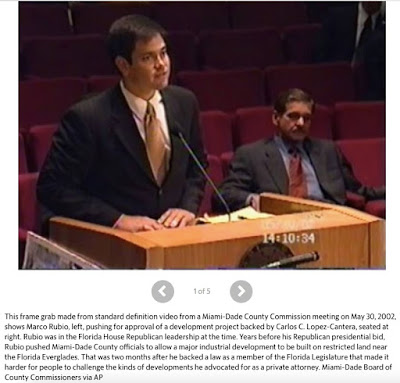
Marco Rubio stood before Miami-Dade County officials in May 2002 and pushed them to permit a multimillion-dollar industrial development to be built on restricted land near the Florida Everglades.

Two months earlier, Rubio — a rising Republican star in the state Legislature — backed a law that made it harder for people to challenge the kinds of developments he advocated for as a private attorney. Around the same period, Rubio also requested state money to be earmarked to benefit a flood-prone area around the development project.

Tuesday, December 15, 2015

The Meeting Julie Dick Did her Op Ed on is going on right now (UDB Line movement request). By Geniusofdespair

Pepe Diaz the puppet. You always know what he will say...what ever the developer said. He is arguing about the size of our wellfield protection zone that it should have been made smaller to not to interfere with this property.


Juan Zapata (the commissioner of the district) made a motion to transmit and deny. He doesn't believe the covenant means anything that the developer offered to put on. Only Barbara Jordan believed the covenant and SHE was one of the Commissioners that lifted it on the Brown application. What a creepy thing to do...to act like it has meaning when Barbara Jordan knows she helped make it meaningless by lifting the covenant against residential on the last application that moved the line. At least Juan Zapata wasn't fooled by the covenants.

He made the same motion for Green City that failed. Zapata had Souto, Jordan, Bovo, Barreiro (will someone run against him),  and of course Pepe Diaz. The developer begged that someone locate Monestime.

It is a 6 to 5 vote in favor to transmit and deny. Monestime not there. It needed 7.  Absent  Districts 4 and 2 districts.  No: Districts 3, 6, 7, 8, 9.

Zapata made a motion to deny, that passed.

A woman from Catalyst Miami with Miguel DeGrandy in the background.
Drew Martin from the Sierra Club Everglades Committee with that Dick Rep. Erik Fresen sitting behind Martin. (This "DICK" reference is not to be confused with Julie Dick). Erik is working for the developer

Julie Dick has it Soooo Right On UDB Vote Today. By Geniusofdespair

Julie Dick of the Everglades Law Center

Water, water everywhere and the Neighborhood Planning Company wants the County Commission to move the UDB for their development. Who are they? Armando Guerra, Ramon Rasco, Agustin Herran and Sergio Pino. Boy have I heard those names before. They wanted the airport at Homestead without a bid, they are prominent in the Latin Builders Association (Build at all costs) and THEY ALL are/were the directors of the failing U.S. Century Bank that consistently has been rated a zero star bank by Bauer Financial (out of 5 stars).
This was the US Century Board when the Property was purchased. ALL THE NAMES ARE THERE.

In the Miami Herald today, Julie Dick's Opinion piece was against expansion of the Urban Development Boundary for Neighborhood Planning Company (meeting requesting the expansion will be held TODAY at the County). She gave numerous reasons but here is where Julie Dick hit the mark with a sledge hammer - FLOODING:
Not only is the proposed development inconsistent with the county’s Comprehensive Development Master Plan, it flies in the face of responsible planning for sea-level rise. It is part of continuous pressure to develop outside the UDB, in most cases on land that is extremely low lying and vulnerable to sea-level rise. Neighborhood Planning Company’s proposed industrial and commercial expansion of the UDB is one of several projects in the works that would add infrastructure to undeveloped areas in the county vulnerable to sea-level rise.

Similarly, a expansion proposal for South Miami-Dade would put a landfill in the footprint of Everglades restoration in a location that will be completely inundated with two feet of sea-level rise. The landfill proposal is particularly egregious considering one of our best defenses against sea-level rise is restoration of the Everglades ecosystem.

Likewise, the proposed expansion of State Road 836 would put a major highway through the Everglades ecosystem in low-lying wetlands.

All of these projects must be stopped. Flood control in the face of rising sea levels is a challenge we have not yet figured out how to address. One thing is clear: We are struggling to find flood-control solutions for the existing urban footprint. We cannot afford to bring on additional land, which will require additional flood control, to urbanized Miami-Dade County.
In the same edition of the Miami Herald Farmers complain they have standing water on their crops and are looking for aid:

"We've been through worse and never had water standing for this long" said Mike Casuely, who lost 300 acres of crops. Now picture a couple of thousand homes on that same land. Be good stewards Commissioners, don't put people in harms way.


Commissioners: HOLD THE LINE. We know that covenants are worth shit -- so do not believe them. Remember the Brown covenants? 30 Year Covenants lifted after 5 years by you guys. Some pact with the people's trust!


Water World: Terrible movie but it is a portent of our future?

It isn't often that I and Gimleteye write about the same thing (see post below). I just have more photos.

County Commission: Reject UDB moves ... by gimleteye

County Commissioners: Raise your hand if you want to move the Urban Development Boundary! The refrain echoes at county hall, the same way as in the not-so-distant future, snorkel manufacturers will argue for subsidies now that rising seas are good business.

In the Miami Herald, Everglades advocate Julie Dick writes, "Reject proposal to expand the UDB". We've seen this picture. Many, many times. Take a look at sprawling West Dade -- Marco Rubio Country -- , complaining about inadequate services -- fire and police protection -- although we thought development was supposed to pay its own way through increased ad valorem taxes.

The US Century Bank constituency, that ran the County Commission like a mob operation in the 1990's and 2000's, has had a more difficult time since the housing crash and the bad politics it fomented. But people's memories are short and there is always room for another subdivision if the lenders are willing, if the insurance is there, and if the land is cheap (ie. land outside the UDB).

The guys and women in suits will all be at County Hall today, earning their monthly retainers, to advocate: yes we can move the UDB!

Count on County Commissioner Pepe Diaz to raise his hand: yes we can! And Javier Souto. And Bruno Barreiro. These are the core of what EOM calls "the unreformable majority".

Writer Julie Dick adds an appeal regarding sea level rise and flood control costs that only a decade ago would never have had traction at the county commission.

Environmentalists made sea level rise arguments in 2005: that is to say, we must prioritize development to preserve identifiable watersheds and steer development away from low lying areas susceptible to flooding under conditions of global warming. Ten years ago, the argument fell flat as an arepa. Not any more.

$400 million spent on flood control projects on Miami Beach say so, and so does a tsunami of media reports backed by science about the vulnerability of South Florida to the costs of sea level rise.

There is another aspect, though, that ought to be the determinant factor in any discussion about moving the UDB now: that is, can we really afford to leave the poorest and most vulnerable communities at greater risk than they already are in Miami-Dade, by allowing development that does not pay its own way to move out past the UDB and towards the Everglades?

In the past (when life was good for the sprawl supply chain), the unreformable majority could count on support from African American county commissioners representing districts in the urban core. The reason is that voting for more sprawl outside their districts ensured campaign contributions from developers et al. Although African American county commissioners still rely on the benefits of incumbency like any of their other colleagues, they can't avoid the fact that sea level rise is a real and imminent threat to their districts and constituents who can't afford to move away.

For common sense to prevail, we can always keep our fingers crossed.


OP-ED
DECEMBER 14, 2015
Reject proposal to expand the UDB
Proposed development puts water supply at risk
Sea-level rise, flood control must be considered
County commission must be better steward of environment
BY JULIE DICK
julie@evergladeslaw.org

Miami-Dade County leaders have a number of decisions to make in the coming days, months and years that will define how we prepare for a changing Miami. If unsustainable developments are approved and move forward — be it a landfill expansion, a highway running through the Everglades ecosystem or new commercial and industrial development in currently undeveloped low-lying areas — they will create future liabilities and sprawling urban areas that will require expensive, though not necessarily effective, flood control. This will put the region’s water resources at risk.

Thursday, November 19, 2015

Hold the line....in horse country... attracted crowds. By Geniusofdespair

Hold the Urban Development Boundary attracted few people. I reported on the results yesterday.  There were bused in people who didn't know the issue.

One of the reasons there were so many people there for the Development in Horse Country? I believe Jose Luis Castillo drummed them up. He was lurking around during the Horse Country hearing and left after it was over. At least he gives everyone a nice red T Shirt. There were just as many people speaking against the issue in yellow shirts. Javier Souto voted against the development in his beloved horse country, other commissioners followed because it is zoned agriculture. The development was gone. I guess the worst County Commissioner, without a doubt, is Pepe Diaz. He argued for it. What a flake that guy is. Stay in the Keys and leave us alone Pepe. He always argues FOR the developments. ALWAYS.

I didn't do much of anything downtown except take pictures.

Downtown Brickell Village is a mess of  new development:


Yes, I want an award for this photo of a homeless man.

Economic Guru for all the UDB Applications, Andrew Dolkart. He always gets the numbers to work for the developer.

Traffic Guru for all the UDB Applications, Cathy Sweetapple. She always gets the number to work for the developer. Like Andy, both of these people are used on every application I have seen go down the pike. I have never heard them say anything negative about an application to move the Urban Development Boundary.
More Homeless in Downtown Miami.
Rep Erik Fresen speaking in favor of Ludlam Trail.  Commissioners Rebeca Sosa and Juan Zapata in the background.
Commissioner Juan Zapata cannot get his vision for his district in play. I know he is frustrated because he inherited a built-out stupidly district. He wants a hub with jobs so people do not have to travel so far to work, yet he has to deal with the Urban Development Boundaries restrictions. I don't think he wants more people, I think he wants a central area, he wants jobs. But the Everglades is a tough neighbor. And now with sea level rise, that buffer land is all the more important. The flooding will come not only from the Coast but also from the West.

What I don't understand is hundreds of people show up for an application in horse country for an application to change agriculture to development. Yet a piddly shit number show up for the same issue OUTSIDE the Urban Development Boundary.  Nimby is alive and well in Miami.

Oh, Commission Chair Monestime, I timed myself. It takes me at least 10 seconds to give my name and address (second try). 50 seconds is not enough time for the public to speak (people were given 1 minute at Tuesday's meeting). I drive an hour each way. Give us a break. It makes me think you do not care about my opinion...that you don't care about me. ONE MINUTE IS NEVER ENOUGH.