At The Orlando Sentinel, opinion writer Mike Thomas' breezy beat includes the environment. Thomas, who wrote worst timed editorial of the century-- blasting environmentalists for being overly concerned about deep well oil exploration days before the Deepwater Horizon disaster-- now weighs in, "Rick Scott will finish off what's left of Florida's environmental movement".
Thomas is right, but how he got there is unrecognizable. In the interest of full disclosure, I wrote opinions on the environment and politics regularly for the Sentinel for three years until political pressure in the newspaper editorial staff pushed my editor to push me off the page. (My work is archived at alanfarago.wordpress.com) Here's Thomas on April 23, 2009: "Some places, like Alaska's Bristol Bay, are too precious, too unique and too valuable to allow drilling except in a national energy crisis. The deep waters off the Gulf of Mexico hardly fall into this category. It's nothing but an undersea desert out there. But you'd hardly know it listening to the worn-out, hysterical screeching about oil-stained shores destroying the environment and the economy." And Thomas again, on May 1, 2010, "The only shameful ploy I see in this drilling debate is opponents using outdated scare stories about oil-coated shorelines destroying our “pristine” beaches. The last offshore blowout of an American well happened 40 years ago off the Santa Barbara coast in California. Ever since, the industry has vastly improved its technology and safety record..."
On the devastating course Florida is taking under Governor Scott, Thomas arrives at the same conclusion we, at Eyeonmiami, reached long ago: that Rick Scott is going to finish off Florida's environmental protections. But Thomas knows a little of what he is talking about when he speaks of golden age of environmentalism. He misses the practical reasons that environmentalists have been beaten down to a few. They are all traceable back to the nuclear arms race in campaign contributions that deform democracy. It is a point Thomas fails to mention.
But back to Thomas' imagined golden age.
The generation that sprang out of the 1960's and Rachel Carson's "Silent Spring" was under attack from the first, by well-funded entities. Today they include the billionaire sugar barons who use anti-environmental tactics as part of their marketing budgets and have for decades. But 40 years ago, it was the US Chamber of Commerce that decided it was time for the conservative movement to develop and organize against environmental laws.
Yes, in the meantime there have been billions of dollars spent on state parks and big projects, like restoring the Everglades. But there have been trillions -- many trillions-- deployed to forms of growth that harm the environment. Suburban sprawl, the encroachment of Big Ag on wetlands and watersheds; the bottom line is that economic interests who profit from commandeering water resources are undeterred by the intent of laws. Their names are stamped on university buildings, department chairs, and hospital walls.
The mainstream media, including Thomas' employer The Tribune Company, have been under continual pressure to pull back from anything but a neat, non-controverisal, green focus on the environment; certainly not the underlying political poison that infects county commissions and local municipal governments from one end of the state to the other, from the Gulf of Mexico to the Atlantic shores. Here's one example: the public relations firm serving Big Sugar in Miami: Wragg and Casas. Joanna Wragg was a career senior editor at The Miami Herald. Nothing having to do with criticism of sugar was allowed in the paper unless it passed her judgment. When she retired, she went to work for sugar directly. There are many examples of the mainstream media ignoring the facts -- Dr. Larry Brand's comes to mind as does the suppression of the work of former Naples Daily News reporter Cathy Zollo. Look to the Miami New Times for Brand's story and to the archives for Zollo who reported out the conflict between environmental protection and the building boom until her editors got queasy.
Thomas writes, "Nasty globs of algae infest our springs. Lake Butler is turning green. Dolphins in the Indian River Lagoon are dying. Red tide is blooming. And who is there to care?" There are not many to care, in part because the mainstream media failed to do its job; tackling tough, hard stories that cross economic interests and persisting. Hell, even Carl Hiassen left Miami.
Thomas also makes mistakes of fact: "As governor, Bob Graham wanted to turn green into a mainstream issue. This recession has taught us it remains a luxury item." People who are close to the Florida environmental movement well know that Bob Graham's compromises on the Everglades restoration-- allowing aquifer storage and recovery for example to be the centerpiece of the original CERP while federal prosecutors were pulled off the case against the state and sugar--, and the unwillingness of the mainstream media to attack him for it, was a baleful example. Graham may get awards and accolades and even claims that the Everglades are his signal achievement in a long career, but in reality the deal that Graham supported in the early 1990's to let Big Sugar off the hook for its nutrient pollution of the Everglades was tragic.
It is the same error being repeated now by Senator Bill Nelson, who is seeking to deflect the US EPA that after a decade of inertia is finally, under Barack Obama's pledge to science over politics, attempting to deal with onslaught of pollution of Florida's waters. To tell the truth: there has not been a single mainstream media story on this facet of the nutrient problem: political leadership that fails to meet the test of protecting the public commons because of special interest money in politics.
Thomas writes, "What I see now are green-group professionals trying to rally masses who have more pressing issues to worry about. This cannot sustain a movement that always took its strength from grass roots." As a writer and activist who has focused on grass roots for twenty years (I am conservation chair of the grass roots organization founded by Marjory Stoneman Douglas, Friends of the Everglades and past leader of Sierra Club in Florida), I can say with confidence that we have all been swamped by the arms race for political money. There is the root of the problem, and Thomas makes no mention of it at all.
It is a curious omission, given the fact that Thomas was right-- early on-- about the horrendously weak candidacy and Democratic campaign of Alex Sink as governor. With so much room to make this connection, why does Thomas take aim at a good subject then just whiff at it?
The influence of special interest money on both the media and politics has pushed the national debate on the economy and the environment far to the right of most people's interests. And the environment, as a social issue, has company in this phenomenon: concern for the poor, for the weak and incapable, for the rights of workers and for people of all faiths and persuasions: these western, liberal and yes, Christian, values have been distorted beyond recognition by conservatives who wear American flag pins on their lapels and carry a Bible next to their cheat sheets derived from Fox News.
The hypocrites rule Tallahassee and Washington. America and Florida is desperate for "jobs", but no one knows how to get jobs moving after thirty years of massive globalization, stripping the United States of industry while failing to keep up with the demands of a global economy. There is one final point on the absence of environmental leaders to carry the torch forward. The men and women who lead the nation's environmental movement in the 1960's and who were my mentors and examples in the late 1980's were, all, children of the Great Depression. They shared an ethic-- not just of the environment-- but also of pitching in and contributing to the public good. This is not imagined. For environmentalists born of "the greatest generation" the example of shared pain and contribution to a common cause were inspiration models. In South Florida, they had names: Dagney Johnson, Grace Maniello, and George Kundst. They didn't ask for or want monuments. And for their environmental activism they were not celebrated. Today they are gone. There are a few of us who continue to fight, day in and day out, but we are not just "an army of ants" fighting against greed; we are fighting against a society that has abandoned its true values and instead wears them like pins of the American flag on their lapels or in narrow, self-centered reading of Scriptures that omit, conveniently, how people once chased the money changers from the temple and took the sanctity of God's creation as gospel.
I doubt the Tea Party has the foggiest notion of the dynamics at work. Nor does Mike Thomas. (Click, 'read more', for the full text of the Sentinel OPED by Thomas)
orlandosentinel.com/news/columnists/os-mike-thomas-environment-apathy-03020110307,0,1215213.column
OrlandoSentinel.com
Rick Scott will finish off what's left of Florida's environmental movement
Mike Thomas
COMMENTARY
6:51 PM EST, March 7, 2011
advertisement
If Rick Scott could create 1,000 jobs by barbecuing manatees, sea pigs would be roasting on a spit tomorrow.
They apparently taste like elephant.
Just how much outrage would that cause?
I'm beginning to wonder.
The green glory days are coming to an end in Florida.
And now we have a governor who pretty much will finish the job to a rousing round of apathy.
The end of a most amazing era is going out with a whimper.
Florida did things no state had done before. We rejected the massive flood-control projects of the U.S. Army Corps of Engineers. We stopped the Cross Florida Barge Canal. We restored the Kissimmee River. Next up was the Everglades. We spent billions of dollars preserving land.
We led the nation in abused kids and cheap jobs, but by God we had the best network of state parks in the country.
The environment was becoming an alpha issue in Florida, elevated to the level of education, taxes and crime. Any politician had to raise his right hand and swear allegiance whether he meant it or not.
The movement was led by the greatest armada of environmentalists ever assembled in a single state — Marjory Stoneman Douglas, Art Marshall and Marjorie Carr, to name a few.
Grass-roots groups like Friends of the Wekiva formed to fight local battles.
It was pave versus save.
We led the nation in both destroying and preserving natural lands.
We bought 2 million acres. We had the Conservation and Recreation Lands Program, Save Our Rivers, Save Our Coast, Preservation 2000 and Florida Forever.
What couldn't be bought was fought over.
The developers were armed with money, lawyers and lobbyists. The greenies countered with an army of intelligent and passionate activists who were well-versed in the intricacies of regulatory battle and usually backed by the media and public-opinion polls.
We had rules and regulations to protect everything from wetlands to beach mice. We had local planners, regional planners and state planners. We had five water-management districts and the Department of Environmental Protection. And behind them lurked even more federal agencies. There were zoning boards and governing boards, administrative hearings and lawsuits.
The forces of green would use each and every one of these assets in lengthy battles of attrition with the forces of concrete.
As one developer groaned: "It's like being attacked by ants."
That forced the inevitable compromises, the bigger retention pond, a few more acres of open space, a few less units per acre.
This is grueling, time-consuming activism.
It requires people with the affluence, passion and time.
Their ranks are thinning fast. The environmentalists I mentioned above are long dead. And I don't see them being replaced.
Nasty globs of algae infest our springs. Lake Butler is turning green. Dolphins in the Indian River Lagoon are dying. Red tide is blooming.
And who is there to care?
Rick Scott plans to abolish the Department of Community Affairs, gut the budgets of the water-management districts, and dispense with all those layers of rules, regulations and agencies. When you do these things, you lessen the need to compromise.
Scott also wants to dump the land-buying programs.
He wants to hand over the land we bought to the Department of Management Services, which traditionally oversees office buildings. I am guessing some will be put up for sale eventually.
There was a time when each of these proposals would warrant full front-page-Sunday treatment.
But there is 12 percent unemployment and a collapsing state budget.
As governor, Bob Graham wanted to turn green into a mainstream issue. This recession has taught us it remains a luxury item.
Florida's massive investment in its environment was funded by its massive growth. Every time a developer flipped property or sold a condo, it was money in the land-buying bank.
The enemy fed the insurrection, and now the enemy is gone.
What I see now are green-group professionals trying to rally masses who have more pressing issues to worry about.
This cannot sustain a movement that always took its strength from grass roots.
Most people here don't even know what the place used to be like. How can you miss what's gone if you never knew it was there?
And those of us who do will be gone soon enough.
mthomas@tribune.com or 407-420-5525
Copyright © 2011, Orlando Sentinel
Showing posts with label Mike Thomas. Show all posts
Showing posts with label Mike Thomas. Show all posts
Monday, March 14, 2011


Tuesday, June 01, 2010
Gulf Oil Spill and Mike Thomas, Orlando Sentinel: wrong by twenty million gallons of oil ... by gimleteye
Mike Thomas, Orlando Sentinel columnist, has been dead wrong on the Gulf Oil Spill and offshore drilling as an environmental and economic disaster. Here's a gem from the worst timed editorial of the century: "The image of oil villains despoiling our beaches is simplistic rhetoric aimed at simple minds. It is fodder for political grandstanding and greenie fundraising." That's right: all those environmental groups really got traction against offshore drilling in Florida, with the Florida legislature until disaster struck. And now those "greenies" are just wallowing in cash, right Mike, and competing toe-to-toe with the billions earned every quarter by Big Oil. If you just went to New Orleans Airport, Mike, you could see those corporate jets owned by Sierra Club, NRDC, and Clean Water Action parked wingtip to wingtip. That's a joke for the humor-challenged, but read on:
"Drilling foes don’t have any recent pictures of oily birds to make their case, so they throw out worst-case scenarios that are about as likely as an oil bit goosing Godzilla out of the depths." (Drill, baby, drill, April 23, 2009) On the one year anniversary of that Orlando Sentinel column the BP Deepwater Horizon sank, unleashing the worst environmental disaster in US history. Here's the picture Mike was missing (credit to Alan Taylor, Boston Globe)

It's all fun to write that stuff and, yes, it appeals to the Sentinel's conservative readers and its editors' preferences. (Funny, how all those Gulf Coast conservatives are shouting themselves into a deep shade of blue with oil staining their beaches.) Thomas did write a little mea cupla about "eating crow", but in truth he's swerving a little this way and a little that.
There's a smudgy feeling to "Let's cool overkill reactions to Gulf spill", a recent Thomas editorial (May 6, 2010), he writes: "Naturally, as far as the media are concerned, this is the BIGGEST DARNED DISASTER IN THE HISTORY OF DISASTERS! The oil is going to destroy the Gulf of Mexico, wipe out 40 percent of the nation's fisheries and cripple Florida's tourism industry. Then it will head south and take out the Keys before heading north to Cocoa Beach."
Yeah, it's a joke. Hah hah. We're all yo-yo's. I wonder if Orlando Sentinel editors who let Thomas bloviate believed the BP estimate of 1,000 barrels per day leaking into the Gulf? Or the revised 5,000 number? Or did they even pay attention that independent scientists had calculated the spill was at least four times that volume, two weeks before the government concurred?
Thomas takes a little paw swipe at "giddy environmentalists" and tops it off with a disclaimer that the 1979 spill off the coast of Mexico was worse. Where were you doing your research on the Mexico spill in 1979, Mike? Cancun at spring break? I don't know anyone giddy about what is going on in the Gulf, and I suspect that anyone who would write that is detached from reality. The Gulf catastrophe has already spilled the equivalent of four Exxon Valdez into the Gulf of Mexico. Maybe Mike Thomas is auditioning for Fox News. He'd fit right in.
"Drilling foes don’t have any recent pictures of oily birds to make their case, so they throw out worst-case scenarios that are about as likely as an oil bit goosing Godzilla out of the depths." (Drill, baby, drill, April 23, 2009) On the one year anniversary of that Orlando Sentinel column the BP Deepwater Horizon sank, unleashing the worst environmental disaster in US history. Here's the picture Mike was missing (credit to Alan Taylor, Boston Globe)

It's all fun to write that stuff and, yes, it appeals to the Sentinel's conservative readers and its editors' preferences. (Funny, how all those Gulf Coast conservatives are shouting themselves into a deep shade of blue with oil staining their beaches.) Thomas did write a little mea cupla about "eating crow", but in truth he's swerving a little this way and a little that.
There's a smudgy feeling to "Let's cool overkill reactions to Gulf spill", a recent Thomas editorial (May 6, 2010), he writes: "Naturally, as far as the media are concerned, this is the BIGGEST DARNED DISASTER IN THE HISTORY OF DISASTERS! The oil is going to destroy the Gulf of Mexico, wipe out 40 percent of the nation's fisheries and cripple Florida's tourism industry. Then it will head south and take out the Keys before heading north to Cocoa Beach."
Yeah, it's a joke. Hah hah. We're all yo-yo's. I wonder if Orlando Sentinel editors who let Thomas bloviate believed the BP estimate of 1,000 barrels per day leaking into the Gulf? Or the revised 5,000 number? Or did they even pay attention that independent scientists had calculated the spill was at least four times that volume, two weeks before the government concurred?
Thomas takes a little paw swipe at "giddy environmentalists" and tops it off with a disclaimer that the 1979 spill off the coast of Mexico was worse. Where were you doing your research on the Mexico spill in 1979, Mike? Cancun at spring break?
 I don't know anyone giddy about what is going on in the Gulf, and I suspect that anyone who would write that is detached from reality. The Gulf catastrophe has already spilled the equivalent of four Exxon Valdez into the Gulf of Mexico. Maybe Mike Thomas is auditioning for Fox News. He'd fit right in.
Tuesday, May 11, 2010
Mike Thomas, Orlando Sentinel: blundering on the carpet with oil on his shoes ... by gimleteye
Orlando Sentinel columnist Mike Thomas wins the award for "worst timed editorials" of the century. Reading him witlessly bash offshore oil opponents and admit to his failure to do "due diligence" after the fact, reminds me I was pushed off the editorial page at the same newspaper for far less offense. (see note, below)
Here are a few excerpts from Thomas editorials on offshore oil drilling, including one published by the Sentinel exactly a year to the day a killer methane bubble flew up the Deepwater Horizon drill pipe, creating the towering inferno and "greenie" scenarios that Thomas dismissed jokingly:
"The image of oil villains despoiling our beaches is simplistic rhetoric aimed at simple minds. It is fodder for political grandstanding and greenie fundraising. Drilling foes don’t have any recent pictures of oily birds to make their case, so they throw out worst-case scenarios that are about as likely as an oil bit goosing Godzilla out of the depths."
Mike, here's a picture of that bird.

The April 23, 2009 editorial was titled, "Could Gulf Coast oil wells drill vision into us?" Here's more:
"Some places, like Alaska's Bristol Bay, are too precious, too unique and too valuable to allow drilling except in a national energy crisis. The deep waters off the Gulf of Mexico hardly fall into this category. It's nothing but an undersea desert out there. But you'd hardly know it listening to the worn-out, hysterical screeching about oil-stained shores destroying the environment and the economy."
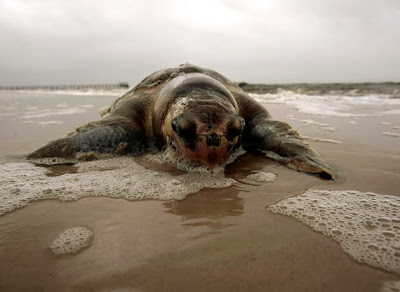
Mike, here's a dead sea turtle. (From Newsweek, it's really dead.)
"Ranked in order of environmental threats, drilling in the Gulf ranks far below freighters emptying their bilge pumps. Yet every day in Florida, some editorial writer, columnist or greenie gets out of bed, turns down the air conditioning, cooks breakfast, drives to work and lashes out at drilling. It's time for members of the congressional delegation to stop pandering to eco-nonsense and cash in on the opportunity that now presents itself."
Pandering. Is that what Mike Thomas was doing on May 1st, when he went back and seemed to eat crow with readers, admitting that he had not done due diligence?
"... The only shameful ploy I see in this drilling debate is opponents using outdated scare stories about oil-coated shorelines destroying our “pristine” beaches. The last offshore blowout of an American well happened 40 years ago off the Santa Barbara coast in California. Ever since, the industry has vastly improved its technology and safety record. Last year, the Santa Barbara Board of Supervisors actually voted in support of oil drilling. Some people move on."

This photo was taken a year to the day Mike Thomas' April 23 column appeared in the Orlando Sentinel. Although the Deepwater Horizon sunk, taking eleven lives with it, Thomas' columns still stand.
What is interesting about Thomas' May 1 column is that he fast-backwards to his April 1 column, but doesn't touch on the year earlier, "Drill, baby, drill". I don't disagree with Thomas' on big picture stuff. For poo-poo'ing environmentalists who have argued the precautionary principle for decades, there is no criticism that is too off track. Click 'read more', for the Thomas editorials mentioned above.
(Note: For three years I wrote regular opinion pieces for the Orlando Sentinel as a special contributor. My opinions on politics and the environment engaged readers and worried editors enough that when criticism of them, for publishing me, grew too heavy, they cut me loose. (The archive of opinion pieces is available at: alanfarago.wordpress,com) I started co-blogging Eyeonmiami around the same time. Today, my op-eds are regularly published at Counterpunch.)
Mike Thomas: Drill, baby, drill!
April 23, 2009
Orlando Sentinel
The American oil cartel is using the state’s budget crisis to slip through a last-minute law opening up Florida’s coast to drilling.
For every steel proboscis the kings of crude poke into a fossil-fuel depository, we would get millions of dollars in royalties, which then would be used to buy and preserve land under Forever Florida.
It’s a clever ploy by future House Speaker Dean Cannon to link our most cherished environmental program with our biggest environmental boogeyman.
The St. Petersburg Times calls it a “shameful ploy.”
I call it a golden opportunity to pursue good public policy.
The only shameful ploy I see in this drilling debate is opponents using outdated scare stories about oil-coated shorelines destroying our “pristine” beaches.
The last offshore blowout of an American well happened 40 years ago off the Santa Barbara coast in California.
Ever since, the industry has vastly improved its technology and safety record. Last year, the Santa Barbara Board of Supervisors actually voted in support of oil drilling.
Some people move on.
The reason is simple. Another accident would devastate the oil companies. There would be the immediate costs of cleanup, economic damages, lawsuits and fines. Then there would be the long-term political consequences of being blocked from future drilling.
The image of oil villains despoiling our beaches is simplistic rhetoric aimed at simple minds. It is fodder for political grandstanding and greenie fundraising.
Drilling foes don’t have any recent pictures of oily birds to make their case, so they throw out worst-case scenarios that are about as likely as an oil bit goosing Godzilla out of the depths.
Not that Miami couldn’t use a good stomping.
The drilling ban always has been a political luxury. We could afford it when gasoline and natural gas were relatively plentiful and cheap. The only reason to drill here, foes argued, was to increase oil-company profits.
Then came the summer of 2008, when gas hit $4 a gallon and there was talk of worsening worldwide shortages caused by demand from China and developing countries.
Florida’s protected status came under the gun. Even Gov. Charlie Crist backed off his longtime opposition to drilling.
Then prices collapsed, as did the motivation for seeking out new supplies.
This would be a wonderful thing if the respite came from vast new discoveries or some breakthrough in hydrogen power. But it came from collapsing demand caused by a global recession.
When economies pick up, so will energy use. Demand will rise, and prices will skyrocket once again.
And we will be back right where we started.
We lurch from energy crisis to energy crisis because decisions are made based on the here-and-now instead of the future.
Critics say this law won’t provide any immediate salve for the Florida budget.
This is true. We probably wouldn’t see any oil or gas or royalties until well into the next decade.
By then, gas could well be rationed at $20 a gallon.
We could slough off such scenarios if we weren’t mopping up after our second oil war, confronting a nuclear-armed Iran, drone-bombing al-Qaeda in Pakistan, facing 200 million SUVs in China and kowtowing to a Saudi royal family that makes Castro look like a Cub Scout.
The oil off our shores won’t by itself solve the above, and it won’t bring down prices. It simply will be one of many small steps we must make on the journey to a future free from burning dead dinosaurs.
The environmental agenda is to eliminate access to oil in hopes we can pull off some technological Hail Mary pass to eliminate the need for it. That day remains decades away. So all they are doing is laying the groundwork for the next energy crisis.
Hybrids are nice. But they still burn gas.
Perhaps even more important than the oil off Florida’s shore are massive reserves of natural gas. The nation, particularly Florida, has grown increasingly addicted to this energy source to fuel power plants. And like oil, most of the world’s reserves are found in countries such as Saudi Arabia, Iran and Russia.
A rational energy policy would direct us toward conservation, insulation, renewable energy, smaller cars and more mass transit.
It also would recognize the continuing need for fossil fuels during the transition away from it.
Conserve — and drill? We must do both
April 01, 2010|By Mike Thomas, COMMENTARY
For decades we have had an energy policy based on no.
From the environmentalists, we got no to drilling, no to nuclear plants and no to coal.
From conservatives we got no to conservation and no to increased mileage standards.
The policy of no is taking us in the direction of constant shortages, brownouts, huge price increases and more dead troops in the Middle East.
The policy of no threatens not only our economic development but our national security.
And now, at least, we have a president with the common sense to begin saying yes to everything. We need drilling, we need nukes, we need energy-efficient lifestyles, we need cars that can go from Orlando to Daytona on a gallon of gas.
In unveiling the drilling portion of his national energy plan, Barack Obama proves once again he is more pragmatist than socialist.
Long ago, Jimmy Carter declared that pursuing oil independence was the moral equivalent of waging a war. At last we have a president who seems to be pursuing it.
As part of his energy policy announced Wednesday, Obama would allow drilling within 125 miles of Florida's west coast, where the rigs would be far, far from view. Given the safety record of drilling in American waters, this is about the most benign way possible to extract fossil fuels.
It sure beats blowing the tops off mountains in West Virginia to get coal, or poisoning aquifers out west from the increased use of a natural-gas-drilling technique known as hydraulic fracturing.
Obama's energy team understands all this. It is why sensitive areas in the Arctic either were put off limits or were required to undergo more study before drilling is allowed.
Some places, like Alaska's Bristol Bay, are too precious, too unique and too valuable to allow drilling except in a national energy crisis.
The deep waters off the Gulf of Mexico hardly fall into this category. It's nothing but an undersea desert out there.
But you'd hardly know it listening to the worn-out, hysterical screeching about oil-stained shores destroying the environment and the economy.
Please. Florida's major beaches now consist of dredged-up offshore silt piled up in front of condos and hotels.
Florida's beaches are as phony as the opposition to drilling.
We have dumped so many pollutants into the Gulf we have turned it into a red-tide cesspool. On top of that, we are wiping out the fish stocks.
Ranked in order of environmental threats, drilling in the Gulf ranks far below freighters emptying their bilge pumps.
Yet every day in Florida, some editorial writer, columnist or greenie gets out of bed, turns down the air conditioning, cooks breakfast, drives to work and lashes out at drilling.
It's time for members of the congressional delegation to stop pandering to eco-nonsense and cash in on the opportunity that now presents itself.
Last year, there were proposals in Congress to bring drilling rigs within 45 miles of the west coast. They could come closer in the Panhandle to tap into a massive natural-gas deposit south of Pensacola. To entice Florida into taking the deal, one idea was to give the state 37.5 percent of royalty fees paid to the federal government.
Over time, this could amount to billions of dollars.
We need to revive this deal. There is no difference between drilling 45 miles offshore and 125 miles offshore.
And just to be clear, this will not end our dependence on foreign oil. We can't drill our way out of this mess because we don't have the reserves. Drilling will not bring down prices. The pro-drilling forces who promise such things are lying.
But as Obama says, we can tap into our own energy sources as a bridge to the future. A gas field that meets only a fraction of our needs today will meet a much bigger fraction in 10 years when we are more efficient.
Drill, baby, drill.
Conserve, baby, conserve.
COMMENTARY
May 2, 2010
There is nothing like the taste of crow deep-fried in a barrel of light, sweet crude.
With a side of poached tar balls.
It has been served up daily in my e-mail:
Dear Mike: Remind me one more time why offshore drilling is responsible and necessary? Your brain is diminishing more quickly than your carbon footprint.
Dear Mike: The first thing I thought of when I saw pictures of the oil slick were your columns swearing these drilling platforms were harmless and could be used for sunbathing within a dingy hop from St. Pete Beach.
Here is what I said only one month ago about drilling off Florida's coast: "There is no difference between drilling 45 miles offshore and 125 miles offshore. Given the safety record of drilling in American waters, this is about the most benign way possible to extract fossil fuels."
Not if you're a Louisiana pelican, it seems.
For someone who covered the shuttle Challenger explosion, I should have known better. I bashed NASA for its negligence, then fell into the same mindset on offshore drilling.
The space and oil disasters share many similarities. The technology behind them had not failed in the past, creating a complacency that they would not fail in the future despite the harshest operating environments possible. With the shuttle it was space; with drilling it was ocean depths up to 5,000 feet and holes drilled another 20,000 feet. The heat and pressure are tremendous.
Both endeavors require an army of people do their jobs correctly and that thousands of components function properly. Margins for error are miniscule. The smallest of breaches can lead to catastrophic failure in a fraction of a second.
It is impossible to eliminate such risk, just manage it with training, oversight, engineering and redundant safety systems.
NASA believed it had the risks of space flight so well managed, a crew escape plan was not necessary.
The oil companies believed they had the risks of drilling so well managed, a fast-response blowout plan was not necessary.
Now there is a plan to lower a dome over the leak and funnel the oil up to a tanker. But it has never been tested at extreme depths. A plan to bring in another rig and drill a second hole to plug this one will take months.
Given the increased amount of deep-water drilling, the natural questions are:
Why haven't they tested a dome at depths to see if it would work? Why isn't a dome ready to go?
And why isn't there a backup drilling rig stationed in the Gulf, ready for immediate deployment?
I know the answers. The drilling industry considered the blowout risk so low that it did not justify the cost of adequate preparation.
And I fell for it, based on the industry's record. I didn't do my due diligence and ask, "What if?"
Chew. Chew.
Here are a few excerpts from Thomas editorials on offshore oil drilling, including one published by the Sentinel exactly a year to the day a killer methane bubble flew up the Deepwater Horizon drill pipe, creating the towering inferno and "greenie" scenarios that Thomas dismissed jokingly:
"The image of oil villains despoiling our beaches is simplistic rhetoric aimed at simple minds. It is fodder for political grandstanding and greenie fundraising. Drilling foes don’t have any recent pictures of oily birds to make their case, so they throw out worst-case scenarios that are about as likely as an oil bit goosing Godzilla out of the depths."
Mike, here's a picture of that bird.

The April 23, 2009 editorial was titled, "Could Gulf Coast oil wells drill vision into us?" Here's more:
"Some places, like Alaska's Bristol Bay, are too precious, too unique and too valuable to allow drilling except in a national energy crisis. The deep waters off the Gulf of Mexico hardly fall into this category. It's nothing but an undersea desert out there. But you'd hardly know it listening to the worn-out, hysterical screeching about oil-stained shores destroying the environment and the economy."
Mike, here's a dead sea turtle. (From Newsweek, it's really dead.)

"Ranked in order of environmental threats, drilling in the Gulf ranks far below freighters emptying their bilge pumps. Yet every day in Florida, some editorial writer, columnist or greenie gets out of bed, turns down the air conditioning, cooks breakfast, drives to work and lashes out at drilling. It's time for members of the congressional delegation to stop pandering to eco-nonsense and cash in on the opportunity that now presents itself."
Pandering. Is that what Mike Thomas was doing on May 1st, when he went back and seemed to eat crow with readers, admitting that he had not done due diligence?
"... The only shameful ploy I see in this drilling debate is opponents using outdated scare stories about oil-coated shorelines destroying our “pristine” beaches. The last offshore blowout of an American well happened 40 years ago off the Santa Barbara coast in California. Ever since, the industry has vastly improved its technology and safety record. Last year, the Santa Barbara Board of Supervisors actually voted in support of oil drilling. Some people move on."

This photo was taken a year to the day Mike Thomas' April 23 column appeared in the Orlando Sentinel. Although the Deepwater Horizon sunk, taking eleven lives with it, Thomas' columns still stand.
What is interesting about Thomas' May 1 column is that he fast-backwards to his April 1 column, but doesn't touch on the year earlier, "Drill, baby, drill". I don't disagree with Thomas' on big picture stuff. For poo-poo'ing environmentalists who have argued the precautionary principle for decades, there is no criticism that is too off track. Click 'read more', for the Thomas editorials mentioned above.
(Note: For three years I wrote regular opinion pieces for the Orlando Sentinel as a special contributor. My opinions on politics and the environment engaged readers and worried editors enough that when criticism of them, for publishing me, grew too heavy, they cut me loose. (The archive of opinion pieces is available at: alanfarago.wordpress,com) I started co-blogging Eyeonmiami around the same time. Today, my op-eds are regularly published at Counterpunch.)
Mike Thomas: Drill, baby, drill!
April 23, 2009
Orlando Sentinel
The American oil cartel is using the state’s budget crisis to slip through a last-minute law opening up Florida’s coast to drilling.
For every steel proboscis the kings of crude poke into a fossil-fuel depository, we would get millions of dollars in royalties, which then would be used to buy and preserve land under Forever Florida.
It’s a clever ploy by future House Speaker Dean Cannon to link our most cherished environmental program with our biggest environmental boogeyman.
The St. Petersburg Times calls it a “shameful ploy.”
I call it a golden opportunity to pursue good public policy.
The only shameful ploy I see in this drilling debate is opponents using outdated scare stories about oil-coated shorelines destroying our “pristine” beaches.
The last offshore blowout of an American well happened 40 years ago off the Santa Barbara coast in California.
Ever since, the industry has vastly improved its technology and safety record. Last year, the Santa Barbara Board of Supervisors actually voted in support of oil drilling.
Some people move on.
The reason is simple. Another accident would devastate the oil companies. There would be the immediate costs of cleanup, economic damages, lawsuits and fines. Then there would be the long-term political consequences of being blocked from future drilling.
The image of oil villains despoiling our beaches is simplistic rhetoric aimed at simple minds. It is fodder for political grandstanding and greenie fundraising.
Drilling foes don’t have any recent pictures of oily birds to make their case, so they throw out worst-case scenarios that are about as likely as an oil bit goosing Godzilla out of the depths.
Not that Miami couldn’t use a good stomping.
The drilling ban always has been a political luxury. We could afford it when gasoline and natural gas were relatively plentiful and cheap. The only reason to drill here, foes argued, was to increase oil-company profits.
Then came the summer of 2008, when gas hit $4 a gallon and there was talk of worsening worldwide shortages caused by demand from China and developing countries.
Florida’s protected status came under the gun. Even Gov. Charlie Crist backed off his longtime opposition to drilling.
Then prices collapsed, as did the motivation for seeking out new supplies.
This would be a wonderful thing if the respite came from vast new discoveries or some breakthrough in hydrogen power. But it came from collapsing demand caused by a global recession.
When economies pick up, so will energy use. Demand will rise, and prices will skyrocket once again.
And we will be back right where we started.
We lurch from energy crisis to energy crisis because decisions are made based on the here-and-now instead of the future.
Critics say this law won’t provide any immediate salve for the Florida budget.
This is true. We probably wouldn’t see any oil or gas or royalties until well into the next decade.
By then, gas could well be rationed at $20 a gallon.
We could slough off such scenarios if we weren’t mopping up after our second oil war, confronting a nuclear-armed Iran, drone-bombing al-Qaeda in Pakistan, facing 200 million SUVs in China and kowtowing to a Saudi royal family that makes Castro look like a Cub Scout.
The oil off our shores won’t by itself solve the above, and it won’t bring down prices. It simply will be one of many small steps we must make on the journey to a future free from burning dead dinosaurs.
The environmental agenda is to eliminate access to oil in hopes we can pull off some technological Hail Mary pass to eliminate the need for it. That day remains decades away. So all they are doing is laying the groundwork for the next energy crisis.
Hybrids are nice. But they still burn gas.
Perhaps even more important than the oil off Florida’s shore are massive reserves of natural gas. The nation, particularly Florida, has grown increasingly addicted to this energy source to fuel power plants. And like oil, most of the world’s reserves are found in countries such as Saudi Arabia, Iran and Russia.
A rational energy policy would direct us toward conservation, insulation, renewable energy, smaller cars and more mass transit.
It also would recognize the continuing need for fossil fuels during the transition away from it.
Conserve — and drill? We must do both
April 01, 2010|By Mike Thomas, COMMENTARY
For decades we have had an energy policy based on no.
From the environmentalists, we got no to drilling, no to nuclear plants and no to coal.
From conservatives we got no to conservation and no to increased mileage standards.
The policy of no is taking us in the direction of constant shortages, brownouts, huge price increases and more dead troops in the Middle East.
The policy of no threatens not only our economic development but our national security.
And now, at least, we have a president with the common sense to begin saying yes to everything. We need drilling, we need nukes, we need energy-efficient lifestyles, we need cars that can go from Orlando to Daytona on a gallon of gas.
In unveiling the drilling portion of his national energy plan, Barack Obama proves once again he is more pragmatist than socialist.
Long ago, Jimmy Carter declared that pursuing oil independence was the moral equivalent of waging a war. At last we have a president who seems to be pursuing it.
As part of his energy policy announced Wednesday, Obama would allow drilling within 125 miles of Florida's west coast, where the rigs would be far, far from view. Given the safety record of drilling in American waters, this is about the most benign way possible to extract fossil fuels.
It sure beats blowing the tops off mountains in West Virginia to get coal, or poisoning aquifers out west from the increased use of a natural-gas-drilling technique known as hydraulic fracturing.
Obama's energy team understands all this. It is why sensitive areas in the Arctic either were put off limits or were required to undergo more study before drilling is allowed.
Some places, like Alaska's Bristol Bay, are too precious, too unique and too valuable to allow drilling except in a national energy crisis.
The deep waters off the Gulf of Mexico hardly fall into this category. It's nothing but an undersea desert out there.
But you'd hardly know it listening to the worn-out, hysterical screeching about oil-stained shores destroying the environment and the economy.
Please. Florida's major beaches now consist of dredged-up offshore silt piled up in front of condos and hotels.
Florida's beaches are as phony as the opposition to drilling.
We have dumped so many pollutants into the Gulf we have turned it into a red-tide cesspool. On top of that, we are wiping out the fish stocks.
Ranked in order of environmental threats, drilling in the Gulf ranks far below freighters emptying their bilge pumps.
Yet every day in Florida, some editorial writer, columnist or greenie gets out of bed, turns down the air conditioning, cooks breakfast, drives to work and lashes out at drilling.
It's time for members of the congressional delegation to stop pandering to eco-nonsense and cash in on the opportunity that now presents itself.
Last year, there were proposals in Congress to bring drilling rigs within 45 miles of the west coast. They could come closer in the Panhandle to tap into a massive natural-gas deposit south of Pensacola. To entice Florida into taking the deal, one idea was to give the state 37.5 percent of royalty fees paid to the federal government.
Over time, this could amount to billions of dollars.
We need to revive this deal. There is no difference between drilling 45 miles offshore and 125 miles offshore.
And just to be clear, this will not end our dependence on foreign oil. We can't drill our way out of this mess because we don't have the reserves. Drilling will not bring down prices. The pro-drilling forces who promise such things are lying.
But as Obama says, we can tap into our own energy sources as a bridge to the future. A gas field that meets only a fraction of our needs today will meet a much bigger fraction in 10 years when we are more efficient.
Drill, baby, drill.
Conserve, baby, conserve.
COMMENTARY
May 2, 2010
There is nothing like the taste of crow deep-fried in a barrel of light, sweet crude.
With a side of poached tar balls.
It has been served up daily in my e-mail:
Dear Mike: Remind me one more time why offshore drilling is responsible and necessary? Your brain is diminishing more quickly than your carbon footprint.
Dear Mike: The first thing I thought of when I saw pictures of the oil slick were your columns swearing these drilling platforms were harmless and could be used for sunbathing within a dingy hop from St. Pete Beach.
Here is what I said only one month ago about drilling off Florida's coast: "There is no difference between drilling 45 miles offshore and 125 miles offshore. Given the safety record of drilling in American waters, this is about the most benign way possible to extract fossil fuels."
Not if you're a Louisiana pelican, it seems.
For someone who covered the shuttle Challenger explosion, I should have known better. I bashed NASA for its negligence, then fell into the same mindset on offshore drilling.
The space and oil disasters share many similarities. The technology behind them had not failed in the past, creating a complacency that they would not fail in the future despite the harshest operating environments possible. With the shuttle it was space; with drilling it was ocean depths up to 5,000 feet and holes drilled another 20,000 feet. The heat and pressure are tremendous.
Both endeavors require an army of people do their jobs correctly and that thousands of components function properly. Margins for error are miniscule. The smallest of breaches can lead to catastrophic failure in a fraction of a second.
It is impossible to eliminate such risk, just manage it with training, oversight, engineering and redundant safety systems.
NASA believed it had the risks of space flight so well managed, a crew escape plan was not necessary.
The oil companies believed they had the risks of drilling so well managed, a fast-response blowout plan was not necessary.
Now there is a plan to lower a dome over the leak and funnel the oil up to a tanker. But it has never been tested at extreme depths. A plan to bring in another rig and drill a second hole to plug this one will take months.
Given the increased amount of deep-water drilling, the natural questions are:
Why haven't they tested a dome at depths to see if it would work? Why isn't a dome ready to go?
And why isn't there a backup drilling rig stationed in the Gulf, ready for immediate deployment?
I know the answers. The drilling industry considered the blowout risk so low that it did not justify the cost of adequate preparation.
And I fell for it, based on the industry's record. I didn't do my due diligence and ask, "What if?"
Chew. Chew.
Subscribe to:
Posts (Atom)