Showing posts with label Sorenson. Show all posts

Monday, January 02, 2017

Larry Hawkins: A different obituary, a different journalism, a different civic outcome ... by gimleteye

Larry Hawkins, photo by Miami Herald

The hand-wringing over the election of the least qualified president in the history of the United States has revived calls for attention to civics in education.

The passing of the late Miami-Dade county commissioner Larry Hawkins provides an opportunity to reflect on damage done to our democracy as a consequence of political manipulation outside the boundaries of ethical conduct.

The Miami Herald obituary of Larry Hawkins was straight down the line; without color or commentary.

Hawkins, a Democrat, came along at a time in Miami-Dade politics as the balance of power shifted from an earlier generation, roughly defined as white, Caucasian (cf. Steve Clark), to a Cuban-American one.

The corruption of the county commission could be defined by free Bahamian casino chips or condos with obscure title ownership or cash in paper bags, but if so, they have to be retrieved from the dustbin of history as rumor; rumor one repeats at risk. However.

Having observed and participated in some of the external manifestations of Larry Hawkins' involvements -- the Homestead Air Force Base fiasco in the mid 1990's and the Homestead Raceway debacle -- I feel on safe ground to offer the following.

Donald Trump was elected to the White House because enough voters in key electoral states believed that a bull-in-the-china shop could destroy business as usual separating taxpayers from their government. How does government end up failing taxpayers so thoroughly that voters would literally risk blowing it up?

On the one hand, it is true that there is an extraordinarily low level of understanding of civics, how power works, the role of checks and balances in the three branches of government, and the ideals of democracy. On the other hand, there are thousands of examples how democracy is deformed every day, in every corner of America, related to the organizing principle of political conduct in America today: money.

After Hurricane Andrew in 1992, Larry Hawkins saw a way to weld a popular outcry for redevelopment in the last rural section of Florida's most politically influential county with political service to Cuban American developers who, ever since the Bay of Pigs, voted Republican.

Why not give this military air base to private developers (without bidding) allied with the GOP to spur economic redevelopment? It started as a small plan; only a couple of hundred acres. The air base still needed to be transferred from federal ownership to the county, but once Hawkins and his Cuban-American cartel, called HABDI, saw how easily the small plan was approved by local government, they aimed to take thousands of acres. And not just the air base; if zoning codes could be flipped around, tens of thousands of acres of surrounding farmland could be easily converted to the economic engine of choice in Florida: suburban sprawl.

In 1993, Hawkins figured that the Homestead Air Force Base at the edge of Biscayne National Park could be used as a bargaining chip; a win-win scenario for everyone who had an interest in making boatloads of money out of the natural disaster and political profit to Democrats.
President Bill Clinton, flanked by Larry Hawkins, left, and Howard Glicken, Democratic fundraiser
The plan Hawkins set in motion was disastrous. It was disastrous because it was unethical, it involved the Miami-Dade county commission, its chairman Art Teele Jr. and then commissioner Alex Penelas in a game of power-brokering that eventually acquired the momentum of a force 4, political tornado: a slow-moving, all-encompassing waste of taxpayer dollars and political capital skirting the edges of the law, that eventually even enmeshed a president, Bill Clinton, and his hopeful successor, Vice President Al Gore. As a power play to benefit Democrats, to say that it seriously backfired would be the understatement of the 20th century.

Hawkins lost his district commission seat, under accusation of sexual misconduct, but he hung at the periphery as the air base drama unfolded. County commissioner Katy Sorenson, who battled for and won successive terms to District 8, became the visible leader of an effort to hold government accountable to its own laws.
The late Arthur Teele, former chairman of the Miami-Dade County Commission, a Republican, opposed the Hawkins / HABDI plan

Eventually and quietly, in 2002, the US Department of Defense brought the ignominious saga to an end. People moved on.

The Cuban American developers assembled from the board of directors of the Latin Builders Association, HABDI, might have lost a few million. Maybe not even that. Taxpayers, through the usurping of local government agencies, including the aviation department and the county attorney's office -- lost a lot. A real cost accounting was never performed or even demanded by the county commission, but likely involved tens of millions. In this case, the money obscures the end tragedy: a deformation of democracy.

The heart of this taxpayer and political disaster wasn't touched on, at all, by the Miami Herald obituary of Larry Hawkins, and that is too bad. History only counts, only matters, if it is told.

What Hawkins did in the case of the Homestead Air Force Base fiasco was to empower the notion that a key purpose of government is to be at war with itself.

It happens when corporations and private interests and agendas commandeer regulations and rules that are intended to protect the majority of people. In the case of the air base, those regulations and rules define what private developers can do to wetlands, to endangered species, to water quality, to traffic and infrastructure meant to protect peoples' quality of life.

The war by government against government has become a defining theme of our times, without any reasonable defense of the purpose of government to protect people. By empowering special interests to control the levers of government, voters are in fact collaborators in the subversion of democracy. It wasn't Larry Hawkins' fault, except that he saw political and economic opportunity and he pushed it hard.

By being at war with itself, government moves away from a purpose of service and honor to taxpayers to a tool of insiders and elites who dictate the weapons and terms of war with the public, with voters and taxpayers. That is not only happening in Florida today, it is a model that virtually defines the political logic of Florida governor Rick Scott and his designated successor, Agriculture Secretary Adam Putnam.

These lessons can be taught in a civics class, but they can also be served by lessons of history -- drawn from many examples of a subtropical paradise lost, one deep cut at a time.

Thursday, December 10, 2015

Urban Environment League's Orchids and Onions Awards. By Geniusofdespair

County Commission Chair Jean Monestime gave a stirring keynote speech.
Grace Solares, Urban Environment League President, Presented the Awards

I Captured only some of the award winners:

Emerge Miami got the Community Organizing award. They gave the best speech that made everyone in the audience chuckle. They said they had to get the younger generation involved to take over as they were almost out of their 20's. We were all thinking, that is what you are here for, you are the younger generation to take over for us!
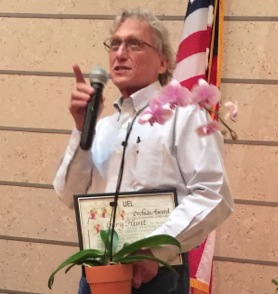
Gary Hunt got the Environmental Restoration Award
Daniel Ciraldo received the Enid Pinkney Award for Historic Preservation
Liz Plater-Zyberk was on hand to present an award to Nathaniel Connolly. He was not there but Greg Bush of the Urban Environment League accepted the award.
Blanca Mesa received the Dan Paul Award for Public Waterfront Protection
County Commissioner Daniella Levine Cava got the Katy Sorenson Award for Government Ethics.
Biscayne Times Publisher Jim Mullin got the David Lawrence, Jr. Award for Public Information.
No Awards on this one, I just liked this photo of County Commission Chair Jean Monestime and Former County Commissioner Katy Sorenson
UEL Board Member, Scientist John Van Leer urged everyone to join the Citizens Climate Lobby
As I said I did not include all the award winners go to UEL.Org or their Facebook page to see the rest.

The Onions went to Climate Change Deniers: Rick Scott, our Awful Governor; and Marco Rubio, our absent, awful Senator. County Commissioner Pepe Diaz also got an onion and it wasn't for drunken driving. Jonah Wolfson got an onion for his PAC.

Friday, September 13, 2013

Miami Dade's Pollyanna and my Defense of Recalls. By Geniusofdespair


In 1913 Eleanor Porter wrote the classic Pollyanna about a little girl with an optimistic outlook. Merriam-Webster defines pollyanna as " a person characterized by irrepressible optimism and a tendency to find good in everything".

Former County Commissioner Katy Sorenson, in my view, is Miami Dade County's version of Pollyanna. Don't get me wrong, I love Katy and think she is a great person but I think she is wrong to be against recalls and unrealistic on finding candidates.  She keeps telling me, instead of recall: "Find a good candidate to run against them." I can find the best candidate in the world, but when up against $600,000 in their campaign account  (AND A PAC, Political Action Committee with as much if not more) and an absentee ballot machine (legal or not), my "great candidate" has no chance EVER.

No one will give money against a sitting commissioner. It is unrealistic to expect donors to raise the anger of the sitting commissioners. You can only find vendetta money (like Norman Braman's and that won't cut it, not enough).

Katy won her campaign because of the perfect storm. Larry Hawkins, the sitting commissioner she ran against, had issues...plenty of them.

Katy doesn't believe in recall.  I love recall because it gives us a real chance to oust the offending politician. It is swift and clean. Money doesn't cut it like it does in a campaign.

So, Katy, I give you credit, trying to train these neophytes to be ethical and effective. And I love you for all your good work and your positive attitude but I disagree with you. What you say can't be done. As Carlos Gimenez said to me: "Money is the mother's milk of a campaign." Without money we get more of the same.

Meanwhile my method, I want to slash and burn. All we are doing is settling for mediocrity in local and county government anyway. What is to lose by giving a bad one an extra push out the door? We would never have gotten Seijas out without a recall.  How many years did Dorrin Rolle rape the county and in the process destroy Jesca before we could get him out?  And it was only because of Ron Book and others that he is gone.  It takes a lot to swing the "money changers" of this era away from a sitting commissioner. Rolle is the only one I can remember. Even the lobbyists couldn't justify his candidacy anymore. Meanwhile, your win over Larry Hawkins in 1995 was seen as a fluke:
But for many people Sorenson's victory had far less to do with the quality of her candidacy than it did with the scandal surrounding her opponent. Hawkins had been dogged for months by allegations he had sexually harassed several of his aides. Sorenson was the only woman to challenge him, and she won by a margin of almost two-to-one.
 A failed recall is better than no recall. It taints the Commissioner.

Friday, June 21, 2013

UM Dean of Architecture Elizabeth Plater-Zyberk who aims high, to step down ... by gimleteye

Yesterday, the Herald reported on a changing of the guard at the UM School of Architecture. The article glossed over Ms. Plater-Zyberk's contribution to this era of Miami-Dade's growth.

Plater-Zyberk has been one of the only "insiders" linked up to "outsiders" who advocated, mostly to no avail, for sound and sensible planning both in the urban core and the suburban fringe of Florida's most populous county.

The Miami Herald never reports on this dynamic; how civic and citizen activists press up against the organized, well-funded cogs of the Growth Machine. It is not a simple David versus Goliath story, however.

As a practicing architect and planner, while dean of the School of Architecture, Plater-Zyberk stood up and helped design a new zoning code for the city of Miami during the Diaz term, opposed by many civic activists who feared it would lead to greater densification and sacrificed quality of life. Although DPZ -- Duany Plater Zyberk -- has been the nation's pre-eminent advocate for new urbanism, its efforts to create examples in Miami-Dade also met neighbors' resistance as in the case of Salamanca, a "traditional neighborhood development" once planned for West Dade.

Throughout, Ms. Plater Zyberk demonstrated an amazing sense of calm and centered-ness.

The Herald story noted Plater-Zyberk's contribution to the rebuilding after Hurricane Andrew in 1992. It missed the key point: Plater-Zyberk lead a team of architects and planners who offered a major re-thinking of the Florida City and Homestead city core, including the US 1 corridor to the Florida Keys. It was thoroughly rejected by the Growth Machine.

A few years later, Plater-Zyberk and then county commissioner Katy Sorenson gained the support of the county commission to design a plan to save agriculture in South Dade. The Growth Machine soundly throttled and then bottled up the results, condemning Plater-Zyberk's involvement. (For that, thank Bill Losner.)

Notwithstanding minor skirmishes at the periphery of new urbanism, Plater-Zyberk's example illustrates how common sense in land use planning to protect neighborhoods for the long-term places a distant second to the financial arrangements of suburban sprawl; tangling elected officials in the chase for campaign contributions outside their district boundaries.

The South Dade agriculture study -- and, later, the fiasco of the Homestead Air Force Base redevelopment plan -- lead to yet another study: the South Dade Watershed Study that re-cycled on paper the key tenets of Plater-Zyberk's concept of land use planning. At the time, the Watershed Study was the most extensive and expensive ever undertaken in the United States and pointed in the direction of reforming infrastructure in already developed areas; a key concern as more and more American cities suffered under the fiscal weight of decaying bridges, roads, and built environments.

In Miami, too few in positions of power listened to Plater-Zyberk's reasoning and those who did listen, like the lobbyists and beneficiaries of the Growth Machine, made small fortunes marginalizing the precepts of new urbanism. (They are still at it, of course!)

Importantly -- on a week where the national magazine Rolling Stone features a report on Miami and sea level rise, "Goodbye, Miami" -- it bears emphasis that for more than twenty years, Elizabeth Plater Zyberk advocated for sustainable development, protecting wetlands and watersheds and concentrating development around walkable, livable neighborhoods with clear public spaces, that dovetail with climate change mitigation strategies.

Thursday, September 01, 2011

The Good Govenment Initiative or as I call it: Katy's Class. By Geniusofdespair

Some politicians want to be better (or former County Commissioner Katy Sorenson strong-armed them - less likely). The following are actually taking a course to learn to be good, effective, HONEST public servants:

Patricia Asseff, Vice Mayor, City of Hollywood
Jennifer Ator, Council member, City of Miami Springs
Dwight Bullard, State Rep., Florida District 118
Heather Carruthers, Mayor, Monroe County
Daniel Dietch, Mayor, Town of Surfside
Jorge Exposito, Commissioner, City of Miami Beach
Wendy Harrison, Council member, Town of Jupiter
Barbara Kramer, Council member, City of North Miami Beach
Keith London, Commissioner, City of Hallandale Beach
Sue Loyzelle, Council member, Town of Cutler Bay
Frank Quesada, Commissioner, City of Coral Gables
Raquel Regalado, School Board Member, Miami-Dade County
Felicia Robinson, Council member, City of Miami Gardens
Roxanna Ross, Mayor, Village of Biscayne Park
Nora Rupert, School Board Member, Broward County
Robin Smith-Martin, School Board Member, Monroe County
Francis Suarez, Commissioner, City of Miami
Elsa Vazquez, Commissioner, City of West Miami

Call these people and tell them you are proud of them. The members will participate in comprehensive training on issues, including economic development, land use, ethics, cultural diversity, and more. This weekend included a focus on budget, the fundamentals of leadership, and community history Sorenson said:
“I’m excited about this first crop of students who represent the future of leadership in our community. They have demonstrated that they are interested in improving their skills in governance and in working with their peers to improve government throughout South Florida,”
If you want to help Katy's program go to their website. They could sure use funding. She did manage to lasso 3 of our hottest male politicians for this class, all candidates or future candidates of our beauty contest: Keith London first row right (winner in 2009), Frank Quesada - white shirt 4th row and Frances Suarez back row. (hit the image to make it larger)

Dwight Bullard, I have high hopes for you. Please learn to serve your community well. I have a video of you that impressed me. As for Katy Sorenson, I always say throw the bums out, she is offering an alternative: make them better. I hope she can. There is a difference between a politician who can raise money and a public servant that can help the community. She believes there is public servant potential in politicians, I don't really. I hope Katy is right. Maybe we can fix the broken system from within. After all, these people can now go back and teach the others on their commission, council or board, leading by example. Will there be a trickle down effect?

Friday, April 01, 2011

Lynda Bell vs. Clean Water in Miami-Dade. Guest Blog by Cara Capp, Clean Water Action

Katy Sorenson’s presence will be particularly missed this week, as her predecessor pushes forward an anti-water initiative at the Miami-Dade County Commission.

Recently-elected District 8 Commissioner Lynda Bell has struck her first of what will likely be many blows against our clean water supply, sponsoring a resolution to oppose the Environmental Protection Agency (EPA)’s proposed numeric nutrient criteria that would provide statewide protection to our polluted waterbodies.

The EPA was legally mandated to establish measurable pollution standards after environmental groups sued the agency for not properly enforcing the Clean Water Act. The numeric nutrients program seeks to improve water quality by increasing efficiency at sewage treatment plants, managing agricultural runoff, and establishing residential fertilizer ordinances – all at minimal cost to taxpayers.

Bell’s resolution makes blatantly incorrect claims about the EPA’s proposed program, like stating that the County will be under an unreasonable timeline to achieve new water quality standards, and that “the short deadline will require aggressive and extensive modifications to all programs to meet the standards of this new criteria.” Actually, the program clearly states that the extended timeline is set to twenty years. In what universe is two decades considered a “short deadline” for compliance?

And that’s not even the worst of it. This resolution is not a public hearing item, meaning the Commission is railroading this critical issue without an opportunity for residents to comment.

Don’t be silenced on this important decision. Call or e-mail your County Commissioners. Remind them of their obligation to represent your health and future; opposing reasonable pollution standards is certainly not in the public interest.

Saturday, February 19, 2011

Former County Commissioner Katy Sorenson asks a good question ... by gimleteye

Former County Commissioner Katy Sorenson has established a new project at the University of Miami: The Good Government Initiative. Her inaugural event begins with a community conversation and a good question: "Civility in Government: Can it Happen in South Florida?" The premise is that civility is NOT happening in local government. That would be obvious.

What is not so obvious, but very much related, is how the decline of civility in government tracks the decline in values that protect democracy in the United States compared to other developed nations. For the world, Americans imagined themselves to be the Shining City on the Hill. But we are not, in fact. Not even close. As created by the International Monetary Fund, some of these metrics were published by the New York Times today. They contain dismal indicators of the health of our democracy.

Having spent 15 years on the receiving end of a lack of civility from fellow county commissioners, former Commissioner Sorenson is an expert. But having a feel-good, cheerleading session to awaken Miami! isn't going to shed light on the subject.

It would be better to start by considering the facts behind Sorenson's nemesis on the county commission, Natacha Seijas. Seijas, who has mastered the lack of civility to her own ends, is subject of a second recall effort by constituents. The special interests flooding to aid Seijas are contributors whose business lines direct intersect with county contracts or zoning issues.

The bottom line is that these special interests are all well-heeled and some are very wealthy. Their children go to private schools and colleges. They live in gated communities in Coral Gables or Pinecrest, far from Seijas' core constituents; poor or lower middle class residents and voters of Hialeah. In other words, the people who run government-- for their own interests-- are far removed from the metrics highlighted by the New York Times chart of indicators.

I doubt the absence of civility these business interests support in government and politics is matched by conduct in their home life, although that is just a guess. I believe that this phenomenon is due to shortened business horizons and opportunities that are largely the result of fouling our own nest in South Florida and elsewhere. Instead of investing for the public good, we have turned over the keys of government to short term, private profit.

This points to the fundamental crisis in America today: that the powerful interests that run the dominant politics, the GOP, don't care for and don't believe in the public good. In fact, they belittle it. I know, because I have been on the receiving end-- as an environmentalist in Florida-- for many, many years. There can't be civility in government until business leaders demand change. But the attitude of business leaders is, why should I care? If America is going down, shouldn't I take care of my own, first?


Thursday, September 02, 2010

Colleen Griffin ... by gimleteye

(Colleen Griffin with UF scientists, 2005, courtesy of Pat Wade)
Florida's tropical fruit industry lost a pioneer yesterday with the passing of Colleen Griffin. Colleen's family grew mangos along 200 St. and 147 Ave. Colleen was very active in the tropical fruit industry, as well as the community, and she worked very hard to help to keep Florida tropical fruits viable. She was an active member of the Mango Forum, was on the TFGSF (Tropical Fruit Growers) Board of Directors for many years, and was TFGSF president for three years from 2000 - 2002. She is survived by her husband Joe, and her two sons Joe, Jr. and Earl. Colleen Griffin, according to friend Pat Wade, was the kind of activist for her community that is more and more scarce. "She was on more committees than I could count," said Wade. Griffin, from a pioneering family in the Redland, was part of a small network--derided by County Hall and county commissioners-- to keep suburban sprawl at bay. There will be a viewing on Tuesday (8/31) from 6-8 pm at Palms Woodland Cemetery at 27100 Old Dixie Hwy, Naranja. The service will be at Palms Woodland at 10 am on Wednesday (9/1). Mail can be sent to Joe Griffin at 14600 SW 200 St, Miami, 33177.

Friday, August 27, 2010

Prepare for the day Natacha Seijas retires ... by gimleteye

Since the zaniest things are happening this election cycle, like the Florida GOP imploding, my mind is set to other impossibilities that may come true in the fullness of time. The photo of Katy Sorenson holding up a Flinn t-shirt during her endorsement set me to a reverie of what news of Natacha Seijas' retirement could inspire. In fact I don't know what it will take to pry Natacha Seijas loose from the Miami-Dade county commission. Her dour presence is a constant reminder how voters in Miami-Dade get exactly what they deserve. Seijas stays as far away from computers, we hear, as Osama Bin Laden from cell phones. Still, it is entertaining to speculate how news of her resignation could trigger some paranormal event, like an electric surge of excitement setting off computers across the state. Or maybe just sparklers around the edge of the screen.

Thursday, August 26, 2010

Commissioner Katy Sorenson has endorsed Eugene Flinn. By Geniusofdespair


It is official, late this afternoon County Commissioner Katy Sorenson endorsed Mayor Eugene Flinn for the District 8 seat she is vacating. Too bad Lynda. Maybe vile Natacha Seijas will endorse you? I am really happy that Sorenson got off the fence and backed Flinn. He will make a good Commissioner and she gave him a glowing recommendation. There was more to the speech but I was getting tired of holding up my phone. You can read about it and watch video on Channel 4.

Wednesday, July 21, 2010

Katy Sorenson's Remarks at the Nuke Scoping Meeting. By Geniusofdespair

Turkey Point is probably the most environmentally unlikely nuclear installation in the nation. If we had it to do all over again, would we really put a massive power plant complex on the border of a National Park, in the middle of sensitive wetlands and then convert thousands of acres of coastal mangroves into a giant radiator for two nuclear reactors?

We may not have the chance to do it all over, but we can certainly think better of making things worse.

The Environmental review of an expanding nuclear facility abutting a national park – in the middle of wetlands that the Federal, state and local governments have spent millions working to restore and protect – deserves extra scrutiny.

One of the most important things that the NRC can do as a function of the environmental review of this application is to evaluate the cumulative environmental impacts from all of these plants. After all, the reactors are called 6 & 7, not 1 & 2. Just evaluating this application as if the proposed plants exist in a vacuum as the State is doing through their permitting process would be a disservice to the community and our environment. (Hit read more)

The NRC needs to evaluate the impacts of the two new reactors – direct impacts like wetland losses, dredge fill pads, permanent on-site nuclear waste storage, and “temporary” 20 year roads through an Everglades restoration project – in the context of the impact already caused by the existing power plant complex.

There is growing evidence that the thousands of acres of cooling canals designed for Turkey Point 3 & 4 are exacerbating saltwater intrusion in the area, and is believed to be impeding the flow of groundwater to Biscayne National Park. If no solutions to these impacts are addressed in this application review, then you will have contributed to the degradation of our national parks and our quality of life in Miami-Dade.

I know it isn’t the Nuclear Regulatory Commission’s place to determine need, but I do believe that there is a deep reservoir of available energy if we would only embrace energy efficiency. A recent report by Duke University and Georgia Tech concluded that the Southern States could meet our future energy demand through aggressive energy conservation programs. There are a lot more jobs to be had putting people to work now – not 5, 10, 15 years from now – retrofitting homes and businesses throughout our community.

And we don’t have to pay for these jobs and reduced energy bills through an “Early Cost Recovery” fee.

I also want to join the voices of the Mayors from Cutler Bay, Palmetto Bay, Pinecrest, and South Miami. We object to the environmental impact of power lines along the US 1 corridor which would destroy our communities’ plans for mixed-use pedestrian and transit oriented development, compact urban form that holds the line on sprawl and which in turn, protects our Everglades and environmentally sensitive areas.

I urge you to consider all of these environmental issues. Thank you for the opportunity to participate in this process.

Saturday, July 10, 2010

Love to Get Recognized by my Peers. By Geniusofdespair

It is always an honor to be recognized. I was a runner up for Post of the Week for my post last week about Peter and Karen. I did get Post of the Week by South Florida Daily Blog the week of June 22nd. SFDB said:

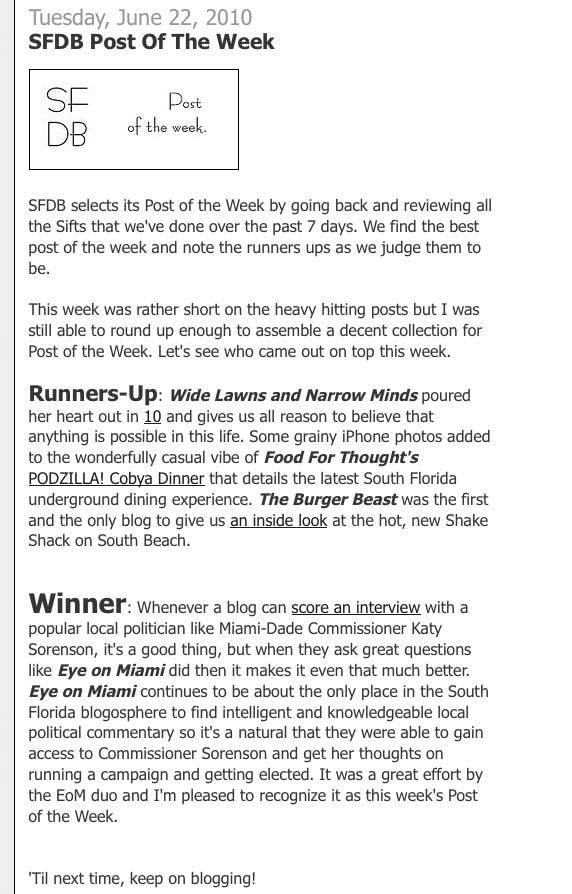
Winner: Whenever a blog can score an interview with a popular local politician like Miami-Dade Commissioner Katy Sorenson, it's a good thing, but when they ask great questions like Eye on Miami did then it makes it even that much better. Eye on Miami continues to be about the only place in the South Florida blogosphere to find intelligent and knowledgeable local political commentary so it's a natural that they were able to gain access to Commissioner Sorenson and get her thoughts on running a campaign and getting elected. It was a great effort by the EoM duo and I'm pleased to recognize it as this week's Post of the Week.

Now the Katy Sorenson interview is up for Post of the Month. People have to vote for one of the 4 nominees.

I guess some people do recognize when you put that extra effort into your post. Thanks Rick.

Tuesday, June 22, 2010

US Century Bank: the insider piggy bank...? by gimleteye


"No", is how County Commissioner Katy Sorenson answered our interview question: "Do you think the economic crisis has changed the county commission at all?" The reason that business as usual persists at all levels of government is because there is no penalty for taking outsized risks. You can destroy the Gulf of Mexico and not even go to jail. For elected officials, like the county commission, a routine aspect of risk has been allowing insider special interests to dominate zoning councils and decisions related to construction and development. Exhibit A: the board of directors of US Century Bank, including Ramon Rasco, Sergio Pino, Rodney Barreto, Jose Cancela, Armando Guerra, Augustin Herran and other speculators whose business model was based on suburban sprawl by forcing zoning changes in farmland and wetlands edging to the Everglades beyond the Urban Development Boundary.

Today, the bank rating agency, Bauer Financial, based in Coral Gables gives US Century Bank its lowest rating above zero. Among indicators in which US Century raises alarm in comparison to its peers: loans to insiders, noted above by Bauer. County commissioners like Natacha Seijas, Bruno Barreiro, Javier Souto, Joe Martinez and Pepe Diaz-- the group we call the unreformable majority-- have been and continue to be enthusiastic cheerleaders for whatever US Century Bank insiders need. The Bauer flashing red lights indicate this bank is one of the riskiest in its peer group.

This level of insider dealing represents the kind of transactional behavior for which there is no penalty-- not for the land speculators, not for the county commissioners who support them. US Century Bank will continue to take out full page ads in The Miami Herald, ensuring that the speculators are treated with deference. If this bank fails, whose principals argued for suburban sprawl right alongside the LBA, it will be absorbed by a more healthy vulture backed by US taxpayer guarantees. Commissioner Sorenson, for whom the insiders at US Century have little respect, is right: this economic crisis has changed nothing. When the speculators fail at suburban sprawl or growing sugar in the Everglades, they can always become rock miners.

Thursday, June 17, 2010

The Urban Environment League Dinner Honoring Katy Sorenson. By Geniusofdespair


(Photo: Former County Attorney Murray Greenberg and Party-Crasher Miguel Diaz de la Portilla - He came for cocktails. This was the best photo I took last night, I was otherwise engaged in drinking and talking. Wait, I did take one more photo -- at bottom -- of a teddy bear presented to the commissioner so she could have a reminder of her years on the dais.)

Gimleteye's toast to Commissioner Katy Sorenson last night:


If we go back to the beginning, when you were a lady in tennis shoes running for the Miami-Dade County Commission, no one would have believed that you are still wearing the same tennis shoes. From the bottom of my heart, I urge you to buy new tennis shoes. It is a strange and wonderful mystery how you survived sixteen years of county commission meetings that often stretched into late hours and required hazmat suits and decontamination afterwards. For all those years, citizens of Miami-Dade County could set their compasses to your bearing. Particularly on matters of the environment and human rights, we are indebted to your vision and your willingness to stand for fairness, equity, and balance. You are the real thing and we wish you many more years of helping our community grow productively, honestly, and with the sense that possibilities of achievement are far stronger and more powerful than tendencies to self interest. With great affection and respect, Alan Farago

The Natacha Seijas doll

Monday, June 14, 2010

An Interview with Miami-Dade County Commissioner Katy Sorenson about Campaigning and the District 8 Election. By Geniusofdespair


G.o.D.: The Campaign Consultant, how important is having one to win an election? What about WHO the consultant is, what conclusions can the public draw? Have you had what the public might consider a controversial consultant?

Katy Sorenson: I think it helps to have a consultant who knows the ins and outs of campaigning, along with the political landscape. If the candidate is very sophisticated and knowledgeable, maybe he or she could do without one, but it would be difficult. The consultant always did my direct mail and campaign commercials as well (with my input), and they know the deadlines, time-lines, strategy and help with messaging. They can also assist with polling, if desired. A consultant is only one member of the team; the candidate should be the one providing the vision and direction. If those roles get reversed, trouble can ensue.

In my initial campaign, Irene Secada did most of the work. Subsequently, Ric Katz was the main consultant who did the above tasks, and Irene assisted. In my last campaign, Steve Marin was the consultant. I had a good working relationship with all of them, and I would recommend them.

G.o.D.: Walking the District: Tell us about how you walk and how you talk? What should your future constituents learn about you in these visits? How long do you stay? How often did you walk?

Katy Sorenson: I walked and walked and walked! I always had a driver, and I would go to the homes of frequent voters. I would introduce myself and hand out a piece of literature. In my first election when no one knew me, I would give a bit of biographical info, then state that I was running to beat Larry Hawkins, who at that point had completely discredited himself. In subsequent elections, I would always ask "how am I doing"? and discuss the critical issues of the day. These visits could last anywhere from a minute to 10 minutes, but I tried to keep it short to maximize the number of people I reached. I walked any weekday evening when I didn't have a fundraiser or an event, and Saturdays and Sundays, morning and afternoons.

G.o.D.: The Campaign Report: Is taking contributions from anyone ever off limits? Can we draw conclusions from the campaign reports? What should we read into a campaign contribution of $5,000 all by one person via different corporations. Are these contributions a necessary evil?

Katy Sorenson: I took everyone's contributions, and thanked them for their investment in good government. If I knew there was a legal problem with someone, I would not take a contribution. Never did I lead any contributor to think that I owed them anything else except to answer their phone calls and listen to their issues. I think it's a good idea for the public to scrutinize contributions, but you can't really draw conclusions until the person is in office and performing. Unless someone is independently wealthy, money is a necessary part of winning an election.

Another thing to evaluate is how grassroots the campaign is. If there are many volunteers from community groups, neighborhoods and civic organizations, it is likely that the candidate will feel more responsible to those people than to people who merely write a check. Sweat equity counts!

G.o.D.: How do voters decide between candidates, what should they look for in a district 8 candidate? What should voters ask the candidates? If you were speaking to the candidates, what would you think are the most important issues?

Katy Sorenson: I think what is important is the candidates life experience, work experience, and views of the County.

I would want to know what would be their priorities (land use and transit, economy, what to do about Jackson Memorial Hospital, social justice in a diverse community,
affordable housing, etc.) and how would they go about trying to accomplish their goals?

G.o.D.: Who should contribute and why?

Katy Sorenson: Anyone who cares about the future of Miami-Dade County.

G.o.D: Why should a person from outside the district throw a fundraiser for a district 8 candidate?

Katy Sorenson: Because with any luck, the candidate might be concerned about countywide and regional issues that transcend the parochial interests of the district. See all the issues I listed above.

G.o.D.: What would you say to district 8 voters about this election? What would you say to the candidates?

I would ask the voters to evaluate who would be the person who would best represent the public interest and would work hard to leave this county better than they found it. Who has a track record? Who has the skills, knowledge, work ethic, values to contribute to the betterment of the county?

To the candidates, I would say, District 8 is a diverse and demanding place. People expect a lot. This campaign will take all of your time -- 7 days a week, 16 hours a day. Be prepared. Study the issues, raise money and meet as many voters as you can. Get a great volunteer team and make sure they're well supervised and working according to the campaign plan. HAVE a campaign plan, for that matter! Tell the truth, admit it when you don't know something.

Gimleteye: What is the most unexpected lesson you learned as a county commissioner?

Katy Sorenson: Maurice Ferre once told me, "there are no friends in politics, only temporary alliances." I think it's important to remember who your real friends are -- they are your family and a few others who love you unconditionally. When you're a commissioner, though, it's all about what have you done for me lately? Personal relationships are important for the soul and relationships are important in politics. But principles and serving the public interest should always come before relationships when it's time to vote or to advocate a position.

It is hard not to be cynical about county government. What qualities are important, to stay up into the late hours of the morning knowing that you will be on the losing side of a vote?

People are cynical about ALL government. Gandhi said (I'm paraphrasing) you always have to do the right thing. It may not be in your power, it may not be in your time that you get the result you want. But if you do nothing, there will be no change.

I have always felt a tremendous sense of responsibility to the public and to myself -- to be intellectually honest and to serve to the best of my ability.

Gimleteye: Do you think that the economic crisis has changed the county commission in any way?

Katy Sorenson: No.

If you have any questions for Commissioner Katy Sorenson that you think I should have asked, write them in comments and we will try to do a follow-up piece.

Commissioner Sorenson said she shared my goal of wanting a good commissioner in District 8. Let's all make it happen by working together. Talk to your friends and neighbors about the candidates...because in my opinion, this is one of our most important County Commission seats.


Monday, May 24, 2010

For, County Commission District 8 ... by gimleteye

It was an entertaining, civilized evening at the Urban Environment League dinner and panel discussion with seven candidates to be the next county commissioner of Miami-Dade District 8. Seven is a big number. It wasn't possible to have anything close to a debate. (Not with the sounds of a mariachi band coming in from next door and over the PA system.) Nevertheless, questions were well phrased and earnestly answered (see 10 video clips). It was possible to glean a sense of what each candidate might be like, were he or she to be elected to represent District 8. (click read more)

Katy Sorenson has held that commission seat since 1994. She ran back then as a mom in tennis shoes. Her election victory owed much to the calamity the incumbent, Larry Hawkins, brought on himself. Hawkins, then a Democratic operative, aspired to be a mover-and-shaker. He was the first county commissioner to conceive the plan to convert the Homestead Air Force Base, devastated two years earlier in Hurricane Andrew, into a gusher of political fortunes. (Notably, Terry Murphy--chief of staff to Natacha Seijas, the de facto chair of the county commission, worked in the same role for Hawkins.)

Voters didn't care that Sorenson had little experience in county politics. What Katy Sorenson demonstrated, in more than fifteen years on the county commission, is a steadfast-- even steely-- determination to vote along the lines of what is best for people and not the insiders who have dominated what we refer to on Eyeonmiami as the unreformable majority of the county commission. To Katy, it never mattered that she was routinely on the minority end of decisions; especially decisions relating to land use and sprawl. And it never mattered to me, as a supporter, that the lobbyists had given up calling on her long ago. With such strong majorities in their back pockets, what did they care about District 8?

There was one note that rang hollow to me, at least, in the UEL sponsored debate. The notion that the next District 8 county commissioner should 'reach out to all sides' as though there were any fair play in the way politics play out between county commissioners and the public. Of the seven candidates, I wonder which would be most like Katy Sorenson in independence from the unreformable majority. That candidate would have my support.

Tuesday, May 11, 2010

New Candidate in the District 8 "Katy" Seat and an Additional Mayor Candidate. By Geniusofdespir

Add number 8 to the list of candidates for Katy Sorenson's District 8 Commission seat: Daniel "Danny" Marmorstein. His treasurer is Anne Katz. He wrote "Rabbi" on his form and crossed it out so I would suppose this is a photo of him. This is an August 2009 report on the arrival of the "Hitler Torah" to his congregation.

Also running for Miami-Dade Mayor is Lazaro R. Gonzalez. I believe that is the same guy who ran the unsuccessful mayor recall campaign a few months back.

Thursday, April 22, 2010

Annette Taddeo in District 8 Race. By Geniusofdespair

It is official, Annette Taddeo has joined the 6 other candidates in the race for the $6,000 salary. Taddeo has name recognition, having run against Rep. Ileana Ros-Lehtinen. She got a respectably 41.60% of the votes, totaling 84,904 voters.

Taddeo said “I’m committed to making a difference for the residents of District 8; we need to build a better community together.”

Note to Annette: We want you to represent us all. We have enough Commissioners who act as if they are feudal lords governing their fiefdoms. Katy Sorenson was an at-large Commissioner -- we are hoping the next Commissioner in District 8 will think in broad, 13-district terms like Katy.

In Taddeo's press release there was a lot about her chamber of commerce background: Taddeo is a member of the exclusive Committee of 200, Past-Chair, Secretary and Treasurer of the Coalition of Dade County Chambers of Commerce, Past Chair of the Women’s Chamber of Commerce of Miami-Dade County and has also served on the Board of Directors of the Greater Miami Chamber of Commerce.

Someone should tell Annette that some people don't like the Chamber of Commerce...like me for instance. Anyway, I wish her luck with her campaign and I expect to meet her on Wednesday at the UDB hearing.

I will endorse in this very important race but I am far from that point. There is much to learn about these 7 candidates.

Monday, April 12, 2010

Obdulio Piedra in District 8 County Commission Race. By Geniusofdespair

Obdulio Piedra, born in Havana, a resident of Pinecrest, just entered the District 8 race. Thirty years of community service is his claim to fame. He says he is active in the Chamber of Commerce and was on the Charter Review Committee and the Budget Review Committee, appointed by Former Commissioner Dusseau. He said "My agenda is the people's agenda." Obdulio said that he thinks the UDB line issue has to be one of 'balance' -- and he admits that it will be part of the dialogue for this seat. He is right, especially with the Homestead Speedway trying to move the UDB line at this time. The speedway issue will bring out all the candidates UDB line stance.

His treasurer is Fernando Aran. He joins 5 other candidates and 2 rumored candidates in this race...see my blog. NEWS FLASH: Carlos Pereira has dropped out of the race.


Thursday, April 08, 2010

Political Hot Potato: AT&T's Yellow Pages. By Geniusofdespair

You don't need them anymore with the internet, but those annoying thick, yellow covered phone books arrive at your doorstep anyway. I take them from my doorstep and put them directly in the dumpster. What a colossal waste of paper. County Commissioner Sorenson decided it was a waste of paper too and thought it worth a reform but the AT&T Lobbyists came out like pit bulls against her ordinance because The Yelllow Pages are a cash cow, filled with money paying advertisers' ads.

Sorenson's ordinance allowed for people like me to "opt-out" from getting the yellow pages. The method to opt-out would have been on the front page of the book. Yippee!

Well, the lobbyist killed it April 6th (watch the video - 7A).

Pretty much everyone voted against it - some County Commissioners saved face because AT&T lobbyists gave them cover by raising First Amendment concerns. What?
(Hit read more...)
They said that the yellow pages is protected free speech and that the County Commission telling people how to "opt-out" of getting the book was a violation of the Constitution. However, even AT&T's attorneys admitted that was a long shot.

AT&T is doing a volunteer "opt out" program that no one knows about. Problem is, who will enforce it when you continue to get the books? The Sorenson ordinance would have mirrored their voluntary program, but added the teeth of an enforcement fine after a warning. That would have given AT&T and any other Yellow Page publisher more than a year to remedy mistakes in their database before the first fine was issued.

The debate on this was one for the books. Besides the obvious stuff with Vile Natacha slamming it (expected and boring) we had Souto accusing Katy of "living in lala land" and he meandered on to say her ordinance would lead to outlawing libraries. Mayor hopeful, Little Joe Martinez argued that the penalties were still too high and even said that voting for the opt-out was promoting global warming because you'd have to use a computer to search for information. Others were "concerned" about taking away phone books from the elderly and people without computers (ignoring the fact that it was an opt-out, so they'd have to ask to not get the book). Nobody changed their minds when they learned that AT&T has already gotten the OK from the PSC to stop delivering the White Pages last year. Sorenson, seeing the irony, suggested in jest that we pass an ordinance requiring the delivery of the White Pages since there was so much concern amongst the Commission for the "elderly and people without computers". Note: There are no advertisements in the white pages, AT&T doesn't make money on it so why deliver it? This issue is all about money!

Gimenez, Sosa, and Heyman were co-sponsors however, all of them fled (under Lobbyist pressure?) and voted against the ordinance. So you will continue getting those books piled up on your doorstep and you will also get that annoying follow up phone call to make sure you got the books you threw away. Thanks for nothin' County Commission, but I could use those white pages...the internet sites are starting to charge for numbers.