The following story appeared in the St. Pete Times but should be of interest to Miami readers, too, since the story has to do with Miami residents and health services fraud. Please click "read more".
Feds: Cuba exiles fleece Medicare, then flee U.S.
By David Adams, Times Latin America Correspondent
Published Saturday, February 28, 2009
MIAMI — Eduardo Moreno came to Miami from Cuba in 1997 with nothing.
A decade later the 40-year-old repairman owned a half-million-dollar home and bought his paramour a $106,000 second-hand Rolls-Royce Phantom.
Was he living the American Dream?
Hardly.
Instead, federal agents say Moreno's wealth was the product of a criminal phenomenon sweeping South Florida: multimillion-dollar Medicare fraud perpetrated by Cuban-American exiles.
Even more troubling, many jump bail and flee the country rather than face trial. Often they end up back in Cuba, out of reach of U.S. law enforcement.
Dozens of Cuban-Americans accused of bilking the government for as much as $1 billion were identified in court records by a Miami Herald investigation. One group used 85 phony medical equipment companies to file $420 million in fraudulent Medicare claims. Thirty-six accused scam artists fled to avoid prosecution, absconding with $142 million.
At least 18 — probably more — are believed to be in Cuba, with others in Canada, Mexico and elsewhere in Latin America.
"It's very frustrating for us. We'd pick them up and then we saw them bonding out and leaving the country," said Randall Culp, head of a health care fraud squad at the FBI's Miami office.
Most of the accused Cubans left the island in the 1990s as political refugees. "No one thought they were a flight risk," Culp said.
Medicare investigators began to notice a sharp increase in billing about five years ago, especially from "drug infusion" clinics providing intravenous medication for HIV patients.
"The numbers didn't jibe with our AIDS population," said Timothy Donovan, a senior Miami FBI agent in charge of white-collar crime. Agents calculate the infusion fraud alone accounted for about $1.5 billion.
An unusual number of Cuban-Americans showed up in their investigations. Among them was a former model, Leonardo Bolaños, 42, who allegedly operated two clinics on Miami Beach that racked up $5.2 million in claims in barely six months.
"It was a huge, huge scam," said Claudia Franco, director of the Miami office of the Center for Medicare and Medicaid Services, the federal agency that manages those health care programs. "They simply billed for services that were never rendered."
Before he could be arrested, Bolaños disappeared. FBI officials tracked him down in Canada and are seeking his extradition.
Soon after the crackdown began on drug infusions, investigators saw a spike in billing for medical equipment supplies, from wheelchairs to neck and knee braces. That's when they came across Moreno.
A Medicare inspector noticed he filed claims totaling $2.3 million in two months in late 2006 from one office he ran. In four cases the beneficiaries were dead. At the same time he filed $1.2 million in claims from another office, Faster Medical Equipment. The address turned out to be an unfurnished 6-by-6-foot "utility closet," containing buckets of sand, road tar and a wrench.
Moreno was arrested in April. Days later a judge ordered him to surrender his U.S. passport and set bail at $450,000. He posted bail and travel records indicate Moreno used his Cuban passport to return to Cuba, agents say.
The United States does not have an extradition agreement with Cuba, making the retrieval of wanted criminals hard.
Cuba does cooperate with the United States in some limited areas, such as fugitive sex offenders, drug smugglers and repatriation of Cuban boat people by the U.S. Coast Guard. The State Department confirmed it does "request assistance from the Cuban government from time to time with respect to U.S. fugitives." But it said it cannot discuss specific cases.
Community leaders are not entirely surprised that some immigrants have become so quickly entangled in elaborate crimes. While most Cubans are honest, hard-working people anxious to get a new start in life, the transition often isn't easy.
"People who leave Cuba are brought up on a culture of stealing from the state and generally getting away with it," said Uva de Aragón, a director at Florida International University's Cuban Research Institute. "They want to come here, but don't have much means when they get here, so when they see a chance to make some easy money they might grab it."
FBI agents say schemes usually involve a more experienced immigrant with at least 10 years in this country, who often recruits newly arrived Cubans to operate as front men, or as fraudulent beneficiaries.
Over the past year, judges have gotten tougher, ordering higher bail and sometimes pretrial detention. A judge recently sentenced one Cuban-American woman to 30 years for her role in a Medicare fraud scheme.
But fleeing doesn't always mean a clean getaway. FBI officials have gotten word that Moreno may not be so comfortable in Cuba.
In fact, he and three other fugitives may be in jail.
Times researcher Caryn Baird contributed to this report.
© 2009 • All Rights Reserved • St. Petersburg Times
Saturday, March 07, 2009


Who is Richard Grosso? By Geniusofdespair
 Who is he? Only our best weapon against developers gone wild!
To know this guy is to love him! Ask anyone who knows him. I will be reporting on Richard, a North Miami Beach native son, more soon as he was one of the lawyers representing our side at the Lowe's Big Box Administrative Hearing...decision expected very soon!
Richard Grosso is the Executive Director and General Counsel of the Everglades Law Center (ELC) a public interest law firm which represents citizens in South Florida in cases that defend the public interest in environmental and land use matters.
He directs the ELC's public interest litigation practice and clinic at the Shepard Broad Law Center at Nova Southeastern University in Ft. Lauderdale, where he is an Associate Professor. He specializes in land use, growth management and environmental policy and permitting issues.
Richard Grosso has successfully litigated a number of important and precedent setting cases, including: 1) Pinecrest Lakes v. Shidel, where demolition of buildings erected in violation of a local comprehensive plan was ordered by the courts. 2) 1000 Friends of Florida v. Monroe County, the precedent - setting case on the issue of carrying-capacity - based planning. 3) Sierra Club, et al v. Miami-Dade County, which overturned the state approval for a commercial airport at the former Homestead Air Force Base. 4) Fla. Wildlife Fed. & Sierra Club v. US Army Corp of Engineers, which halted construction of a new city on the fringe of the Everglades in western Palm Beach County and resulted in the relocation of the project to an urban infill area.
He won a major victory for citizen enforcement of the Growth Management Act in Poulos v. Martin County, which guaranteed citizens the right to a de novo trial in plan consistency challenges, and co-authored an influential amicus curie brief in the ground-breaking case of Brevard County v. Snyder.
In his prior service to the state of Florida, he successfully argued the inverse condemnation cases of McKay v. DER and Namon v. DER, which strengthened the state's ability to protect wetlands on private property; DCA v. Withlacoochie Regional Planning Council, which upheld the state's authority to require Regional Policy Plans to be consistent with the State Comprehensive Plan; and Homebuilders and Contractors v. Dept. of Community Affairs, which upheld the state's ability to discourage urban sprawl.
Should we care about this guy fighting David and Goliath issues? I think we should take an interest in what he and his staff are doing because what they do is for our benefit and the future of Florida!
 From left to right:
Richard Hamann, Joel Mintz, Laurie Macdonald, Robert Hartsell (in rear),Richard Grosso, Janet Reno, Thomas Ankersen, Lisa Interlandi, David White. Not pictured: Jason Totoiu, Jennifer Tuby.
(Most of the case details were plagiarized from their website)
Friday, March 06, 2009
The County Commission 101: District 2, Dorrin Rolle. By Geniusofdespair
 I decided I would do brief bio’s of the County Commissioners, Eye On Miami style. Some of you might not know a lot about County Commissioners, but you should! So I will do every Commissioner and here is District 2 ( Also see District 1). Dorrin D. Rolle is the commissioner for District 2. It is mainly a Haitian and African American district. He got into office in 1998 by appointment. Since the Governor appointed him, I assume the Commissioner before him got arrested but I don’t know. Rolle has about 100,000 residents in his district.
Commissioner Rolle until recently, was President at JESCA for $198,214 (12/07) a year. JESCA helps at risk kids and gets County Funds and School Board funds. There was a shakeup (almost two hundred thousand dollars of bank charges, a bad audit and funding cut off by the School Board) Rolle was out. (hit read more)
Let me begin by saying I have no opinion on these Corporations. Some of his larger discretionary fund donations went to WEDR radio ($25,000) to back a Black Consumer Marketing Conference (owned by Cox Radio Corp.); Speaking Hands (officers are from Naples and other parts of Florida) got $10,000; Voices for Children Foundation,Inc. (officers from Coconut Grove, Coral Gables, etc.) got $10,000; Mt. Moriah Missionary Baptist Church, Inc.(officer mostly from St. Pete) got $15,000; Haitian Neighborhood Center got $25,000 and Haitian American Foundation, Inc. got $30,000 (He needs Haitians to get reelected).
Rolle stated that on June 30, 2008 his net worth was $1,113,254. His income from the County was $50,214 in 2007. He stated that almost $800,000 of his money was in retirement funds. I am guessing his portfolio is not worth that anymore (like the rest of us).

I don’t know how Rolle views himself, we view him as one of the stalwarts of the unreformable majority, voting for every application to move the Urban Development Boundary. He pushed some of the Stackhouse crap and got a lot of money for his campaign from Stackhouse interests. A lot of the HOUSE OF LIES activity was in his district. You would think he might have gotten curious when he saw empty lots for years where the County was funding affordable housing projects. Didn't he have eyes?
Chairman Denis Moss put Rolle as the Chair of the Airport and Seaport Committee.
I have seen him sleeping on the dais. He loves his bling and likes to wear bright colors. So you can identify him, he always has name embroidered on his hat. Last, I found this judgment against Rolle and Jesca:

Dear Vice President Biden: don't support suburban sprawl ... by gimleteye
Our Vice President is in town to meet with powerful Democrats. It is all about reviving the economy and the fiscal stimulus. The Miami Herald shows Joe meeting with Carlos (Alvarez, Mayor of Miami-Dade County) and Manny (Diaz, Mayor of the City of Miami) at the site of the billion dollar plus Miami Intermodal Center, meant to propel Miami International Airport (again) into the 21st century.
Mr. Vice President, what many civic activists have worried about, with respect to the fiscal stimulus, is that the money will fall into the hands of the sprawl builders who are largely responsible for creating the national economic crisis in the first place. This is a certainty if history is any guide.
If you read the Miami Herald this morning-- as I am sure you will-- the section I would advise you first reading the Herald advertising section called, the "Home Guide". The guide is buried somewhere behind the sports section. Today it is only a few flimsy pages, but it was once the powerful capital of Miami Herald profits (no more) and, as such, explains how the Latin Builders Association and the South Florida Builders Association prevailed in tamping down public criticism of the housing market bubble as it occurred.
There is no doubt that the production homebuilder lobby in Miami-Dade, that controlled local politics and state politics by extension for decades, is going to make a run at fiscal stimulus money to pave more roads out near the Everglades to meet transportation concurrency requirements of the State of Florida, in order to speed more zoning for platted subdivisions in farmland or commercial "job related" real estate. (Never mind such delectable items as; the homebuilders are actively lobbying the state legislature to eliminate transportation concurrency requirements in Florida state law, or, that sprawl booster banks are desperately seeking capital or to sell their banks outright.)
This failed economic model is on full view in the "Home Guide", Mr. Vice President, where I would call your attention to the only McMansion advertisement in the once muscular section. I would like to offer you a "guide" to reading this week's "Home Guide", that inform you of the waiting disaster if the fiscal stimulus money is used to "rescue" production homebuilders.
First, note that the developer is trying to sell inventory at more than a 50 percent discount to listed price: "auction-like prices on luxury estate homes". That's right: this business model that commandeered Florida politics for decades is, today, only viable for bottom feeders. Is that really how we want to get our economy going, Mr. Vice President? By appealing to bottom feeders?
I would like to draw your attention, Mr. Vice President, to a related point of history: it is the full half-page ad below the "auction-like price" info ad. This half page ad also advertises "HUGE price reduction at Sunset Falls" in Broward County. The ad is paid for by GL Homes. Here is a slice of history on GL Homes.
In December 1994, after a year and a half battle with community activists, a corporation called Atlantic Gulf Communities-- once a hugely influential production home builder in Miami, long ago bankrupt and a shell of its former self-- succeeded in obtaining permits in Broward for a 2000 home development called Sunset Lakes. (Sun Sentinel, December 21, 1994, Sunset Lakes in Miramar gets OK).
Sunset Lakes was a kind of Waterloo for Florida environmentalists; the place where the battle to stop sprawl was lost.
Both Miami Lakes (the Graham Companies) and Weston (Arvida, Cobb real estate), now communities totaling tens of thousands of residents, had emerged in a naïve era of zoning and permitting. But by 1994-- fifteen years ago, Mr. Vice President-- the battle lines were clearly drawn. In the case of Sunset Lakes in far western Broward County, it was a Democratic administration in Tallahassee that delivered a devastating blow to environmentalists.
“Broward County took its finger out of the dike today. You can’t restore what you’ve given away,” said Patti Webster of the Environmental Coalition of Broward County to the Sun Sentinel at the time of the zoning approval, only a mile and a half from the Everglades. The Sunset Lakes development was strong-armed through by lobbyists and bankers and production homebuilders who hungrily eyed vacant space near the Everglades as the next big thing.
The tragedy was that it occurred despite a newly formed blue ribbon panel, The Governor's Commission for a Sustainable South Florida, that specifically and explicitly sought to tamp down building in areas that were critical for water storage and Everglades restoration. All the players, except for civic activists fighting sprawl, were on the Governor's Commission.
In July 1995, a Democratic administration in Florida waved concerns that had been expressed by the weakest regulator in the nation, the US Army Corps of Engineers, that the land in question should be considered as a buffer between the Everglades and urban development—and approved the project.
The Chiles administration was unmoved by the clamor that Sunset Lakes would destroy open land “crucial for replenishing water to the Everglades and restocking underground reservoirs that will be the primary source of drinking water.” (Sun Sentinel, Miramar project heads for OK, July 26, 1995)
In November 1999, Atlantic Gulf sold its interest in Sunset Lakes to sprawl builder GL Homes, the advertiser in today's "Home Guide".
Today, ten years after GL Homes picked up Sunset Lakes, Mr. Vice President, the Broward land near the Everglades has been sucked dry by developers who are now gaming Congress for bailouts, subsidies and stimulus money to "improve" roadways near sprawling projects whose only conceivable purpose is to rescue wealthy and politically influential land speculators. Draw your own conclusions, please, and take this message back to Washington, Mr. Vice President, to our former community organizer and President. I really hope you will.
Mr. Vice President, what many civic activists have worried about, with respect to the fiscal stimulus, is that the money will fall into the hands of the sprawl builders who are largely responsible for creating the national economic crisis in the first place. This is a certainty if history is any guide.
If you read the Miami Herald this morning-- as I am sure you will-- the section I would advise you first reading the Herald advertising section called, the "Home Guide". The guide is buried somewhere behind the sports section. Today it is only a few flimsy pages, but it was once the powerful capital of Miami Herald profits (no more) and, as such, explains how the Latin Builders Association and the South Florida Builders Association prevailed in tamping down public criticism of the housing market bubble as it occurred.
There is no doubt that the production homebuilder lobby in Miami-Dade, that controlled local politics and state politics by extension for decades, is going to make a run at fiscal stimulus money to pave more roads out near the Everglades to meet transportation concurrency requirements of the State of Florida, in order to speed more zoning for platted subdivisions in farmland or commercial "job related" real estate. (Never mind such delectable items as; the homebuilders are actively lobbying the state legislature to eliminate transportation concurrency requirements in Florida state law, or, that sprawl booster banks are desperately seeking capital or to sell their banks outright.)
This failed economic model is on full view in the "Home Guide", Mr. Vice President, where I would call your attention to the only McMansion advertisement in the once muscular section. I would like to offer you a "guide" to reading this week's "Home Guide", that inform you of the waiting disaster if the fiscal stimulus money is used to "rescue" production homebuilders.
First, note that the developer is trying to sell inventory at more than a 50 percent discount to listed price: "auction-like prices on luxury estate homes". That's right: this business model that commandeered Florida politics for decades is, today, only viable for bottom feeders. Is that really how we want to get our economy going, Mr. Vice President? By appealing to bottom feeders?
I would like to draw your attention, Mr. Vice President, to a related point of history: it is the full half-page ad below the "auction-like price" info ad. This half page ad also advertises "HUGE price reduction at Sunset Falls" in Broward County. The ad is paid for by GL Homes. Here is a slice of history on GL Homes.
In December 1994, after a year and a half battle with community activists, a corporation called Atlantic Gulf Communities-- once a hugely influential production home builder in Miami, long ago bankrupt and a shell of its former self-- succeeded in obtaining permits in Broward for a 2000 home development called Sunset Lakes. (Sun Sentinel, December 21, 1994, Sunset Lakes in Miramar gets OK).
Sunset Lakes was a kind of Waterloo for Florida environmentalists; the place where the battle to stop sprawl was lost.
Both Miami Lakes (the Graham Companies) and Weston (Arvida, Cobb real estate), now communities totaling tens of thousands of residents, had emerged in a naïve era of zoning and permitting. But by 1994-- fifteen years ago, Mr. Vice President-- the battle lines were clearly drawn. In the case of Sunset Lakes in far western Broward County, it was a Democratic administration in Tallahassee that delivered a devastating blow to environmentalists.
“Broward County took its finger out of the dike today. You can’t restore what you’ve given away,” said Patti Webster of the Environmental Coalition of Broward County to the Sun Sentinel at the time of the zoning approval, only a mile and a half from the Everglades. The Sunset Lakes development was strong-armed through by lobbyists and bankers and production homebuilders who hungrily eyed vacant space near the Everglades as the next big thing.
The tragedy was that it occurred despite a newly formed blue ribbon panel, The Governor's Commission for a Sustainable South Florida, that specifically and explicitly sought to tamp down building in areas that were critical for water storage and Everglades restoration. All the players, except for civic activists fighting sprawl, were on the Governor's Commission.
In July 1995, a Democratic administration in Florida waved concerns that had been expressed by the weakest regulator in the nation, the US Army Corps of Engineers, that the land in question should be considered as a buffer between the Everglades and urban development—and approved the project.
The Chiles administration was unmoved by the clamor that Sunset Lakes would destroy open land “crucial for replenishing water to the Everglades and restocking underground reservoirs that will be the primary source of drinking water.” (Sun Sentinel, Miramar project heads for OK, July 26, 1995)
In November 1999, Atlantic Gulf sold its interest in Sunset Lakes to sprawl builder GL Homes, the advertiser in today's "Home Guide".
Today, ten years after GL Homes picked up Sunset Lakes, Mr. Vice President, the Broward land near the Everglades has been sucked dry by developers who are now gaming Congress for bailouts, subsidies and stimulus money to "improve" roadways near sprawling projects whose only conceivable purpose is to rescue wealthy and politically influential land speculators. Draw your own conclusions, please, and take this message back to Washington, Mr. Vice President, to our former community organizer and President. I really hope you will.
Thursday, March 05, 2009
Miami Herald: Check out Jim Morin, Article on Marco Rubio and Column on Lobbyist Do-Gooder Ron Book
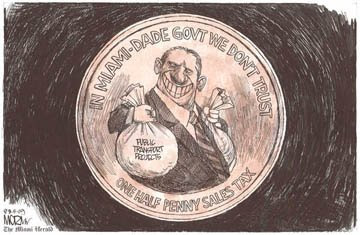 Terrific cartoon today by Jim Morin. It goes with my blog of yesterday on transit. One question: Shouldn't the record be broken Jim?
 Columnist Fred Grimm Looks at Lobbyist Ron Book. Book said about 48 sex offenders living under a bridge: “There are people convicted for other offenses who have similar difficulty finding housing.” Grimm says: “Except other convicts aren't forced to live under a bridge.”
And, one of my worst nightmares has come true: Pretty Boy Marco Rubio is running for the U.S. Senate. ICK.
Coral Gables Candidate Gonzalo Sanabria Voted to Move the Urban Development Boundary Line Again and Again. By Geniusofdespair
 On 11/14/05 Gonzalo Sanabria made a speech at the Planning Advisory Board meeting discounting Hold the Line (HTL). He said that Brown (one of the applications to move the Urban Development Boundary line) had 2,000 petitions and Gonzalo said that in comparison, HTL had the same 5, 6 or 7 people speaking all the time. He said maybe when HTL can come with 2,000 signatures we will listen to them. In fact, I don’t think Gonzalo ever knew, Coral Gables was a member of Hold the Line.
 Communities joined HTL because with billions of dollars of unfunded and deteriorating infrastructure within the line, they did not want to further strain the budget by going outside the line. They wanted to catch up within the line first.
You would think while Gonzalo Sanabria was a member of the Planning Advisory Board, considering he lived and worked in Coral Gables, that he would have the interest of his hometown in his heart. He voted exactly opposite of Christi Sherouse (on every single vote to move the UDB Line). He voted to move the Urban Development Boundary, Christi voted not to. Heck, he didn't only vote he also argued in favor of most of the applications. He and Christi argued with each other during the preliminary meeting 11/14/05 and the final meeting on 3/30/06.
Christi Sherouse was representing the County Commissioner of Coral Gables: Gonzalo was representing the district including Aventura, Bal Harbor, Bay Harbor Islands, North Miami, North Miami Beach, Surfside, Sunny Isles and some of Miami Beach for Former County Commission Chair Gwen Margolis, then Sally Heyman. The Planning Advisory Board Members do not have to live in the district they represent. But, Gonzalo, you should note that North Miami, North Miami Beach, Surfside, Aventura, Miami Beach, Bal Harbor and Bay Harbor Islands were all members of Hold the Line. You were representing these cities on the Planning Advisory Board. You didn't even vote the same way as the Commissioner who you were representing. I think you agreed on one application: Hialeah. The rest, you voted to move the line and Sally Heyman voted no. Exactly who were your representing?
During the final vote 3/30/06, Gonzalo Sanabria voted in favor of every application to move the UDB line. He even argued in favor of the Doral West Commerce Park application in November, which was a half-hearted application at best, no one else was giving it much support. I think it might have been withdrawn but I am not sure.
Hey Gonzalo, if I heard you right, you argued that the Hialeah application would create 16,000 jobs. Have you checked on that lately? Follow-up is important. You also were voting for the Lowes Big Box Store application, you said based on the promise that they were going to sell the school board/charter school land for a new school. There was nothing in writing on that promise either. And, if the line was moved and the school board/charter school did not use the land, Lowe’s would have been free to use the land for other purposes. How do I know this? I sat in at the Administrative Hearings this year, Lowe's admitted as much.

It is dangerous to make such important votes on promises. Christi Sherouse didn’t vote like you did on any of the applications, she represented Coral Gables well. She listened, she held the line.
Wednesday, March 04, 2009
City of Miami: Marlins Meeting Set for Friday has been Canceled. By Geniusofdespair
The Friday meeting at Miami City Hall to vote on the Marlin Baseball Stadium deal has been canceled. Another meeting has been set, according to Commissioner Sarnoff, it is March 19th.
Speaking of other stuff...The Miami Herald is said to be facing another 20 percent reduction in staff. I was told department chiefs must make their decision by Friday. Pay cuts and furloughs are likely for those left behind. Ick.
Speaking of other stuff...The Miami Herald is said to be facing another 20 percent reduction in staff. I was told department chiefs must make their decision by Friday. Pay cuts and furloughs are likely for those left behind. Ick.
The County Commission has Voted to Divert our Transit Tax Dollars. by Geniusofdespair
 This article has me so angry today, I couldn’t even eat breakfast: Miami-Dade changes policy on spending of half-cent tax for transit. Herald Transit Reporter, Larry Lebowitz said:
Under the plan approved on Tuesday, all of the Metrorail expansion projects and new bus service that voters approved in 2002 would become aspirational goals, not mandatory requirements. This will give county managers more freedom to use a large chunk of sales-tax proceeds for routine transit agency operations and maintenance, as long as 10 percent of the net proceeds are set aside each year for capital expansion.
I actually agree with County Commissioner Joe Martinez on this one:
“I will do whatever I can to repeal this half-percent tax.”
Thank you Commissioners Rebeca Sosa, Joe Martinez and Carlos Gimenez for voting against this betrayal of the public trust. And, to the rest of you, why didn’t you listen to Carlos Gimenez when he said:
“As a government, we need to abide by our word, even if it hurts.”
News Flash from Paris, France ... by gimleteye
While we are all fretting when the economy will revive, it's good to know where the sun is shining. From our correspondent:
"At the Hotel Meurice waiting for a cab. Watching a Gulf State royal family's luggage being unloaded out of 3 trucks. Not vans. Trucks with hydraulic loading platforms. A dozen black Mercedes Benz and men in black with earphones circling like hornets around a nest."
"At the Hotel Meurice waiting for a cab. Watching a Gulf State royal family's luggage being unloaded out of 3 trucks. Not vans. Trucks with hydraulic loading platforms. A dozen black Mercedes Benz and men in black with earphones circling like hornets around a nest."
Trivial pursuits: the Blue Monsters ... by gimleteye
OK. There are at least two subjects worth commenting on, today, from The Miami Herald: first, the editorial page finally woke up to the machinations of the Growth Machine trying to manipulate the Florida legislature to do what it couldn't achieve under two terms of former Gov. Jeb Bush; dismantle once and for all growth management in the state of Florida.
Under the Republican's incredibly idiotic conception, wetlands regulations are responsible for the housing market collapse. That's right: eliminate regulations is the answer. That's how the red state legislature intends to fix Florida, a state that lost 84,000 acres of wetlands between 1998 and 2005 during a period of no-net loss of wetlands. The timid Herald editorial board could have used a sharper pencil in its broadside: why won't it? But these Capitol Idiocrats are not today's target of ire.
Second, the Herald coverage of the imploding deal for the Marlin's professional baseball stadium is also gathering steam. The newspaper is encouraging local elected officials to acknowledge the new era of fiscal reality we have been clamoring about on our blog, for seemingly ever. But I don't want to write about the pro-stadium Idiocrats on the city and county commissions (mayors, too).
I want to write about another manifestation of the Idiocracy. A subject that deserves to be pushed up through the news blizzard: the pathetic parking meters used by the City of Miami and Miami Beach. Parking meters? The question of the day: are these oft-malfunctioning parking meters, dismal-looking and weather-beaten, a side business of tow truck companies?
I picture cubicles filled with fat, overweight guys sitting behind steel grey desks with complaint telephones in one hand and dispatch walkie-talkies in the other. ("Yeah, Marco, we got a couple of blue monsters that ain't workin over on NE 2nd. Send over my brother-in-law. He needs the work.")
I'm talking about the blue electronic monsters that eat your credit card, wrecking the magnetic striping, and print out a white receipt you put on your dashboard. Anyhow, there are slight variations among the machines, but they malfunction identically.
You put your credit card in (many cannot take dollar bills) and a couple of things happen with increasing frequency: first, the LED readout is illegible. Second, as often as not the electronic reader mis-reads the credit card information. Third, after waiting seemingly interminable amounts of time, the machine yields your credit card back but has ripped at the magnetic striping in the meantime. This really pisses me off: not only has the machine failed to read your perfectly good credit card but it has started the process of ruining the card at the same time; requiring you to now call your credit card company ("please touch tone or speak your 92 digit card number now") to get a new card that will be promptly marred by the first blue monster you slide the new card into.
When the blue meters appeared on the streets of Miami, several years ago, I thought; finally, Miami is showing a single example to the world that we belong in the developed world. It was the same kind of feeling as when Miami International Airport finally allowed rental luggage carts ("Smart Cartes"), after County Commissioner Natacha Seijas had held up the contract for years because the company didn't use her favorite lobbyists.
So how about it, Mayor Diaz. A week ago, President Obama, speaking of the trillion dollar fiscal stimulus, cautioned you and the cities of America, "don't screw this up". Let's see if you and Miami Beach can fix your electronic parking meters. Or does that set the bar too high?
Under the Republican's incredibly idiotic conception, wetlands regulations are responsible for the housing market collapse. That's right: eliminate regulations is the answer. That's how the red state legislature intends to fix Florida, a state that lost 84,000 acres of wetlands between 1998 and 2005 during a period of no-net loss of wetlands. The timid Herald editorial board could have used a sharper pencil in its broadside: why won't it? But these Capitol Idiocrats are not today's target of ire.
Second, the Herald coverage of the imploding deal for the Marlin's professional baseball stadium is also gathering steam. The newspaper is encouraging local elected officials to acknowledge the new era of fiscal reality we have been clamoring about on our blog, for seemingly ever. But I don't want to write about the pro-stadium Idiocrats on the city and county commissions (mayors, too).
I want to write about another manifestation of the Idiocracy. A subject that deserves to be pushed up through the news blizzard: the pathetic parking meters used by the City of Miami and Miami Beach. Parking meters? The question of the day: are these oft-malfunctioning parking meters, dismal-looking and weather-beaten, a side business of tow truck companies?
I picture cubicles filled with fat, overweight guys sitting behind steel grey desks with complaint telephones in one hand and dispatch walkie-talkies in the other. ("Yeah, Marco, we got a couple of blue monsters that ain't workin over on NE 2nd. Send over my brother-in-law. He needs the work.")
I'm talking about the blue electronic monsters that eat your credit card, wrecking the magnetic striping, and print out a white receipt you put on your dashboard. Anyhow, there are slight variations among the machines, but they malfunction identically.
You put your credit card in (many cannot take dollar bills) and a couple of things happen with increasing frequency: first, the LED readout is illegible. Second, as often as not the electronic reader mis-reads the credit card information. Third, after waiting seemingly interminable amounts of time, the machine yields your credit card back but has ripped at the magnetic striping in the meantime. This really pisses me off: not only has the machine failed to read your perfectly good credit card but it has started the process of ruining the card at the same time; requiring you to now call your credit card company ("please touch tone or speak your 92 digit card number now") to get a new card that will be promptly marred by the first blue monster you slide the new card into.
When the blue meters appeared on the streets of Miami, several years ago, I thought; finally, Miami is showing a single example to the world that we belong in the developed world. It was the same kind of feeling as when Miami International Airport finally allowed rental luggage carts ("Smart Cartes"), after County Commissioner Natacha Seijas had held up the contract for years because the company didn't use her favorite lobbyists.
So how about it, Mayor Diaz. A week ago, President Obama, speaking of the trillion dollar fiscal stimulus, cautioned you and the cities of America, "don't screw this up". Let's see if you and Miami Beach can fix your electronic parking meters. Or does that set the bar too high?
Tuesday, March 03, 2009
When will the Marlin's deal be dead? by gimleteye
We're all having to cut back. Here's how I would spend $600 million of tourism-based tax dollars: first, I'd lobby the Florida legislature to expand the definition of projects that can received funding from tourism tax dollars. Look: we've pretty much destroyed the natural attractions of the state of Florida that lured so many millions of people to the state in the first place. Isn't it time we invested in neighborhoods in urban areas to improve our quality of life, to build and fund parks where parks don't exist? How about community "Victory" gardens? Have you noticed how you are spending the same amount in grocery stores for food, that keeps coming in smaller and smaller packages? The time for Miamians to be growing our own food is NOW.
And who could use Victory Gardens more than the poor people in Michelle Spence Jones' district? I don't blame the city commissioner at all, for wanting as much for her district as the Marlins want to take out of the public pockets, for their shareholders. And I hope she doesn't cut a deal.
The same principles of fairness and equity should have been applied to the Performing Arsht Center: local communities should have received, dollar for dollar, funding for school programs for the arts as went into concrete there.
Misplaced public priorities have cost Floridians dearly, lining the pockets of private corporations/ campaign contributors and their teams of lobbyists. (Parcel B, anyone?) Maybe, what we are seeing with the obstruction of a new professional baseball stadium is a public acknowledgment of economic reality. And maybe it is time for cart to stop driving the horses, and for the needs of taxpayers to be better represented by public investments in our quality of life and the public commons.
And who could use Victory Gardens more than the poor people in Michelle Spence Jones' district? I don't blame the city commissioner at all, for wanting as much for her district as the Marlins want to take out of the public pockets, for their shareholders. And I hope she doesn't cut a deal.
The same principles of fairness and equity should have been applied to the Performing Arsht Center: local communities should have received, dollar for dollar, funding for school programs for the arts as went into concrete there.
Misplaced public priorities have cost Floridians dearly, lining the pockets of private corporations/ campaign contributors and their teams of lobbyists. (Parcel B, anyone?) Maybe, what we are seeing with the obstruction of a new professional baseball stadium is a public acknowledgment of economic reality. And maybe it is time for cart to stop driving the horses, and for the needs of taxpayers to be better represented by public investments in our quality of life and the public commons.
It's your water, and they get rich from it ... by gimleteye
It's good to be in the bottled water business in Florida, not in the business of protecting water. Not that protecting water is a business in Florida. There is a business "protecting" water, but it's mainly the business of protecting water from rules and regulations (ie. lobbyists), exploiting water resources (ie. big engineering firms), digging wells (ie. well drillers), doing "environmental law" (ie. Greenberg Traurig), or providing equipment to provide industrial processes to provide what nature did for free.
The deeper you dig into the business of water the dirtier it gets. For more than a decade, Miami Dade county commissioner Natacha Seijas single-handedly held back public investment in necessary water infrastructure just to accommodate campaign contributors from the building industry who didn't want the "high" cost of water to the public to deter their plans to build out Miami Dade County with suburban sprawl. The public has no clue. But back to bottled water.
According to this morning's Herald, the companies that produce bottled water make between 10 and 100 times their fixed costs. There is no cost for extracting water to put in bottles, except a permit fee of a few hundred dollars. Never mind the hidden costs of the carbon footprint of bottle water: shipping around the state and the world in expensive containers made from petrochemicals, using oil and gas to move the bottles here and there.
Governor Charlie Crist is ready to make the bottled water companies pay more, a tax of $.06 for every gallon of water they take from limited aquifers. "The thinking behind the plan is water is available for all of us and we pay taxes and water bills to provide it, but when we choose to spend a buck for a bottle of Florida water, not a cent of that dollar goes to Florida. The company who pumped the water out of the ground didn't pay the state for it either. That is untapped cash that Florida sees a need to go after. All that water that comes out of Florida rivers and out of the ground you pay for."
What do you think?
Posted on Tue, Mar. 03, 2009
Charlie Crist wants to stop free flow for bottled water
By MARY ELLEN KLAS
In a rural North Florida town where the water tower bears the motto ''Tiny but Proud,'' residents have a big secret: They give the cold, clear spring water that bubbles up from the aquifer below their soil to the nation's largest bottled-water company -- for free.
Every day, Nestlé Waters of North America sucks up an estimated 500,000 gallons from Madison Blue Springs, a limestone basin one mile north of town. It pipes the 70-degree water a mile to its massive bottling plant and distribution center, fills 102,000 plastic containers an hour, pastes on Deer Park or Zephyrhills labels, boxes it up and ships half of it out of state.
The cost to the company for the water: a one-time, $150 local water permit.
Like 22 other bottled-water companies in Florida, including giants Coca-Cola and Pepsi Co., Nestlé's profit is 10 to 100 times the cost of each bottle.
Payment to Florida? Not a dime.
Gov. Charlie Crist wants to change that. He is proposing a 6-cents-a-gallon state tax on water used for commercial water-bottling purposes.
''It's a resource of the state and if you're going to withdraw it for a profit, we should charge you for that use,'' said Mike Sole, secretary of the Department of Environmental Protection, which has been developing Crist's proposal for six months.
The agency estimates the fee would apply to about 5.4 million gallons a day -- the amount it believes is pumped from state springs and aquifers by bottlers that include Coca-Cola's Dasani and Publix. The estimate does not include the water taken by bottlers from municipal water supplies.
The ''severance fee'' would be phased in to raise an estimated $56 million the first year, according to the governor's office. The money would be used to finance water projects, such as desalination plants and other alternatives to traditional water supplies. Making the money even more attractive: The fund that currently finances those projects faces a $15 million deficit since the tax dedicated to water projects dried up in the real-estate crash.
If the fee is passed on to consumers, the cost of a pint-size bottle of water would increase by less than a penny.
A SHIFT
It's a major shift in position for the department, prompted by Crist, which until December had collected no data on bottled-water use in Florida and takes a hands-off approach to its regulation. The Florida Department of Agriculture's Division of Food Safety makes sure bottlers have approval from local water-management districts to withdraw the water, but no state agency tests bottled water. Crist's proposal wouldn't change that.
Instead, Crist's plan would treat water like phosphate, oil or natural gas, all mined from the ground. Companies that extract those natural resources from which they profit pay fees or royalties to the state. Nestlé and other bottled-water users say it is unfair to single them out from all the public and private water users who extract what the Department of Environmental Protection estimates is four billion gallons of spring water from Florida's aquifers each day.
''I don't see how we're different from the agriculture users which, just a few miles from here, have 30 irrigation pivots draining more water than we are,'' said Rob Fisher, who runs the Blue Springs plant and is director of operations for Nestlé's southwest region.
Bottled water ''isn't a luxury, it's a choice,'' he argues, ``and during times of natural disaster, it's a necessity.''
States, including Vermont and Michigan, already impose user fees on bottled-water companies, while Massachusetts has begun debating a ban on extracting water for commercial uses.
The idea isn't completely new to Florida. In 2005, House Democratic Leader Franklin Sands of Weston proposed legislation imposing a fee on bottled water but the measure was killed in the Senate.
''The water belongs to the people,'' Sands said. ``If you take the people's water, it's about time we compensate them for it.''
Throughout the nation, the bottled water industry is under increasing attack. At the annual meeting of the U.S. Conference of Mayors in Miami last June, mayors adopted a resolution to encourage cities ``to phase out, where feasible, government use of bottled water and promote the importance of municipal water.''
Among the reasons cited: Most cities produce high quality, safe drinking water while bottled-water production consumes 17 million barrels of oil per year and plastic water bottles ''are one of the fastest growing sources of municipal waste.'' The Environmental Protection agency estimates state landfills collect 1.7 billion bottles per year.
The industry fired back, arguing that Environmental Protection reports that production of plastic water bottles contributes only 0.04 percent of total greenhouse-gas emissions and make up only one-third of 1 percent of the waste stream in the United States.
ECONOMIC IMPACT
Florida's dire economy has some Republicans also ready to change the rules on bottled water. Sen. Evelyn Lynn, an Ormond Beach Republican, has filed a bill to impose the state's 6-cent sales tax on bottled water at the point of sale.
She considers bottled water a luxury and objects to Florida water managers restricting water use by homeowners when the state is ``handing out permits for major bottling companies to bottle as much as they want.''
A companion bill is being pushed by Rep. Michele Rehwinkle-Vasilinda, a Tallahassee Democrat. Economists say that if the state applies the 6-cent sales tax to every bottle of water consumed in Florida, it could raise about $42 million.
Sen. Thad Altman, a Melbourne Republican who chairs the Senate Finance and Tax Committee, has launched a review of all sales-tax exemptions to determine which should be eliminated, including the exemption on bottled water.
''It would be hard to argue that if you tax bottled water you lose Florida jobs,'' he said. ``Does it impede competition? No. Does removing the tax put Florida business at a disadvantage? I don't think so.''
Nestlé's Fisher argues that water bottling is a clean industry. Nestlé employs 1,000 people statewide. Its plant in Madison County has been certified as the largest ''green'' building operation in Florida, and the plant has won numerous productivity and job-safety awards.
The plant also pays more than $650,000 in property taxes each year, proof that the state is getting something in return for the water, company officials say.
''We're an easy target,'' said Jim McClellan, spokesman for Nestlé's in Florida.
He notes how bottled water has become essential when pipes are ruptured, there's a boil-water order or a hurricane cuts off a community water source.
''It makes no sense to take the healthiest packaged beverage on the market today, subject it to an onerous tax and not apply it to any other beverage,'' McClellan said. Environmentalists disagree.
''Most people won't see this as an unfair tax,'' said Eric Draper of the Florida Audubon Society. ``It makes a lot of sense and we need the money for alternative water supply and pollution treatment.''
State Rep. Will Weatherford, a Wesley Chapel Republican whose district includes Nestlé's Zephyrhills bottling plant, said he believes the House will be less open to imposing new taxes on bottled water than the governor and Senate. ``We want to be careful not to single out any industry.''
Crist, who has carefully avoided being associated with tax increases, could be spared from repercussions on this one, Draper predicts: ``This will be very popular with ordinary people who do see that these companies are taking something for free and putting it in bottles and charging a lot more.''
Mary Ellen Klas can be reached at
meklas@miamiherald.com
© 2009 Miami Herald Media Company. All Rights Reserved.
http://www.miamiherald.com
The deeper you dig into the business of water the dirtier it gets. For more than a decade, Miami Dade county commissioner Natacha Seijas single-handedly held back public investment in necessary water infrastructure just to accommodate campaign contributors from the building industry who didn't want the "high" cost of water to the public to deter their plans to build out Miami Dade County with suburban sprawl. The public has no clue. But back to bottled water.
According to this morning's Herald, the companies that produce bottled water make between 10 and 100 times their fixed costs. There is no cost for extracting water to put in bottles, except a permit fee of a few hundred dollars. Never mind the hidden costs of the carbon footprint of bottle water: shipping around the state and the world in expensive containers made from petrochemicals, using oil and gas to move the bottles here and there.
Governor Charlie Crist is ready to make the bottled water companies pay more, a tax of $.06 for every gallon of water they take from limited aquifers. "The thinking behind the plan is water is available for all of us and we pay taxes and water bills to provide it, but when we choose to spend a buck for a bottle of Florida water, not a cent of that dollar goes to Florida. The company who pumped the water out of the ground didn't pay the state for it either. That is untapped cash that Florida sees a need to go after. All that water that comes out of Florida rivers and out of the ground you pay for."
What do you think?
Posted on Tue, Mar. 03, 2009
Charlie Crist wants to stop free flow for bottled water
By MARY ELLEN KLAS
In a rural North Florida town where the water tower bears the motto ''Tiny but Proud,'' residents have a big secret: They give the cold, clear spring water that bubbles up from the aquifer below their soil to the nation's largest bottled-water company -- for free.
Every day, Nestlé Waters of North America sucks up an estimated 500,000 gallons from Madison Blue Springs, a limestone basin one mile north of town. It pipes the 70-degree water a mile to its massive bottling plant and distribution center, fills 102,000 plastic containers an hour, pastes on Deer Park or Zephyrhills labels, boxes it up and ships half of it out of state.
The cost to the company for the water: a one-time, $150 local water permit.
Like 22 other bottled-water companies in Florida, including giants Coca-Cola and Pepsi Co., Nestlé's profit is 10 to 100 times the cost of each bottle.
Payment to Florida? Not a dime.
Gov. Charlie Crist wants to change that. He is proposing a 6-cents-a-gallon state tax on water used for commercial water-bottling purposes.
''It's a resource of the state and if you're going to withdraw it for a profit, we should charge you for that use,'' said Mike Sole, secretary of the Department of Environmental Protection, which has been developing Crist's proposal for six months.
The agency estimates the fee would apply to about 5.4 million gallons a day -- the amount it believes is pumped from state springs and aquifers by bottlers that include Coca-Cola's Dasani and Publix. The estimate does not include the water taken by bottlers from municipal water supplies.
The ''severance fee'' would be phased in to raise an estimated $56 million the first year, according to the governor's office. The money would be used to finance water projects, such as desalination plants and other alternatives to traditional water supplies. Making the money even more attractive: The fund that currently finances those projects faces a $15 million deficit since the tax dedicated to water projects dried up in the real-estate crash.
If the fee is passed on to consumers, the cost of a pint-size bottle of water would increase by less than a penny.
A SHIFT
It's a major shift in position for the department, prompted by Crist, which until December had collected no data on bottled-water use in Florida and takes a hands-off approach to its regulation. The Florida Department of Agriculture's Division of Food Safety makes sure bottlers have approval from local water-management districts to withdraw the water, but no state agency tests bottled water. Crist's proposal wouldn't change that.
Instead, Crist's plan would treat water like phosphate, oil or natural gas, all mined from the ground. Companies that extract those natural resources from which they profit pay fees or royalties to the state. Nestlé and other bottled-water users say it is unfair to single them out from all the public and private water users who extract what the Department of Environmental Protection estimates is four billion gallons of spring water from Florida's aquifers each day.
''I don't see how we're different from the agriculture users which, just a few miles from here, have 30 irrigation pivots draining more water than we are,'' said Rob Fisher, who runs the Blue Springs plant and is director of operations for Nestlé's southwest region.
Bottled water ''isn't a luxury, it's a choice,'' he argues, ``and during times of natural disaster, it's a necessity.''
States, including Vermont and Michigan, already impose user fees on bottled-water companies, while Massachusetts has begun debating a ban on extracting water for commercial uses.
The idea isn't completely new to Florida. In 2005, House Democratic Leader Franklin Sands of Weston proposed legislation imposing a fee on bottled water but the measure was killed in the Senate.
''The water belongs to the people,'' Sands said. ``If you take the people's water, it's about time we compensate them for it.''
Throughout the nation, the bottled water industry is under increasing attack. At the annual meeting of the U.S. Conference of Mayors in Miami last June, mayors adopted a resolution to encourage cities ``to phase out, where feasible, government use of bottled water and promote the importance of municipal water.''
Among the reasons cited: Most cities produce high quality, safe drinking water while bottled-water production consumes 17 million barrels of oil per year and plastic water bottles ''are one of the fastest growing sources of municipal waste.'' The Environmental Protection agency estimates state landfills collect 1.7 billion bottles per year.
The industry fired back, arguing that Environmental Protection reports that production of plastic water bottles contributes only 0.04 percent of total greenhouse-gas emissions and make up only one-third of 1 percent of the waste stream in the United States.
ECONOMIC IMPACT
Florida's dire economy has some Republicans also ready to change the rules on bottled water. Sen. Evelyn Lynn, an Ormond Beach Republican, has filed a bill to impose the state's 6-cent sales tax on bottled water at the point of sale.
She considers bottled water a luxury and objects to Florida water managers restricting water use by homeowners when the state is ``handing out permits for major bottling companies to bottle as much as they want.''
A companion bill is being pushed by Rep. Michele Rehwinkle-Vasilinda, a Tallahassee Democrat. Economists say that if the state applies the 6-cent sales tax to every bottle of water consumed in Florida, it could raise about $42 million.
Sen. Thad Altman, a Melbourne Republican who chairs the Senate Finance and Tax Committee, has launched a review of all sales-tax exemptions to determine which should be eliminated, including the exemption on bottled water.
''It would be hard to argue that if you tax bottled water you lose Florida jobs,'' he said. ``Does it impede competition? No. Does removing the tax put Florida business at a disadvantage? I don't think so.''
Nestlé's Fisher argues that water bottling is a clean industry. Nestlé employs 1,000 people statewide. Its plant in Madison County has been certified as the largest ''green'' building operation in Florida, and the plant has won numerous productivity and job-safety awards.
The plant also pays more than $650,000 in property taxes each year, proof that the state is getting something in return for the water, company officials say.
''We're an easy target,'' said Jim McClellan, spokesman for Nestlé's in Florida.
He notes how bottled water has become essential when pipes are ruptured, there's a boil-water order or a hurricane cuts off a community water source.
''It makes no sense to take the healthiest packaged beverage on the market today, subject it to an onerous tax and not apply it to any other beverage,'' McClellan said. Environmentalists disagree.
''Most people won't see this as an unfair tax,'' said Eric Draper of the Florida Audubon Society. ``It makes a lot of sense and we need the money for alternative water supply and pollution treatment.''
State Rep. Will Weatherford, a Wesley Chapel Republican whose district includes Nestlé's Zephyrhills bottling plant, said he believes the House will be less open to imposing new taxes on bottled water than the governor and Senate. ``We want to be careful not to single out any industry.''
Crist, who has carefully avoided being associated with tax increases, could be spared from repercussions on this one, Draper predicts: ``This will be very popular with ordinary people who do see that these companies are taking something for free and putting it in bottles and charging a lot more.''
Mary Ellen Klas can be reached at
meklas@miamiherald.com
© 2009 Miami Herald Media Company. All Rights Reserved.
http://www.miamiherald.com
Monday, March 02, 2009
Marlins: Mayor Carlos Alvarez is Dropping the Ball. By Geniusofdespair
I have instructed the County Manager not to expend or exhaust further resources or time into the Marlins Baseball Stadium agreements.
Is he playing "Hard Ball"? (sorry can't help it). Hit read more to see Mayor Carlos Alvarez' full statement to County Commission Chair Dennis Moss:
I have long believed that there is a justifiable cause for a government partnership in the management and construction of a baseball facility in Miami-Dade County. Baseball is an important part of our community fabric and a stadium that protects taxpayers’
interests is a worthy project. I have never wavered from that position and I stand by it today.
Miami-Dade County, the City of Miami and the Marlins have spent thousands of hours
hashing out five complex agreements to ensure Major League Baseball has a future in
South Florida. All parties have made concessions and negotiated in good faith. The
deal that our elected officials and residents have been reviewing over the last few
weeks is sound and strong. The project will create hundreds of jobs through 2012, and
help carry one of our core industries and top employment sectors through a historic
downturn. Market forces make this an ideal time to purchase construction materials and services. The financing is based on conservative projections over 35 years, based on the indisputable fact that South Florida remains well-positioned for long term growth and success. The costs have been independently verified as reasonable, risk has been mitigated, and we have forced the team to increase its financial and social contributions.
The deal is good, but the politics are bad.
Sincere and earnest work and meticulous and deliberate negotiations have been
hijacked. The best of intentions have morphed into unreasonable demands that have
nothing to do with baseball. Political grandstanding, the dissemination of half-truths and intellectually dishonest assumptions are rampant. Is there room for further discussion, scrutiny and additional give and take? Yes. However, the art of negotiation is being mocked. It is wrong to exploit the public’s keen interest in baseball in this way. The politicking on the stadium, frankly, has become a distraction.
I have instructed the County Manager not to expend or exhaust further resources or
time into the Marlins Baseball Stadium agreements. While we have never worked on
the ballpark project at the expense of other priority projects, we have other pressing
issues, including making the best use of federal economic stimulus dollars and
preparing a balanced budget for FY 2009-2010.
The fate of the proposed Marlins ballpark is in the hands of the Miami City Commission.
Until the City fully vets the Baseball Stadium Agreements and holds a comprehensive
set of votes on all elements of the proposal, I cannot support the process moving
forward. I would hope that we, as a community, demonstrate that we welcome
investment and can do business responsibly, with the acumen, integrity and panache
that a deal of this magnitude deserves.
Is he playing "Hard Ball"? (sorry can't help it). Hit read more to see Mayor Carlos Alvarez' full statement to County Commission Chair Dennis Moss:
I have long believed that there is a justifiable cause for a government partnership in the management and construction of a baseball facility in Miami-Dade County. Baseball is an important part of our community fabric and a stadium that protects taxpayers’
interests is a worthy project. I have never wavered from that position and I stand by it today.
Miami-Dade County, the City of Miami and the Marlins have spent thousands of hours
hashing out five complex agreements to ensure Major League Baseball has a future in
South Florida. All parties have made concessions and negotiated in good faith. The
deal that our elected officials and residents have been reviewing over the last few
weeks is sound and strong. The project will create hundreds of jobs through 2012, and
help carry one of our core industries and top employment sectors through a historic
downturn. Market forces make this an ideal time to purchase construction materials and services. The financing is based on conservative projections over 35 years, based on the indisputable fact that South Florida remains well-positioned for long term growth and success. The costs have been independently verified as reasonable, risk has been mitigated, and we have forced the team to increase its financial and social contributions.
The deal is good, but the politics are bad.
Sincere and earnest work and meticulous and deliberate negotiations have been
hijacked. The best of intentions have morphed into unreasonable demands that have
nothing to do with baseball. Political grandstanding, the dissemination of half-truths and intellectually dishonest assumptions are rampant. Is there room for further discussion, scrutiny and additional give and take? Yes. However, the art of negotiation is being mocked. It is wrong to exploit the public’s keen interest in baseball in this way. The politicking on the stadium, frankly, has become a distraction.
I have instructed the County Manager not to expend or exhaust further resources or
time into the Marlins Baseball Stadium agreements. While we have never worked on
the ballpark project at the expense of other priority projects, we have other pressing
issues, including making the best use of federal economic stimulus dollars and
preparing a balanced budget for FY 2009-2010.
The fate of the proposed Marlins ballpark is in the hands of the Miami City Commission.
Until the City fully vets the Baseball Stadium Agreements and holds a comprehensive
set of votes on all elements of the proposal, I cannot support the process moving
forward. I would hope that we, as a community, demonstrate that we welcome
investment and can do business responsibly, with the acumen, integrity and panache
that a deal of this magnitude deserves.
The secret diaries of AC Weinstein … by gimleteye
 The stack of unwrapped newspapers outside his condominium on Miami Beach alerted neighbors something was amiss. Last week AC Weinstein, 62, died of an apparent heart attack. AC was chief of staff to successive mayors of Miami Beach. But prior to being a city hall insider — he was a columnist and muckraker, not just here (Sunpost) but also in Key West; an astringent observer of daily political life. He proceeded from skepticism on points of human nature and assumed nothing was as it seems. When he moved to Miami Beach, nearly 20 years ago, it didn't take him long to decode the sharp elbows and monied agendas of politicians and contributors to political campaigns from the real estate development industry. On the blogs, his passing elicited praise, vitriol, and other worldly notes. The photos in the latest edition of Sunpost of AC, accompanied by a broad banner headline, “Farewell”, were fuzzy and out of focus. That is how most people knew him: a man enigma served well.
The entrepreneurial side of AC swerved toward editorial journalism, more to action than passive observing. He wasn't a fan of the mainstream media, that he believed acted mostly as maid servant to wealthy special interests. To people he didn’t like or thought were dumb, he could be short, nasty, and brutish. But that was his form of push-back against the corruption that can grow like kudzu in local politics unless it is constantly cut back. There are no classes in college to understand how this works, or how the news is scarcely reported. Public indifference to political life leaves plenty of space for people with no skin in the game and for reporting from the front line.
I knew AC from his earlier incarnation in Key West, where we both lived for a time. He hosted a local cable television show, “Eye on the Keys”. He roosted in city commission meetings, observing in print, too, far more than bigwigs wanted; either in the mainstream press or political office.
I was advocating for environmental causes in the Keys; water quality, sea grass destruction, terrible land use planning, etc. and eventually had a TV show on the same local cable channel that followed his time slot. AC didn't warm quickly to environmental issues; there just seemed to be so much more that counted. But when he saw how they were wrapped up in the business of money and electoral politics, he grew curious. That side of the world fit the cut of his jib.
It had been a long time since we last saw each other, last spring. I called to invite him to lunch. He was pleased to take my call. Mayor David Dermer had been a great help on the Urban Development Boundary issues, that pitted wild-eyed radical property speculators who commandeered county hall against municipalities struggling to match budgets to needs. AC said he had followed my career. We laughed. He asked if there was anything I needed. On an impulse, I told AC my kids are all surfers and grew up surfing on 1st Street. I told AC, only my youngest is still at home and if I could have a key to the city, he might think all this civic work is for more than the birds. He said, he'd talk to the mayor and we arranged a date for lunch.
We met at the Ice Box, a sidewalk café off Lincoln Road. It didn’t bother him much that every other passerby paused to shake his hand and say, I’ll call you. We shared stories of the characters who have mostly passed from the political scene, retired, or who went from the scene to white collar jail, and marveled how each of our paths had stumbled forward from Key West hot house to Miami, a city strange to both of us when we arrived.
AC came from a television and advertising background. He had that spirit that takes root in a specific time and politics of a place; not reaching for bright colors of novels that may fly off shelves or gather dust.
Over lunch, he confided -- a little shyly-- that he had written every day of his life, stretching back to Key West in a journal comprising “thousands of pages”. He said, he had 'written it all down'. It came out sounding like every particular, every detail of fact and his fervid imagination had been etched in long-hand; a diarist and Samuel Pepys for our time. Now I knew AC well enough to know he could bullshit with the best; it was partly his calling card. But news of his secret diaries didn't come out as trumped up fiction.
To the contrary. I asked if he had shown the journals to anyone. He mumbled about a friend, a NY publisher who was excited, but that the work of editing etc. would wait for his retirement. Then he paused to shake someone else’s hand.
At the end of lunch, after AC had paid his half and we were saying goodbye, he said; oh one more thing and pulled from his pocket a little blue box. I opened it. Inside, there was a key to the City of Miami Beach. We shook hands. I said, let’s get together soon. It was fun. It really was fun, too.
I hope AC's diaries are found and are published. It would be a shame for them to pass, only to urban legend.
Citizen: You are about to get screwed...Again. By Geniusofdespair
 As reporter Curtis Morgan said: Call it Jobs vs. Environment. I call that "bullshit. Jobs are a diverting tactic." According to the article:
“To light a fire under the frozen economy, some lawmakers are seeking to "streamline" a slew of environmental and growth regulations. Proposals call for erasing or weakening everything from wetlands and wildlife protections to requirements that developers improve roads to handle the traffic glut of new projects.” And, Morgan says:
“Environmental groups and the Florida League of Cities warn that the moves could produce more of the uncontrolled sprawl that earned foreclosure-ridden Florida the 'Ponzi State' label in a recent New Yorker magazine piece.”
This sucks. See Gimleteye’s blog about this yesterday. It appears the Miami Herald reported it, a day later. Get the contact information for your Senator with this link. And here is more info on Senate Bill 360:
While 1000 Friends supports many of the concepts underlying the bill, especially incentivizing and stimulating growth in urban areas, we have serious concerns that SB 360 would stimulate sprawl in suburban and rural areas as well. In a nutshell, in those cities and counties with more than 1000 people per square mile or more than 1 million in population, SB 360 would:
Eliminate Development of Regional Impact (DRI) review.
Eliminate Transportation Concurrency requirements.
Eliminate Department of Community Affairs (DCA) Plan Amendment review.
Provide for only one local public hearing for development projects.
1000 Friends agrees that these measures are appropriate to promote infill development in truly urban areas in Florida and would support such legislation. However, SB 360’s “1000 people/per square mile” criterion promotes unchecked development in vast swatches of fringe and rural lands. Using this definition, the above exemptions would be applied to:
All development projects in Broward, Duval, Hillsborough, Miami-Dade, Orange, Palm Beach and Seminole Counties.
All development projects within the incorporated areas of as many as 270 municipalities in Florida, ranging from tiny Arcadia to Tallahassee to Naples. (There are some exemptions for those parts of communities that are in the Coastal High Hazard Area and other special planning areas).
For certain development projects in areas designated as Rural Areas of Critical Economic Concern (these would not require DCA reviews of plan amendments).
Promoting appropriate infill in Florida’s urban areas is an important tool in efforts to limit sprawl and protect this state’s rapidly vanishing rural lands. 1000 Friends would support well-crafted legislation to that end. However, as drafted SB 360 would seriously undermine growth management efforts in some of the most important areas in Florida, and promote rural sprawl in some of the largest counties.
While we understand the desire to quickly pass legislation to stimulate the economy, such efforts must be undertaken with caution. With passage of the 2008 Troubled Assets Relief Program (TARP) bill, we all learned the painful lesson that “the devil is in the details.” Let’s not make similar mistakes with SB 360.
Ask your Senator to make sure that the issues raised in 1000 Friends of Florida’s letter of February 12, 2008 to Senate Community Affairs Chairman Mike Bennett are resolved before this legislation is adopted.
It is Hurricane Time and Where’s the County’s Cavalry? By Guest Blogger YouBetcha'
 Here we are once again facing a hurricane season with a job search for Miami-Dade's Emergency Manager, we have an Interim Director, Curtis Sommerjoff. Douglas Bass (worked June 11, 2007 – January 2009) lasted longer than one could have imagined after the mayor and county manager‘s calls to close schools and South Florida’s resulting business disruption during the Hurricane 2008 season.
 Of course we have misplaced many other emergency managers: Interim Director Bob Palestrant, (February 2006 – June 11, 2007); Carlos Castillo, 2003 — 2006; Chuck Lanza 1995 to 2003 and Kate Hale 1988-1995.

So what makes Miami-Dade County Government so difficult to manage for any length of time? My bet would be on Politics on all accounts. Chuck Lanza was purely political, a hatchet job by former County Manager Steve Shiver. Even with the kind of paychecks that position offers (see Job Description at left - hit it to enlarge it), I suspect that politics still cause people to reconsider the job. Out of the last five managers, three of them were reported to have been chased out of here.
As the St. Pete Times said in a August 2002 article about Hurricane Andrew, ”David Bilodeau, the Pinellas County emergency director, says Hale did "an extraordinary effort against all odds" and did not deserve to lose her job. But, he says it's typical for local politicos to fire the emergency manager after a disaster. They need someone to blame.”
Was Doug Bass told by the county mayor that he did not intend to be apologizing for the weather (or lack of) this hurricane season?
Sunday, March 01, 2009
Jorge Perez's Tale of Woe. By Geniusofdespair
 There is an excellent article by Matt Haggman today: Miami condo king Jorge Pérez battles to survive real estate slump. I never had a big problem with Jorge except with the Mercy Hospital twin tower project. It seems we might have done him a favor, opposing that one. I think it was the right time for him to get out of that deal. He said in the article:
"If I die and am worth $50 million as opposed to $3 billion, it is really not important..."
I wish I could say that.
Sentinel editorial page beats The Miami Herald... by gimleteye
The Miami Herald is suffering massive financial losses. Reportedly, the newspaper is for sale. But that's no excuse for its poor editorial coverage of the housing collapse and related phenomenon. The Tribune is bankrupt, but its coverage--through the Orlando Sentinel-- excels. Here's an Orlando Sentinel editorial that many Miami Herald readers are interested in: the potentially calamitous effect on growth "management" in the State of Florida from the Republican-led legislature. Why aren't these issues being covered by The Herald? (please click, read more).
OrlandoSentinel.com
We think: Even in a recession, lawmakers must respect the environment
February 26, 2009
Days before the start of the legislative session, Tallahassee's resembling a MASH unit, trying to restore the state's health by stabilizing services ranging from education to transportation.
If state government's triage neglects the environment — typically ignored or mistreated during dire economic times — it can forget about any chances of a full recovery.
Unfortunately, efforts are under way that essentially could rub out what's left of the state's efforts to manage growth. And building on the progress the state has made in the fight against climate change is no longer certain, either.
Here are the challenges lawmakers and Gov. Charlie Crist must work to overcome:
False promises
A group of lawmakers led by Sens. Mike Bennett of Bradenton and Don Gaetz of Niceville is promoting a bill that would do away with road-building requirements the state now imposes on developers. Critics of Florida's so-called "concurrency" rules contend the costs have either stymied construction or driven developers to abandon the cities for rural areas, where they can build more cheaply and, in the process, create sprawl.
The senators propose eliminating the transportation requirements in urban areas so developers can build up, making cities more vibrant places to live, curbing growth in pristine areas and stimulating the economy to boot.
Encouraging population growth in metro areas — not in rural outposts like Yeehaw Junction — is what responsible land planners and managers also want. It's what the state's top growth manager, the Department of Community Affairs' Tom Pelham, wants, too. It's what we've advocated.
But oh, the bill's pesky details. Turns out it wouldn't just eliminate those transportation costs for developers in dense urban areas. They'd vanish in cities and counties with more than 1,000 people per square mile or with a population of more than 1 million.
That means developers could escape the cost of building roads in Hillsborough County, home to Tampa but mostly a rural landscape and, of course, Orange County, home to Orlando but also vast stretches of land still vulnerable to development.
There's another thing. In those and other heavily populated counties, the bill would do away with separate reviews of large-scale developments, reviews that have worked to safeguard imperiled species and environmentally rare or sensitive landscapes in rural areas.
Sens. Bennett and Gaetz are expected to retool the bill — hopefully, so it won't compromise efforts to prevent sprawl in rural Florida. Anything less would harm the state.
Hot air
Lobbyists for utilities, the automobile industry and other business interests count several allies in the Legislature eager to resist some of the governor's bold but needed initiatives to fight climate change. House Republican leaders are opposing Mr. Crist's call for legislation modeled after California and New York laws that would limit auto emissions.
They're also looking to "modify" Mr. Crist's clean-energy standards, including his call to reduce carbon emissions 80 percent from 1990 levels by 2050, and for utilities to produce 20 percent of their energy from renewable resources.
And the state's land-buying program that the governor has pushed the Legislature to fully fund, and which the Legislature last year reauthorized, likely will face legislative raiders. They're eager to send the money elsewhere, even though vast tracts needed to preserve water basins and wildlife corridors can be had in the current market for fire-sale prices.
In this economy, the saboteurs and opponents contend, it's not the time to go green.
But they'd oppose that movement in a booming economy, too.
Leaders in the Senate, including Republicans like Lee Constantine, are pushing right back at the House on emissions standards and with new regulations to protect springs, rivers and lakes from harmful fertilizers and leaky septic tanks.
Mr. Crist also should be able to bypass some of the House's resistance to funding green programs by tapping revenues now flowing from Washington. A state energy program that had offered $1.5 million in competitive grants to businesses and educators promoting alternative energy now should have $126 million in federal money.
An adviser to the governor notes most of the green investments can make the state more energy independent — a boon in this or any economy. He's right. Now's not the time for the state to weaken its efforts.
Copyright © 2009, Orlando Sentinel
OrlandoSentinel.com
We think: Even in a recession, lawmakers must respect the environment
February 26, 2009
Days before the start of the legislative session, Tallahassee's resembling a MASH unit, trying to restore the state's health by stabilizing services ranging from education to transportation.
If state government's triage neglects the environment — typically ignored or mistreated during dire economic times — it can forget about any chances of a full recovery.
Unfortunately, efforts are under way that essentially could rub out what's left of the state's efforts to manage growth. And building on the progress the state has made in the fight against climate change is no longer certain, either.
Here are the challenges lawmakers and Gov. Charlie Crist must work to overcome:
False promises
A group of lawmakers led by Sens. Mike Bennett of Bradenton and Don Gaetz of Niceville is promoting a bill that would do away with road-building requirements the state now imposes on developers. Critics of Florida's so-called "concurrency" rules contend the costs have either stymied construction or driven developers to abandon the cities for rural areas, where they can build more cheaply and, in the process, create sprawl.
The senators propose eliminating the transportation requirements in urban areas so developers can build up, making cities more vibrant places to live, curbing growth in pristine areas and stimulating the economy to boot.
Encouraging population growth in metro areas — not in rural outposts like Yeehaw Junction — is what responsible land planners and managers also want. It's what the state's top growth manager, the Department of Community Affairs' Tom Pelham, wants, too. It's what we've advocated.
But oh, the bill's pesky details. Turns out it wouldn't just eliminate those transportation costs for developers in dense urban areas. They'd vanish in cities and counties with more than 1,000 people per square mile or with a population of more than 1 million.
That means developers could escape the cost of building roads in Hillsborough County, home to Tampa but mostly a rural landscape and, of course, Orange County, home to Orlando but also vast stretches of land still vulnerable to development.
There's another thing. In those and other heavily populated counties, the bill would do away with separate reviews of large-scale developments, reviews that have worked to safeguard imperiled species and environmentally rare or sensitive landscapes in rural areas.
Sens. Bennett and Gaetz are expected to retool the bill — hopefully, so it won't compromise efforts to prevent sprawl in rural Florida. Anything less would harm the state.
Hot air
Lobbyists for utilities, the automobile industry and other business interests count several allies in the Legislature eager to resist some of the governor's bold but needed initiatives to fight climate change. House Republican leaders are opposing Mr. Crist's call for legislation modeled after California and New York laws that would limit auto emissions.
They're also looking to "modify" Mr. Crist's clean-energy standards, including his call to reduce carbon emissions 80 percent from 1990 levels by 2050, and for utilities to produce 20 percent of their energy from renewable resources.
And the state's land-buying program that the governor has pushed the Legislature to fully fund, and which the Legislature last year reauthorized, likely will face legislative raiders. They're eager to send the money elsewhere, even though vast tracts needed to preserve water basins and wildlife corridors can be had in the current market for fire-sale prices.
In this economy, the saboteurs and opponents contend, it's not the time to go green.
But they'd oppose that movement in a booming economy, too.
Leaders in the Senate, including Republicans like Lee Constantine, are pushing right back at the House on emissions standards and with new regulations to protect springs, rivers and lakes from harmful fertilizers and leaky septic tanks.
Mr. Crist also should be able to bypass some of the House's resistance to funding green programs by tapping revenues now flowing from Washington. A state energy program that had offered $1.5 million in competitive grants to businesses and educators promoting alternative energy now should have $126 million in federal money.
An adviser to the governor notes most of the green investments can make the state more energy independent — a boon in this or any economy. He's right. Now's not the time for the state to weaken its efforts.
Copyright © 2009, Orlando Sentinel
As they said on this sign in Florida City: “Kiss Your Landlord Goodbye.” By Geniusofdespair

You might as well kiss your money goodbye too if you bought a Tower View Villa. It must be a very old sign. The Corporation that built these abandoned villas was dissolved 9/26/2008. On the sign it says “Homebuyers Club provided by Miami-Dade Affordable Housing Foundation, Inc. and financing through Miami-Dade Housing Finance Authority.”

Out of the 26 built (there are 25 more subdivided lots) 2 1,500 sq. ft. (3/3) units have sold for $225,000 each (assessed now for $50,000 less). One is in foreclosure. Apparently Sun Trust is after the guy Corey and Metro Miami Action Plan too. Sun Trust gave Corey a mortgage for $160,500 and Miami Action Plan gave him $60,000 and a third balloon Mortgage for $13,500. So Corey got $234,000 in financing – more than it cost. That sucks. The other buyer got $148,250 from the bank and $83,500 from the county, however, this woman is NOT in foreclosure. So soon she will be the sole occupant of Tower View Villas. Poor lady could never sell her unit. Nice going Miami Dade County for your help in getting these two people tied up in this particular loser property. I would not want to live among the weeds in these abandoned villas. It was a mistake to "Kiss the Landlord Goodbye."
Delmar also owns a 4 acre plot next to this subdivision which was purchased for $2,976,000 in 2006. My suggestion, to all those holding liens, and there are a bunch of liens, go after this nice chunk of property.
Plenty of photos follow (Hit on all images to enlarge them):


Subscribe to:
Posts (Atom)