Showing posts sorted by relevance for query americans for prosperity. Sort by date Show all posts

Sunday, February 10, 2013

Don't Join Americans For Prosperity of Florida. By Geniusofdespair

The Group sounds OK in a Republican, T-Party sort of way, in the description of what they do:
"Americans for Prosperity is a grassroots movement of over 2.3 million activists nationwide who advocate and promote limited government, lower taxes, and more freedom. We have more than 146,000 activists across the state of Florida who are taking action every day on behalf of the free market movement and influencing decision makers. Whether it’s calling members of congress, gathering with fellow activists, or attending an AFP event in their neighborhood – AFP activists are making a difference in the fight against big government on the local and national level."
Well, this is a Koch brother's funded group. It is not an activist movement as they say, it is a Koch brothers movement.  We have written about them before. The brothers are funding this "grassroots" group in lots of States, 35 of them, many swing states. However, they aren't a grassroots group - they are orchestrated and funded by the brothers to accomplish their goals. They recruit lemmings, not thinking human beings. Here is something Americans for Prosperity the Koch brothers are hosting this week in Florida:
"Americans for Prosperity-Florida, the nation’s premier economic freedom advocate, will host a major two day event, Patriot Days at the Capitol, this Wednesday and Thursday, February 15-16th in Tallahassee. Kicking off with a Rally in Tally, hundreds of activists from across Florida will join together on the steps of the Historic Old Capitol at 1:30 p.m. to urge their legislators to bring real prosperity back to Florida through free market principles."
Tim Phillips President of AFP.
I did stumble on something we would like that they support. This should make Gimleteye very happy, they are against sugar subsidies:

"As November 23rd approaches, the Congressional Super Committee is considering jamming agricultural subsidies into their budget recommendations. These efforts, led by agricultural special interest groups, are an attempt to bypass the traditional Farm Bill legislation planned for 2012. Now state based conservative groups are coming together to share their views with inside the beltway heavyweights to speak out against the inclusion of Big Sugar in a back door, sequestered sneak attack. The Super Committee, charged with righting the economic wrongs of the country, continues to include sugar subsidies that benefit a minority and cost consumers and sugar-using businesses millions annually. Groups such as the National Taxpayers Union and Americans for Prosperity are calling for a more public process that sheds light on these back-door policies."


But, then they are also recruiting Florida candidates to sign their "No Climate Tax" pledge. Stay far away from anything having to do with the Koch brothers. This is a list of products they make. They have their tentacles all over the place.
See how Koch can influence a history museum.

Sunday, October 09, 2011

Occupy Wall Street fills the Tea Party vacuum and here is why ... by gimleteye

Some study is warranted by the Tea Party affiliated with the GOP. The 1773 Boston Tea Party-- in which crates of tea were thrown into Boston Harbor, an event leading to the American Revolution-- was not against taxation. taxation being one of the key rallying cries of the current GOP Tea Partiers.

The original tea party rebels were enraged by taxation without representation. The political candidates who swept into Congress through Tea Party support in 2008 are against taxation of any kind. They have signed pledges that dovetail with key Republican strategist, Grover Norquist, whose goal is to drown government to the size it would fit in a bathtub. Colorful, but diversionary. The substantial support of the Tea Party is from corporations and executives with an axe to grind against regulations like those protecting the environment. (On October 3, POLITICO published an analysis of the big money contributions to the GOP Tea Party.)

Occupy Wall Street, on the other hand, is a spontaneous movement arising out of the fundamental belief that corporations are too powerful: one percent, they claim, controls most of the wealth of the nation and political power. When Occupy Wall Street call themselves "99 percent"; what they mean is much more closely allied with the complaint of the original American revolutionaries and the Boston Tea Party insurgents: taxation without representation.

While GOP quickly now claims the Tea Party as an affiliate, a kind of Junior League for Republicans, Democrats and organizations commonly associated with the party are going to have a harder time claiming the energy and protests of Occupy Wall Street for their own. When it comes to the abuses of Wall Street and Main Street that led to the worst economy since the Great Depression, Democrats had their hands in the Wall Street till. How else can any member of Congress win election (unless he or she is independently wealthy), other than to pander to Wall Street and the corporate power it represents?

The facts need to be made clear by Democratic leaders, should they have any interest in tapping into the energy of Occupy Wall Street: corporate control of elections reinforced by the Bush Supreme Court imposes taxation without representation on Americans.

Long ago, journalist and commentator Bill Moyers called the American campaign system, "a nuclear arms race". If I were a Wall Street banker or many-tentacled corporate executive, facing down the long tunnel of daily protests and a very sick economy, I would think to myself: much better to be free to earn a living than to be hung in the town square for dealing nuclear weapons. America is not at that point yet, but a few bankruptcies in Europe and a few days of rage, and we won't be far. (For the POLITICO report, click here)

Thursday, August 13, 2015

From Energy and Policy Institute

Florida Solar Energy Attacked

Floridians for Solar Choice, a 2015 formed alliance of conservatives, libertarians, and environmentalists, launched a ballot initiative that would allow voters in the 2016 election to vote on whether or not property owners who can put solar panels on their roofs and then purchase the solar electricity generated from third parties.

... Who is the opposition? The opposition is the people that are profiting off of the current monopoly they have right now/

The opponents of the Florida ballot initiative include fossil fuel-backed front groups such as the Americans for Prosperity, Heartland, the National Black Chamber of Commerce, and the Partnership for Affordable Clean Energy.

Fossil fuel companies have also recently come out against the initiative. In June, Florida Power & Light, Duke Energy, Tampa Electric Co., and Southern Company’s Gulf Power, all filed briefs with the state Supreme Court opposing the ballot. Perfetti told ThinkProgress that the opposition didn’t surprise him: “When you upset the status quo, you’re going to have of course the utility industry fight back and use allies of their’s or other individuals who have associations. I was not surprised on any of those groups.”

In July 2015, a utility-sided group called “Consumers for Smart Solar” announced it was launching a campaign for an alternative ballot proposition that would not allow third party sales of solar energy. Perfetti commented on the new ballot initiative saying it “appears to be a very slickly devised campaign to potentially confuse voters.”

Industry-Funded Front Groups Working Together To Fight Clean Power Plan
POSTED BY MATT KASPER, AUGUST 03, 2015

The Environmental Protection Agency (EPA) released the final draft of the Clean Power Plan (CPP) today, which will require states to reduce the carbon pollution from power plants operating within their borders, just a few months before the international climate change conference convenes in Paris.

Power plants are the nation’s largest source of carbon pollution and the EPA’s CPP will limit those emissions. Since the plan will bring about a cleaner economy many fossil fuel corporations and the Koch Brothers’ network of “free-market” front groups are fighting to prevent states from implementing the CPP.

Below are ten industry-funded front groups that have attempted to stop Obama’s plan to combat climate change and will likely continue through the remainder of his presidency. This list is meant to inform reporters and state officials working on the implementation of the CPP about the organizations that will attempt to influence the debate surrounding these important climate regulations.

Friday, August 07, 2009

How to disrupt your local Town Hall meeting on Health Care Reform during the August Recess of Congress: just follow Republican Money ... by gimletye

The PR and lobbying corps is in full swing supported by Republicans eager to topple the Obama administration. They are commandeering Town Hall meetings such as the Broward meeting reported by The Miami Herald yesterday. But the Herald missed the story of who, exactly, is behind the outrage. It is a well-funded campaign by corporations, enlisting conspiracy theorists, and the health care industry to topple Obama and the Democrats.

The Herald is clearly confused how to report the story, without sounding biased; but to describe these Town Hall Events as an outpouring of natural outrage is just like what happened at the Miami-Dade Supervisor of Elections Office in November 2000, when Brooks Brothers Republicans were parachuted in and reported by the media as local objectors to the recount of the contested presidential election. It was a lie then, and so too it is a lie now to report that ordinary middle-class Americans are dominating the Town Hall style meetings that are a routine fixture of the August recess from Congress.

The PR machine fomenting the notion that Town Hall meetings are well-attended by ordinary people who dislike the Obama health care initiative must have been thrilled by the recent Miami Herald story, "Tempers flare in South Florida over Healthcare Overhaul", August 6th). The report begins auspiciously: "The incident is like others that reflect nerves frayed by the nationwide debate. Democrats decry what they describe as a mob rule orchestrated by special interests trying to protect the status quo; Republicans call it genuine grass-roots concern over a costly government takeover."

But the article fails to examine the central question: who exactly is fomenting "the mob"? Rachel Maddow states it plainly: "It is professional, corporate funded Republican PR and should be reported as such." View her: here. Now you might not like Maddow, but you should pay attention to the irrefutable facts.

The organized Town Hall Takeovers are far from average middle class Americans. Consider one example from the Maddow archive. She discusses the website Reccessrally.com whose organizers include Ned Ryan, former speech writer for W., a field director for Bush-Cheney '04, and a raft of DC conservative lobbyists. The Sam Adams Alliance includes the former director of Illinois Republican Party. Let Freedom Ring includes the money man behind ads that supported burning images of 9/11 to promote the Iraq War, funding for the Swiftboating of John Kerry. Another group, Americans for Prosperity includes Art Pope, a millionaire and far right activist for whom the North Carolina Republican Party named its headquarters. The national chairman of Americans for Prosperity? David Koch, owner of the largest private oil company in US and the 19th richest man in the world.

Maddow notes: "These groups are experts at fake grassroots campaigns that represent corporate interests." It is the same money and interests who have claimed global warming is a sham. Just average Americans? Not by a country mile. The Miami Herald should do a much better job, in the future, reporting this scandal, because if we lose the opportunity for health care reform, it will be on account of the same political party that ran the economy off the tracks: that would be the Republican Party.

Wednesday, October 28, 2015

A new milestone in disingenuity: Charles Koch in the Wall Street Journal ... by gimleteye

The Koch Brothers -- Charles and David -- have had enough of being bashed. The American oligarchs have come under attack for their massive contributions to elections, candidates and issues.

Yesterday's Wall Street Journal report, though, is neither honest nor rigorous.
“Someone should remind Charles Koch that you get what you pay for,” said Regan Page, a spokeswoman for American Bridge, which has devoted a website to the alleged misdeeds of the Kochs and their businesses. “The Kochs complain about dysfunction in Washington, forgetting that their network spent hundreds of millions to bankroll the campaigns of far-right, out-of-touch Republicans.”
Well. One can't blame the Journal for a statement by American Bridge that misses its target by a mile.

The point against the Koch's is that they invest in political dysfunction. If they were honest, they would admit the outcome they seek is not a reduced role of government but government that cannot work to protect the rights of people.

Thanks to their relentless efforts to marginalize government, electing officials who expressly believe "government is the problem and not the solution", Koch money has delivered to the American voter government failure by design.

Just look around in Miami. How did the absence of public space, parks, lousy infrastructure, overwhelming traffic occur? It happened because rules, regulations and laws intended to protect the public interest were either undermined slowly, bit by bit, or hacked to pieces at an opportunistic time. Elected officials in Miami became so certain they would not be held accountable -- either because of gerrymandered districts or because of monopolized campaign fundraising -- that baselines shifted on all sorts of metrics for the public good until what needed to be protected disappeared.

That's the story of Brickell Avenue, of US 1 and Interstate 95 and the failure of public transportation. The Kochs didn't have to touch Miami -- who knows if they ever invested in a political campaign here? -- but they are smarter than that: they laid the groundwork, supported the infrastructure and funded the right wing foundations, so their spawn could freely float from sea to shining sea.

Multiply "government failure by design" -- what happened in Miami -- to other American cities driven by reckless growth that fails to account for costs in order to fatten the bottom line of corporations that profit from "streamlined government".

The Koch billions have been directed, Charles says, to the idea of "limited government". It is misdirection, pure and simple. Why not invest in "effective" government?  Because corporate profit models in the United States -- in many industries -- depend on regulatory failure. One of the clearest examples is the regulation of a carcinogen that is a core business line of the Kochs' empire: formaldehyde.

But let's not bog down on detail. American Bridge's comments did no favor to the argument against the Kochs.

Yes, the Kochs invest enormous sums of money in the campaigns of extremist Republicans. Those Republicans have made mincemeat of basic principles of conservation and common sense. Instead of investing in improving the performance of government, the candidates they propelled to elected office politicized agencies from the federal, to the state and local level and with a single purpose: so that they should not be successful.

In Florida, take the Florida Department of Environmental Protection. Under Gov. Rick Scott -- a Koch-style Republican if there ever was one -- enforcement actions against polluters have plummeted from already low levels of earlier Republican administrations in Tallahassee. Hobbling law enforcement breeds a familiar phenomenon: corruption prevails. Around the country, thanks to extremism prevailing in state capitols, lobbyists have unparalleled influence, digging moats to protect against the public, raising walls too high for any but insiders to peer inside.

Charles Koch claims he has little political influence. What is undeniable is that the Kochs have rallied around them an enormous apparatus of message machinery, candidates for office, lobbyists and drill sergeants who can enforce the order with a raised eyebrow. These have imposed an homogeneity on the Republican party, creating an echo chamber that brooks no diversity.

It is no wonder that so many people are angry at them and the GOP. The Kochs argue they are on the side of what is good for people. That is just plain wrong.

The United States has technologies, ingenuity, and drive to make America great again: so why does so much of the United States look like a third world country?

The GOP hard drive is broken. Its files are corrupted and don't read. The Kochs can "spout off" all they want, but they can't change the outcome: for all their billions, the United States is a poorer nation.


POLITICS
A Frustrated Koch Brother Decides It’s Time to ‘Spout Off’

By PATRICK O’CONNOR
Oct. 26, 2015 7:50 p.m. ET

WICHITA, Kan.—Charles Koch sounds a lot like an ordinary voter when he bemoans what he said is a lack of substance and civility in the 2016 White House race.

“It’s mainly about personalities, and ‘your mother sucked rotten eggs,’ ” he said during an interview in his office here.

Except, of course, Mr. Koch is no ordinary voter: The 79-year-old businessman and his brother preside over a network of conservative donors who plan to spend roughly $750 million influencing 2016 races.

Wednesday, June 18, 2014

Florida's Governor Race: will voters continue to vote against their own interests and re-elect Rick Scott? … by gimleteye

Florida takes the prize in categories that turn oddities into good viewing on late night TV. Laughing at others' expense is routine for everyone except the objects of derision. We are not the only ones who notice how the bizarre filters into Florida's daily life with astonishing regularity. One Gulfport woman recently was arrested for hitting a man with a garden gnome (St. Pete Times, Craig Pittman, May 22, 2013) and a Polk County woman named Crystal Metheney fired a missile into another's man car. An even more bizarre event is at work at The Villages, a massive Central Florida retirement community where voting against one's own interests is par for the course.

In late May, incumbent GOP Gov. Rick Scott received an infusion of $81,000 in campaign cash from Villages developer H. Gary Morse and more than two dozen companies in the Villages, according to a campaign-finance report filed last week. Scott received 27 contributions, each for the maximum $3,000 amount. At the same time, a new report, "Florida – A State of Embarrassment" by the Florida Alliance for Retired Americans (FLARA), categorizes the reasons why seniors and young families should not move here. If you are curious why retirees and their host are supporting a governor who is running the state into the ground, undermining their own security, read on.

There are 10 reasons according to Alternet, Floridians should be running from Gov. Rick Scott:

Alternet 
10 Reasons You Should Not Move to Florida—From Floridians Who Know!
By Steven Rosenfeld [2] - June 16, 2014

Florida is sinking and it’s not because of climate change. A new report, Florida – A State of Embarrassment [3], by the Florida Alliance for Retired Americans (FLARA), categorizes the reasons why seniors and young families should not move there.

The report cites crimes that prey on the elderly, regressive taxes, growing gaps between rich and poor, low spending for public schools and libraries, unmet job ands social welfare needs, high home foreclosure rates, poor emergency medical care and more.

“Behind Florida’s palm trees, tropical birds and beautiful beaches is a state with a multitude of very serious problems that are being ignored by its political leaders,” it begins. “These problems undermine the potential for prosperity for Florida’s residents and place their future at risk."

Here are 10 reasons why Florida is not all sunshine.

1. “Ground zero” for health care fraud. According to several [4] reports [5] by the FBI, Florida leads the U.S. in health care fraud, which it says is a $80 billion a year problem.

2. Most identity theft in the nation. Citing a 2012 Federal Trade Commission report [6], the state had 361.3 complaints per 100,000 people. This included government documents and benefits fraud (mostly false IRS tax returns), credit card fraud, telephone or utilities fraud and bank fraud. FLARA said, “Identity theft is so acute in Florida that nine of the 10 large urban areas nationally with the highest rates of identity theft are in Florida. The Miami-Ft. Lauderdale-Pompano Beach Metropolitan Statistical Area leads the nation with 645.4 complaints per 100,000 population, followed by Naples-Marco Island with a rate of 397.8 and Tampa-St. Petersburg-Clearwater with a rate of 352.3.”

3. More shady crimes in Sunshine state. The FLARA report had the sixth highest violent crime rate in the country—murder, rape, robbery, and aggravated assault—according to 2013 FBI statistics. It also had the nation’s highest level of public corruption convictions, with more than 8,000 government officials arrested between 2000 and 2010, and 1,126 convictions, FLARA said.

4. Second most regressive taxes in U.S. Florida is known for being a state where you can keep your home no matter what legal troubles occurred in another state. But FLARA says that perk comes with a price: regressive taxes. “The [state’s] poor and the middle class are taxed at higher rates than than the wealthy in all but one state (Washington),” it said. “The poorest 20 percent of Florida’s non-elderly persons paid 13.2 percent of their incomes in state and local taxes, compared with 8.3 percent for the middle 60 percent [of taxpayers], and 2.3 percent for the top 1 percent.”

5. Third widest rich-poor gap in U.S.There are a lot of statistics tracking the state’s growing inequality and the economic dislocations caused by it. In 2011, Florida had the nation’s third largest income gap between the top 1 percent and remaining 99 percent, according [7] to the Economic Policy Institute. “The average income of the top 1 percent was $1,141, 314 compared to $35,393 for the bottom 99 percent,” FLARA said, adding that “income inequality is growing.” Of the 50 largest U.S. cities, Miami was third for income inequality, a 2014 Brookings Institution report [8] found. Florida ranked eighth for states with the highest percent of public school students eligible for free or reduced cost meals—due to housefold incomes. One out of six Floridians were below the federal poverty line, according to 2011 U.S. Census data.

6. Tremendous unmet job creation needs. Florida is a dismal place to look for work. It has the nation’s “third highest proportion on unemployed persons who have been jobless for six months or more,” FLARA said, citing a 2013 Economic Policy Institute study [9]. “Florida had the third highest percentage, 46.2 percent. New Jersey (46.6 percent) and the District of Columbia (46.6 percent) had the highest percentages.”

7. State spending on education at rock bottom. Whether it is low public investment in education from a young age or state efforts to help the poor or jobless, Florida is not a generous state, a ream of statistics confirms. Citing 2010 Census data, FLARA said the state had the nation’s second lowest per capita spending for education at all levels. It ranked 50th—dead last—for state and local expenditures for higher education. Only five other states had fewer books “per 1,000 population in public libraries” in 2013. Only six states had lower high school drop out rates in 2010, according to the U.S. Department of Education.

8. State spending for social welfare was also bad. Looking beyond education, FLARA found that Florida’s spending on social welfare needs was terrible. Only seven states spent less for local and state social welfare programs, according to 2010 Census data. It also “received an F in the access to emergency care category, placing it 49th among states,” FLARA said, citing a 2014 American College of Emergency Physicians report [10].

“Florida has few psychiatric care beds, which contributes to long wait times for emergency patients,” the report said. “People are waiting on average more than five hours in Florida’s emergency departments. These factors contribute to a situation where many—even those with health insurance—are experiencing issues in accessing appropriate emergency care services.”

9. Leads U.S. in home foreclosures and second in underwater mortages. The housing market collapse is still roiling the "sunshine" state. Florida has the most homes in the foreclosure—one in 346, as of January 2014—according to RealtyTrac. And only Nevada had more home mortgages with a bigger gap between money borrowed and current home value. “RealtyTrac reported [11] that 34 percent of Florida homeowners with a mortgage had a home worth at least 25 percent less than the combined loans secured by the property,” FLARA said.

10. These realities should deter people from moving to Florida. That was the report’s conclusion, saying it was ironic that Florida’s economy and government services were hostile to seniors and young families—because the influx of famlies and seniors helps to lift the economy by creating demand for all kinds of businesses and jobs.

“Our research finds that the three most serious problems undermining the well-being of Floridians are: (1) a wide income disparity which constrains economic opportunity, limits job creation, and increases poverty; (2) unacceptable high levels of violent crime, public corruption, identity theft, and fraud; and (3) a weak public education system,” FLARA said. “The Florida Alliance of Retired Americans believes these and Florida’s other problems can be overcome. Unfortunately, business as usual by Florida’s political leaders will likely deepen Florida's severe problems...

“If you decide to relocate to Florida, the Florida Alliance for Retired Americans hopes that you will become active in changing Florida for the better.”

[12]

See more stories tagged with:

Tuesday, October 28, 2014

Ready for Mitch McConnell as Senate Majority Leader? If not, vote … by gimleteye

MONEY & POLITICS
How to Buy an Election
October 27, 2014
by Lee Fang
This post first appeared at The Nation.

The Supreme Court’s Citizens United decision, which allowed corporate and union money to flow freely in American elections, rested on a critical assumption: that so-called outside groups would not corrupt the political system because they would be legally separated from the candidates. In his majority opinion, Justice Anthony Kennedy acknowledged that without a fire wall between the candidates and outside groups making “independent expenditures,” deep-pocketed donors would come to have an undue influence over politicians. “By definition,” Kennedy wrote confidently, “an independent expenditure is political speech presented to the electorate that is not coordinated with a candidate.”

Tuesday, January 07, 2014

Big Sugar poisons people, poisons Democracy, and poisons the Everglades: the "Take No Money From Sugar" pledge … by gimleteye

A recent report by the OECD (Organization for Economic Co-Operation and Development) highlights that the U.S. spends two and a half times per capita than any other OECD country. "Higher health spending per capita tends to be associated with lower mortality rates and higher life expectancy, but this is not the case for the United States." ("OECD: Switzerland tops 34 nations for life expectancy at 82.8", UPI, Jan. 7, 2014) Since the United States is an "exceptional" democracy, is there any conclusion except that a short life expectancy is the fruit of life, liberty and the pursuit of happiness?

There is another: American politics are organized to protect corporate interests that make voters and taxpayers sick. How does this happen? Sick Americans get well by paying exorbitantly to corporations but only well enough to fall ill again and thereby profit.

How does this happen? Take a look at a key player in the paradox of the world's wealthiest nation tossing away the gift of life: the sugar industry. In Florida it is called, Big Sugar. In other states it is beet production, maple syrup and most ubiquitous of all: fructose extracted from corn and carbohydrates from wheat.

Sugar is the big stake in the heart of American health. "Annual high fructose corn sweetener, one type of sugar in the food supply, increased to 28.7 pounds per capita (in 2013), up from .3 pounds per capital in 1970." (American Heart Association, "With a Heavy Heart: Obesity and Cardiovascular Disease").

"30%-40% of healthcare expenditures in the USA go to help address issues that are closely tied to the excess consumption of sugar." (Credit Suisse Report: "Sugar: Consumption At A Crossroads", Sept. 2013) In Forbes Magazine, contributor Dan Monroe wrote, "Basically, the U.S. healthcare system spends about $1 trillion per year (and possibly more) fighting the effects of excess sugar consumption."

The pathways to obesity and heart disease are like cattle chutes through which voters are channeled in order to profit Big Agriculture and corporations that focus on delivering carbohydrates and sugar.

According to a recent United Health Foundation study, "Nine of the 10 least healthy states in the nation had among the 10 worst obesity rates in the country." Since a root cause of obesity is excess consumption of carbohydrates and sugar, one would think the most exceptional nation in the world ought to be able to devise a better way to protect its citizens' well being.

In the United States, the right wing calls the phenomenon, freedom of the market place. We are free to choose our destinies beyond the reach of government even if that means skyrocketing obesity or dying earlier than we should or inflict costs on the economy of more than twice the average of other developed nations. The combination of factors that organize American politics around what is harming voters -- free from the iron lung of exorbitantly expensive health care -- give Americans a statistical probability of dying earlier than a citizen from Slovenia or Chile.

Name one Republican or Democratic member of Congress or local town selectman or county commissioner who wants to die before their time. Name one.

The recent study by United Health Foundation helps illuminate the paradoxes. (The United Health foundation was established by UnitedHealth Group in 1999 as a not-for-profit, private foundation dedicated to improving health and health care. UnitedHealth calls itself "the most diversified health care company in the United States.")

"America’s Health Rankings" rates the most healthy and least health states by evaluating factors such as healthy behaviors, quality of health care, health policy, the presence of diseases and deaths from illnesses.  So what are the most healthy and least healthy states? Which political party have voters chosen to represent their interests in these states?

The ratio of Democrats and Republican governors from the most and least healthy states is inverse. For example, 70 percent of governors in the most healthy states are Democrat. Only 30 percent of governors are Republican. In the most healthy states, Democrats are 80 percent of the aggregate number of senators, and in the least healthy states, Democrats are only 35 percent of that number.


The website 247 Wall Street viewed the differences through an economic lens:
Money (also) clearly plays a role in determining health. The healthiest states are often among the nation’s wealthiest, and each had a median household income well-above the national median. At the other end, nearly all of the nation’s least healthy states had among the lowest incomes. The three least healthy states — Mississippi, Arkansas and Louisiana — were also the nation’s three poorest by median income. Residents’ ability to pay for health care, as well as the ability to afford a good education, which can affect good health decisions, are possible reasons for this relationship. 
(Behavior plays a major role in determining whether people stay healthy. In an interview with 24/7 Wall St.,) Dr. Reed Tuckson, external clinical advisor to United Health Foundation’s America’s Health Rankings, explained that the relationship between wealth and health could also be the result of lack of optimism poorer people may have. “When you do not have great hope for the future, when you’re living a life that is not as optimistic, people are generally not as inclined to take charge of their overall health. ‘What’s the point,’ people will say. ‘If my life is miserable anyway, why would I do something to make myself live longer?’
It is tempting to leave the analysis to: Americans who vote against their own interests are Republican and susceptible to fears that with Democrats in office, they might be even more poor and hopeless (a fear amply stoked by top Republican political strategists). But that is not the case.

In 2013, the US Senate took up an amendment to the Farm Bill to reduce sugar subsidies. By reducing its guarantees, Congress would have stripped the financial certainty through which the sugar industry hires lobbyists and buys the influence of politicians without fear of consequence. On May 22nd, the Senate voted against the amendment by Senator Jeanne Shaheen, from one of the most healthy states (NH), 54-44. 

In contrast to the party affiliation of members of Congress and the governors of the most and least healthy states -- where the least healthy states are strongly weighted to the far right Republican wing -- opposition to the sugar subsidy was mostly a Republican venture, enlisting wealthy foundations and conservative think tanks like the Club for Growth, Americans for Prosperity, the Competitive Enterprise Institute and Americans for Tax Reform. Writing for the Club For Growth, Andrew Roth said: "The federal sugar program is a prime example of the federal government wrongly picking winners and losers in the private sector. It dislocates jobs, increases prices for consumers and businesses, and includes a protectionist quota that stifles freer trade."

George Will, in the Washington Post, echoed: "Sugar protectionism is government planning. It is industrial policy — government picking winners and losers — applied to agriculture. It is politics supplanting the market in allocating wealth and opportunity. And it is perfectly all right with 20 of the 45 Republican senators." Will lambasted Florida Senator Marco Rubio for ducking (voting against the reform) while Texas senator Ted Cruz, who also has sugar production in his state, stuck with his principles.

So how did the US Senators from the most healthy and least healthy states, vote? Does the outcome match the political preferences of the most and least healthy states? Not exactly.

The healthy state senators -- mostly Democrats -- voted exactly as the final outcome of the vote: opposing sugar reform by 55 percent to 40 percent (NJ Senator Frank Lautenberg did not vote.) On the other hand, US senators from the least healthy states supported sugar reform, by 60 percent to 40 percent.

US senators with sugar constituencies from the healthy states -- Minnesota (D), Vermont (D, I), Colorado (D), North Dakota (D, R) and Hawaii (D) -- all voted against reform. In other words, of senators from healthy states who opposed sugar reform, 85 percent were Democrats. According to the website, Opensecrets.org, the second highest recipient of campaign cash from sugar interests was progressive stalwart, Al Franken (D-Minnesota). Franken in 2013 received $27,999.

Of the least healthy states with sugar production -- Louisiana and Mississippi -- four senators -- all Republican -- voted against reform. But how to account for the surprising rejection by a 60-40 margin of the sugar welfare by all senators of the least healthy states? Senators from Tennessee, Oklahoma, Kentucky and West Virginia (75 percent Republican) voted their principles.

When sugar money is at stake, Democrats in Congress abandon their principles with the same vigor as Republicans. "Sugar is the only industry in the entire agribusiness sector that has consistently supported Democrats during the past two decades." (Sugar Cane and Sugar Beets: Background, Opensecrets)

The real question is not following the money. That is simple to do. The real question is why do voters allow American politicians to decouple public health from policies that enrich corporations peddling addictions to sugar. Living free from disease is not a partisan issue, nor should it be a partisan issue reforming the farm bill to protect the public health.

The costs are in public health, not whether a candy bar costs forty five or fifty cents. For manufacturers and consumers of foods containing sugar, the welfare program for the industry is worth about $1 billion in excess profits. But the true cost to consumers isn't in the price of candy, soda, or the innumerable products that contain sugar in portions by the gram. The cost is health. The real metric is how long American voters live.

How much does it cost sugar industries to persuade Congress to support its welfare program that inflicts a considerable portion of the $1 trillion health care costs cited above? Not much at all.

Opensecrets claims direct contributions to federal candidates for political office in 2012 were only $5.3 million, "evenly split between Democrats and Republicans." In 2012, the sugar industry spent $7.9 million on lobbyists. In fact, the real value of sugar money in American politics disappears through the figments of campaign finance law and filaments of law enforcement. "In 2009, (sugar) crop producers spent more than $20.5 million on federal lobbying." ("How Big Sugar Gets Its Way", The Florida Independent, Sept. 11, 2011) The industries cumulatively spend billions through dark money channels into political campaigns and "independent" expenditure committees supporting their candidates at all levels of government: from the smallest fry in Florida counties, to the state capitols wherever sugar can be grown. ("Koch-backed political coalition, designed to shield donors, raised $400 million in 2012", Washington Post, 1/7/2014)

So weight the relative costs: a trillion dollars of health care expense to the US economy through excess consumption of sugar, a billion dollars of profit through sugar welfare cemented in the farm bill, and the wholesale purchase of Congress and the White House, against all principles and logic, by the sugar industry for only $100 million a year, at most. Apply these numbers and their relative value to the good of the nation, life, liberty and the pursuit of happiness. We are not what we seem.

Life in America is cheap. In the case of Big Sugar, it is good to be king. American voters are ill and suffering under the illusion that among the world's developed nations, the United States is exceptional. Closer to reality: the United States is that special snow flake fallen on a pile of white sugar and melted by campaign finance laws organized to make corporations more powerful than people.

Americans should weigh these costs: of sugar, life expectancy, health care concerns, and take the time to write and call representatives in Congress and the President. Democrats and Republicans should embrace the pledge, "Take No Money From Sugar", as though their lives depended on it. The message is: in fact, they do.

Monday, October 25, 2010

A view of the Mideast you won't read in The Miami Herald ... by gimleteye

With dimwits ruling the airwaves, who needs another headache? Like our wars. Here is a speech that came my way and well worth reading. It is from the former Ambassador to Saudi Arabia, Chas Freeman: "Failed Interventions and What They Teach". It is long but worth the read.
http://www.mepc.org/articles-commentary/speeches/failed-interventions-and-what-they-teach

Failed Interventions and What They Teach

Remarks to the National Council on U.S.-Arab Relations

Ambassador Chas W. Freeman, Jr., USFS (Ret.)

October 21, 2010 | Washington, DC

I feel honored to have been asked to open this conference on U.S.-Arab relations and America’s ties with the broader Middle East. But I confess that, as an American, the results of U.S. policies in the Middle East remind me of the T-shirt someone once gave me. It said: “Sinatra is dead. Elvis is dead. And me, I don’t feel so good.”

The Middle East is a constant reminder that a clear conscience is usually a sign of either a faulty memory or a severe case of arrogant amorality. It is not a badge of innocence. These days, we meticulously tally our own battlefield dead; we do not count the numbers of foreigners who perish at our hands or those of our allies. Yet each death is a tragedy that extinguishes one soul, wounds others, and diminishes the world. If we do not grieve for those we slay, we may justly be charged with inhumanity. If we cannot understand the consequences for ourselves of the manner in which they died, we are surely guilty of strategic ineptitude.

All that is required to be hated is to do something hateful. Apparent indifference to the pain and humiliation one has inflicted further outrages its victims, their families, and their friends. As the Golden Rule, which is common — in one phrasing or another — to all religions, implicitly warns, moral blindness is contagious. That is why warring parties engaged in tit for tat come in time to resemble each other rather than to sharpen their differences.

I want to speak to you today about three things. First, why militarized U.S. policies and the actions we are taking pursuant to them in the broader Middle East risk provoking terrorist retaliation against the United States and its citizens. Second, why our military and quasi-diplomatic interventions in the region have failed or are failing. And, third, how our current policy course is changing us for the worse without changing the Arab and Islamic worlds for the better. I will end with a thought or two on the prospects for changed policies that could produce better results.

War is not the spectator sport that the fans who watch it here on television imagine. Nor is it the “cakewalk” that its armchair advocates like to suggest it could be. War is traumatic for all its participants. Recent experience suggests that 30 percent of troops develop serious mental health problems that dog them after they leave the battlefield. But what of the peoples soldiers seek to punish or pacify? To understand the hatreds war unleashes and its lasting psychological and political consequences, one has only to translate foreign casualty figures into terms we Americans can relate to. You can do this by imagining that the same percentages of Americans might die or suffer injury as foreigners have. Then think about the impact that level of physical and moral insult would have on us.

Consider, for example, the two sides of the Israel-Palestine struggle. So far in this century — since September 29, 2000, when Ariel Sharon marched into Al Aqsa and ignited the Intifada of that name — about 850 Israeli Jews have died at the hands of Palestinians, 125 or so of them children. In proportion to population, that’s equivalent to 45,000 dead Americans, including about 6,800 children. It’s a level of mayhem we Americans cannot begin to understand. But, over the same period, Israeli soldiers and settlers have killed 6,600 or so Palestinians, at least 1,315 of whom were children. In American terms, that’s equivalent to 460,000 U.S. dead, including 95,000 children. Meanwhile, the American equivalent of almost 500,000 Israelis and 2.9 million Palestinians have been injured. To put it mildly, the human experiences these figures enumerate are not conducive to peace or goodwill among men and women in the Holy Land or anywhere with emotional ties to them.

We all know that events in the Holy Land have an impact far beyond it. American sympathy for Israel and kinship with Jewish settlers assure that Jewish deaths there arouse anti-Arab and anti-Muslim passions here, even as the toll on Palestinians is seldom, if ever, mentioned. But, among the world’s 340 million Arabs and 1.6 billion Muslims, all eyes are on the resistance of Palestinians to continuing ethnic cleansing and the American subsidies and political support for Israel that facilitate their suffering. The chief planner of 9/11, Khalid Sheikh Mohammed, testified under oath that a primary purpose of that criminal assault on the United States was to focus "the American people . . . on the atrocities that America is committing by supporting Israel against the Palestinian people . . . .” The occupation and attempted pacification of other Muslim lands like Iraq and Afghanistan as well as the shocking hate speech about Islam that now pervades American politics lend credence to deepening Muslim perception of an escalating U.S. crusade against Islam and its believers.

No one knows how many Iraqis have died as a direct or indirect result of the U.S. invasion and the anarchy that followed it. Estimates range between a low of something over 100,000 to a high of well over 1 million. Translated to American proportions, that equates to somewhere between 1 and 13 million dead Americans. Over 2.25 million Iraqis fled to neighboring countries to escape this bloodbath. Only 5 percent have returned. An equal number sought temporary refuge inside Iraq. Most of them also remain displaced. In our terms, this equals a flight to Canada and Mexico of 24 million Americans, with another 24 million still here but homeless. I think you will agree that, had this kind of thing happened to Americans, religious scruples would not deter many of us from seeking revenge and engaging in reprisal against whoever had done it to us.

The numbers in Afghanistan aren’t quite as frightful but they make the same point. We’re accumulating a critical mass of enemies with personal as well as religious and nationalistic reasons to seek retribution against us. As our violence against foreign civilians has escalated, our enemies have multiplied. The logic of this progression is best understood anecdotally.

I am grateful to Bruce Fein (whom some of you may know as a noted constitutional scholar here in Washington) for calling attention to the colloquy of convicted Times Square car bomber Faisal Shahzad with United States District Judge Miriam Cederbaum. She challenged Shahzad's self-description as a ‘Muslim soldier’ because his contemplated violence targeted civilians,

"Did you look around to see who they were?," she asked.

"Well, the people select the government," Shahzad retorted. "We consider them all the same. The drones, when they hit ..."

Judge Cedarbaum interrupted: "Including the children?"

Shahzad countered: "Well, the drone hits in Afghanistan and Iraq, they don't see children, they don't see anybody. They kill women, children, they kill everybody. It's a war, and in war, they kill people. They're killing all Muslims."

Later, he added: "I am part of the answer to the U.S. terrorizing the Muslim nations and the Muslim people. And, on behalf of that, I'm avenging the attack. Living in the United States, Americans only care about their own people, but they don't care about the people elsewhere in the world when they die."

No amount of public diplomacy, no matter how cleverly conducted, can prevail over the bitterness of personal and collective experience. The only way to reverse trends supporting anti-American violence by the aggrieved is to reverse the policies that feed it.

We are now a nation with unmatched military capabilities. Perhaps that is why we are the only country in the world to have proclaimed that our conflict with terrorists is a “war” or to have dismissed civilian victims of our violence as “collateral damage.” Few allies joined us in Iraq. Those that joined us in Afghanistan did so to demonstrate their solidarity with us, not because they see the piecemeal pacification of the Muslim world as the answer to the extremist non-state actors in its midst. They seem to know, even if we do not, that terrorism is a tactic, not a cause against which one can wage war. Weapons are tools with which to change men’s minds, but the inappropriate use of them can entrench animosity and justify reprisal against the citizens of the nations that wield them. No other people has so powerful a military establishment that it could even begin to persuade itself, as many Americans have, that guns can cure grudges or missiles erase militancy.

If you view the world through a bombsight, everything looks like a target. Yet the lesson of 9/11 is that if you drop bombs on enough people — even peoples with no air forces — the most offended amongst them will do their best to bomb you back. Thus our destabilization of places remote from our shores has already blown back to challenge our own domestic tranquility. There is no reason to doubt that it could do so again. Then, too, one of the main lessons of Iraq and Afghanistan is that there are some problems for which invasion and occupation are inappropriate and ineffective responses. Far from demonstrating the irresistible might of the United States, as their neo-conservative champions intended, these wars have revealed the considerable limits of American power.

As a case in point, the use of force in Iraq has neither shaped that country to our will nor vindicated our values. We have so far given 4,500 American lives, suffered the maiming of 32,000 American bodies, accepted the disordering of the minds of tens of thousands of other young Americans, and spent at least $900 billion in Iraq. Our one clear achievement — the removal from power of Saddam Hussein — culminated in a tragicomic trial and execution that mocked rather than celebrated the rule of law. We will leave behind a traumatized society, brutalized by anarchy, sectarian violence, and terrorism spawned by resentment of foreign occupation. Iraq’s constitutional order, prospects for domestic tranquility, relations with its neighbors, and international orientation all remain in doubt.

The Iranian-influenced, Arab Shiite-dominated regime we brought to power in Baghdad is — for now, at least — at peace with Iraq’s Kurds. But this regime has not shown that it can coexist peacefully with the country’s Sunni Arab minority. More than half a year after national elections, no new government has been formed. Many in the region suspect that the army we Americans are training and equipping may in time emerge, like its predecessors, as the principal institution of government in Iraq as well as the violent enforcer of its national unity under Shiite Arab majority rule. Will Iraq once again balance Iran or will it collude with it? We do not know.

What does seem clear is that neither the Iraqi nor the American people will remember Iraq’s close encounter with the United States proudly or fondly. The years to come are more likely to produce intermittent reminders of Iraq’s agonies and America’s witlessness as this century began than to furnish reasons for nostalgia about shared experience. Nor is the U.S. record in Iraq of much value to the formulation of campaign plans for pacifying other countries.

The “surge” of more troops into Iraq is now presented by some as a model for plucking impasse from the maw of military disgrace in Afghanistan too. But that “success,” such as it was, cannot be translated to Afghanistan. The concentration of U.S. forces in Baghdad froze the pattern of sectarian urban enclaves that had emerged from four years of savage confessional cleansing. It allowed warring Iraqi religious groups to barricade the Baghdad neighborhoods into which they had retreated. This both reduced the level of mayhem and fixed sectarian divisions in place. But Afghanistan cannot be stabilized by such religious apartheid, which is irrelevant to it. Afghan divisions have always been primarily rural, ethnic, and regional, rather than confessional.

In parts of Iraq, a surge of U.S. cash helped Iraq’s conservative Sunni tribesmen to recognize the U.S. Marines as allies against the murderous, foreign jihadis in their midst. Tribes and localities in Afghanistan are also fond of cash, but the context is very different. The foreign jihadis who were in Afghanistan have withdrawn to neighboring Pakistan, and no one wants or expects them to return. The Taliban are Afghans and traditionalists, not foreigners or radicals.

Afghanistan has always defined itself as a confederation of tribes and localities that cooperate for limited purposes while resisting central or foreign control. The only alien presence in Afghanistan at present is U.S. and NATO forces and associated aid agencies and NGOs. But they are there to impose allegiance to Kabul and to challenge tribal customs, not to make common cause with the tribal and local authorities on these matters. Many at the local level see their presence as a nuisance that attracts unwanted attention from home-grown, not foreign guerrillas, and that disturbs, not preserves, the peace.

Counterinsurgency doctrine is an implausible answer to the situation in Afghanistan. It was developed to defend post-colonial governments in newly independent states modeled on those of their erstwhile colonial masters. It was never intended to emulate colonialism by building such states in traditional societies that lack and don’t much want them. It presumes that foreign forces are assisting a national government to defeat rebels attempting to overthrow it or secede from it. In Afghanistan, the national government is a barely established creature of foreign intervention that is attempting to extend central authority in unprecedented ways. The Karzai regime has been happy to leave the task of imposing its rule on the country at large to Americans and other foreigners, while profiting as best it can from our efforts. By all accounts, it hasn’t done at all badly at such profiteering.

Afghanistan is one of the poorest countries on earth. Its nearly thirty million people have a GDP of about $10 billion. Over the past nine years, we have put $350 billion into making war there, and spent another $54 billion on developing the place. Not surprisingly, some Afghans, including not a few in positions of authority, have seen no reason to restrain their enthusiasm about the opportunities for rake-offs this level of spending sustains.

Nine years after it began, the U.S. intervention in Afghanistan has strayed far from its original objectives of suppressing al Qa`ida and punishing the Taliban to deter them from ever again accommodating anti-American “terrorists with global reach.” Our war now seems to be mostly about suppressing reactionary Islam and securing some measure of deference for feminist values. In practice, our primary enemy is no longer al Qa`ida but the Taliban and other Islamists — in both Afghanistan and adjacent areas of Pakistan. Pakistan remains very wary of long-standing Indian ties to the Northern Alliance from which the current Kabul regime emerged. For Islamabad, the war in Afghanistan has come to be as much about forestalling Indian encirclement and destabilization of Pakistan’s strategic rear as it is about appeasing the United States, controlling Pashtun and Baluchi nationalism, and preventing destabilization by Islamic militants. To Pakistanis, we now seem to be part of these problems, not part of their solutions.

Meanwhile, the growing U.S. focus on combating Muslim extremism, broadly defined, is drawing our covert warriors and armed forces into military operations in an ever-lengthening list of countries. The American “Dar al Harb” has already grown beyond Afghanistan, Iraq, south Lebanon, and Palestine to embrace Pakistan, Somalia and Yemen. Nowhere in the domain of Islam are we succeeding in dividing or reducing our enemies, still less diminishing the threat they represent to us and our homeland.

As if this were not enough, the very same people who neo-conned us into war with Iraq seven years ago are working hard to get the United States into yet another war — this one with Iran. Their reasoning mixes bluff with blackmail. They insist that the U.S. must risk regional or even global catastrophe by launching our own war with Iran. Otherwise, Israel will drag us into an even more catastrophic one. For their part, Israel’s military planners quite rationally worry about the limits the loss of their nuclear monopoly would place on their freedom of action against Arab neighbors like Lebanon and Syria. But they know there is nothing much they can do to prevent this. Military frustration plus popular hysteria about Iran in Israel produces repeated threats by Israeli politicians to bomb Iran. Their supporters here faithfully echo these threats. This, of course, increases Iran’s perceived need to develop a nuclear deterrent to such attack. And so it goes.

Ironically, the primary strategic effect of the policies these neo-conservative warmongers advocated in the past was to eliminate Iran’s enemies in Afghanistan and Iraq, while greatly enhancing Iranian influence in Iraq, Lebanon, and Palestine and cementing Iran’s alliance with Syria. As a result, while the United States remains focused on Iran’s nuclear program, it is becoming apparent to countries in the region that Iranian cooperation or acquiescence is essential to address a lengthening list of problems of concern to them. These include issues relating to Iraq, Lebanon, and Syria, as well as Palestine.

The self-defeating actions and statements of both sides over the course of the 30-year impasse in Iranian-American relations prove many basic rules of diplomacy. Unilateral suspensions of international law and comity (whether through hostage-taking or demands that rights conferred by the Nuclear Non-Proliferation Treaty regime be set aside) are quite naturally resented as inherently illegitimate by the affected side. Neither humiliation nor invective induce reflection; both inspire brooding about how to show unyielding determination, indirectly hurt the other side, or retaliate directly against it. Sanctions that are not in support of a negotiating process constitute mindless pressure rather than leverage and invite defiance rather than compromise. Offers of talks premised on the need to check the diplomatic box before proceeding to coercive measures understandably meet with rebuff. (As a case in point: why should Iran cooperate in legitimizing the use of force against it on the spurious grounds that measures short of war have been exhausted?) And so forth. (I’m tempted to go on, but this is not the occasion for a lecture on strategic self-frustration through diplomatic mis-maneuver.)

In sum, our military interventions in the greater Middle East have been both unproductive and counterproductive. And we have hardly tried diplomacy. That is no less true in the context of the Israel-Palestine conflict than with other issues. The political pantomime on the Potomac known as the “peace process” bears the same relationship to diplomacy that Bernie Madoff’s operations did to wealth management. The hopes invested in the transaction alter neither its hollowness nor its cynical insincerity. It seems to serve the interests of its participants but does not lead to anything real — just more of the same. For Israel the so-called “peace process” provides cover for more land grabs. For the Palestinian Authority, it earns international aid to make up for the lack of legitimacy at home. For the United States, it gives the illusion of activism on behalf of peace while avoiding the politically costly decisions necessary actually to produce it.

Israel has yet to attempt an answer to the question Prime Minister David Ben-Gurion asked Nahum Goldman in 1956. "Why should the Arabs make peace? If I were an Arab leader I would never make terms with Israel. That is natural: we have taken their country. Sure, God promised it to us, but what does that matter to them? Our God is not theirs. We come from Israel, it's true, but two thousand years ago, and what is that to them? There has been antisemitism, the Nazis, Hitler, Auschwitz, but was that their fault? They only see one thing: we have come here and stolen their country. Why should they accept that?" We have no answer to that question either. But we need one. If no peaceful path to justice and dignity is available to Palestinians, they will see no reason not to return to violence. There is a mounting danger that many elsewhere will support them if they do so.

Americans seem to sense the growing risk of violent blowback from the Arab world and the broader Middle East. What else can explain our willingness to surrender the very values that have defined us as a society and that we claim to be defending? Our violent interaction with the Arab and Muslim worlds is clearly changing us much more than it is changing Arabs and Muslims. Our obsession with homeland security is corroding our values at home while increasing enmity and disregard for us abroad. If this makes us safer in the short term, it makes us both less free and less safe in the long term. It is also a prescription for diminished international prestige and support amidst continuing worsening of our country’s relations with Arabs and Muslims. It neither preserves our liberties nor advances our security.

The Founding Fathers knew that acceptance of a measure of risk is the prerequisite for freedom. The checks and balances of the American Constitution were instituted to prevent attempts by our government to make us less free in order to make us safer. Yet, not quite 210 years after we enacted the Bill of Rights, we Americans are setting aside the protections enshrined in it. In our pursuit of a zero-risk security environment, we are slowly but steadily substituting the elements of a garrison state for constitutionally ordained freedoms. Increasingly, we seek to achieve national security by impairing the security of individual Americans. Our citizens and foreign residents may take comfort from the thought that foreign terrorists are under American military pressure. But they can no longer feel secure from arbitrary and capricious actions by government agencies and officials here.

Let me be specific. The Fourth Amendment’s ban on searches and seizures of persons, houses, papers, and effects without probable cause has been vitiated by universal electronic eavesdropping, warrantless seizure of paper and electronic records at the border, and intrusive inspection of anything and everything in the possession of passengers using public transportation. The Eighth Amendment’s ban on “cruel and unusual punishments” has yielded to the expediencies of torture and the officially contrived disappearances of “extraordinary rendition.”

The Fifth Amendment’s protections against deprivation “of life, liberty, or property, without due process of law” have not prevented the suspension of habeas corpus or executive branch assertions of a right to detain American citizens as well as foreigners indefinitely without charge or trial.

The Sixth Amendment’s guarantee of the right of anyone accused of a crime to be informed of the charges and confronted with the witnesses against him has given way to trials based on “secret evidence” and sequestered witnesses.

The president now claims the right to act as judge, jury, and executioner of anyone abroad, including Americans, whom he thinks may be aiding or abetting individuals or organizations our political process has listed as “terrorists.”

Meanwhile, talk itself is being criminalized. Advocacy of causes also espoused by so-called “terrorists” risks prosecution for conspiracy to abet terrorism. Lawyers who defend people charged with connections to allegedly terrorist movements can themselves be charged with aiding terrorism. And, as any American Muslim can attest, the neutrality of the government with respect to religion is everywhere under attack. Whatever happened to the First Amendment’s guarantees of freedom of speech and religious belief or the Sixth Amendment’s right to be represented by a lawyer when detained or on trial?

These are the domestic effects of an approach to international affairs that is fundamentally at odds with the philosophy on which American constitutional practices and foreign policy were long based. Our original idea was that we could best secure our own sovereignty and freedom by respecting the sovereignty and diverse ways of life of other nations. This view was best stated by John Quincy Adams in his speech to the U.S. House of Representatives of July 4, 1821.

Adams said, with pride, that: “America . . . has abstained from interference in the concerns of others, [even] when the conflict has been for principles to which she clings, as to the last vital drop that visits the heart . . . She is the well-wisher to the freedom and independence of all. She is the champion and vindicator only of her own. . . . She might become the dictatress of the world: she would be no longer the ruler of her own spirit.”

In my view, Adams was right in both his prescription and his prognosis. We would be far better off, were we to return to the course he advocated. This is an appropriate time to ponder that possibility. Like it or not, the United States cannot avoid changing course in the Middle East.

We are at an unsustainable dead end with Iran. We are increasingly at cross purposes with Turkey. Our relations with Lebanon are strained. Ties with Syria are stalemated. We are leaving the shambles we made of Iraq without having crafted an approach to Persian Gulf security that deals with the consequences of either our intervention or our withdrawal. We are arming our friends in Gulf Cooperation Council countries but have yet to find strategic consensus with them.

Our efforts to promote a “two-state solution” in Palestine — such as they were — have lost all credibility. They cannot continue on the same basis. Israel is more isolated regionally and globally than ever before. Our relations with it are increasingly turbulent. I have spoken to previous gatherings here and elsewhere about the imperative of an Israeli-Palestinian peace for Israel, the Palestinians, and ourselves. I will not repeat myself today.

Most Americans now want out of Afghanistan. They yearn for an Afghan solution to Afghan problems that will allow us to exit gracefully from our frustratingly unsuccessful military intervention there. We do not know what to do about Pakistan’s surging anti-Americanism or its continuing use as a safe haven for terrorists with global reach.

And, looming over all of our foreign policies — and our exceedingly expensive reliance on the use of force rather than measures short of war for their execution — is the possibility of an American fiscal heart attack. Our fiscal difficulties promise — among other things — to force major retrenchment in the American military presence and operations abroad. The only question is whether this will happen abruptly or with all deliberate speed. The certainty of a forthcoming U.S. pullback from military adventurism abroad is illustrated by some simple math.

Our federal government’s revenue from all sources — like income, corporate, excise, social security, and medicare taxes — will total $2.2 trillion this year. Outlays for transfer payments to individuals for unemployment, social security, medicare, and the like will come to $2.4 trillion. We must borrow the $200 billion necessary to make up the shortfall. This is before we pay for all the other functions of government, none of which is now funded by tax revenue. We will borrow another $1.3 trillion to keep our government in business. We take in $2.2 trillion. We spend $3.9 trillion. We are running our government entirely on credit rollovers.

The roughly $1 trillion we spend on military and related activities in the budgets for defense, veterans affairs, intelligence, military assistance programs, homeland security, nuclear weapons and propulsion, and the like is two-thirds of government operations. It is all — every cent of it — borrowed from future taxpayers and current trading partners abroad. A lot of this escalating debt for military expenditures is attributable to the Middle East. Even if our military operations there were achieving their objectives — which they are not — they are fiscally unsustainable in the long term. As Herb Stein’s mother famously observed, “if something can’t go on forever, sooner or later it will stop.”

There’s a lot of unrealism out there that denies this. I wouldn’t be surprised if you heard a farim amount of it today and tomorrow. One way or another, however, change is coming to U.S. policies in the greater Middle East. If properly anticipated and correctly managed, change represents an opportunity, not a setback. This, I hope, not the straight-line projection of a spurious present into the future, will be the spirit with which attendees at this conference will address the many issues now before Americans and Arabs.

An end to military intervention abroad except for decisive action for precise purposes and over a limited time would go a long way toward curbing the further growth of the terrorist threat to our country. A serious effort by our government and public intellectuals to counter and reverse the bigotry of current discourse about Islam and the Arabs in this country could lay a basis for enhanced cooperation with Arab and Muslim governments against Islamist extremists who practice violent politics. After all, they are the enemies of Americans and Muslims alike.

Peace in the Holy Land is essential to secure the safety and prosperity of both Israelis and Palestinians. It is equally essential to the United States. It would eliminate a key driver of anti-American terrorism throughout the Muslim world. Measures short of war to mitigate or eliminate other points of tension between the United States and the peoples of the Middle East would further reduce this threat. A serious dialogue with our partners in the Persian Gulf region as well as Egypt and Turkey could help to identify more effective ways of dealing with the challenges Iran poses to regional security and stability.

In a less fearful atmosphere, Americans could restore civil liberties based on renewed respect for our constitutional traditions and the rule of law. This is the prerequisite for recovery of our status and reputation as a uniquely tolerant society, open to people and their ideas. It is the key to regaining the prestige and influence the United States formerly enjoyed in the Middle East and elsewhere. It is the essential condition for rebuilding relations of mutual trust and confidence with our Arab and Muslim allies and friends. It is the way to make America once again “the ruler of her own spirit.”

In hope that this conference will contribute to these ends, I wish it and all of you every success.

Tuesday, July 07, 2015

Who Owns Sunshine State News? Big Sugar, hiding in plain daylight ... by gimleteye

In Florida the Fox News copycat commentariat is an online web source called Sunshine State News. Nancy Smith, a retired newspaper reporter, leads the operation. With Fox, company ownership is public record. Not Sunshine State.

During the session of the 2015 Florida legislature, the web based source led the counter attack against an outpouring of public support for land acquisition via a major funding source approved by Florida voters in a November 2014 state referendum. So, who is Sunshine State News?

A 2011 report by the Tampa Bay Times asked the same question. "Editors at Sunshine have repeatedly declined to identify the owner of the news service that frequently praises Republican Gov. Rick Scott and routinely trashes Democrats and the mainstream media...  A study completed in July by the Pew Research Center's Project for Excellence in Journalism ranks Sunshine as the least transparent news website in journalism's new Internet-based landscape.” ("Mystery ownership of Sunshine State News identified as CNN, but it's not”, Tampa Bay Times, Oct. 5, 2011)

Through chief editorial writer Nancy Smith, Sunshine State regularly railed against supporters of Amendment 1, the constitutional amendment intended to secure funding for purchase environmentally sensitive lands like those owned by Big Sugar in the Everglades Agricultural Area.

Civic petitions and protests were squashed by state GOP leaders who needed little cover beyond Smith calling Amendment 1, a “bait and switch scam”.  On other issues like aquifer storage and recovery wells to substitute for converting sugar farms to water treatment marshes, Sunshine State News editorials read like policy statements written by Big Sugar.

So who is Sunshine State News? Sunshine State News, according to the Tampa Bay Times, "was initially formed by Justin Sayfie, a former staffer of Gov. Jeb Bush  ... He formed the corporation but says he signed it over to Lane Wright, a former reporter for Sunshine who is now Gov. Scott's press secretary. ... Sayfie said no money changed hands; he just decided he didn't want to pursue the business." According to current records, the manager of Sunshine State News, LLC is Nancy Smith.

"Sunshine State News is always evolving,” claims its website, "always ... looking for ways to make ourselves not just content, but a community for Floridians who care deeply about how and what our leaders are doing to improve our lives."

But the principal place of business of Sunshine State News is not in Florida at all: it is 3009 Sweetgum Avenue in Ocean Springs, Mississippi. The telephone contact for Sunshine State News has an area code in Mississippi. The address is an 1890 square foot single family home with two bathrooms. Nancy Smith is listed as one of its owners.

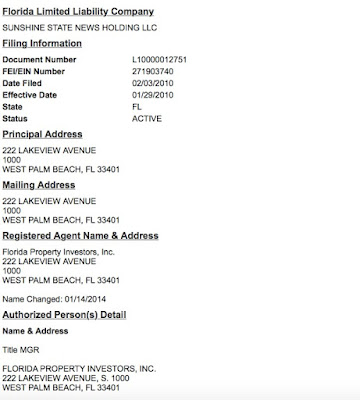
Public records disclose a second corporation: Sunshine State News Holdings, LLC.

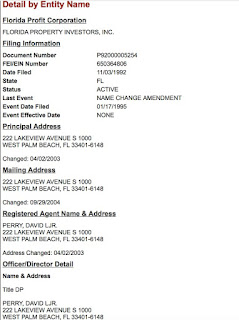
Its address is 222 Lakeview Avenue, Suite 1000, West Palm Beach. Its registered agent and manager is Florida Property Investors, Inc., at the identical address. Florida Property Investors, Inc. lists one officer and manager; David L. Perry Jr., a senior partner with Holland and Knight. The law firm's West Palm Beach offices are recorded at the same address: 222 Lakeview Avenue, Suite 1000.

Previously, Mr. Perry was an attorney with the Miami law firm, Steel Hector & Davis. Steel Hector for many years was the primary law firm on Everglades related litigation on behalf of Big Sugar billionaires, the Fanjuls of Coral Gables and Palm Beach.

The Fanjuls’ corporate vehicles include Flo-Sun, Inc., Okeelanta Corporation, and Florida Sugar Crystals, trademarked in 1991.

David L. Perry Jr., now of Holland and Knight and registered manager of Sunshine State News Holdings, LLC, was correspondent attorney when he worked for Steel Hector for the Fanjul trademark registration of Florida Sugar Crystals.

It could be that Jeb Bush's confidante, Justin Sayfie, handed Sunshine State News, with no concern for money at all, to MS. Ms. Nancy Smith.  Only Holland and Knight or the Fanjuls could disclose whether Sunshine State News Holdings LLC is an owner of Sunshine State News LLC, based in Mississippi.

The bottom line: Sunshine State News is the friendly fire of Big Sugar. In 2015 it laid down a steady patter of attacks against environmentalists as unreasonable and driven by emotion, misrepresenting the strong support of qualified scientists for the buyout of lands owned by Big Sugar. That friendly fire gave cover to politicians doing Big Sugar's business in Florida, who otherwise faced a daily barrage of critical editorials by mainstream news.

Other qualifications of Sunshine State staff include working for Fox News, a former “senior media analyst for the Taxpayers Protection Alliance” in Washington, DC, and and a former organizer for the Florida operations of Americans For Prosperity. Both light up in the network of right wing entities masquerading as the Tea Party and funded by the Koch Brothers.

The Sunshine News website plainly states, "... we strive to cut through the jargon” and that doesn't take long: the drive from the registered office of Sunshine State News Holdings, LLC to Florida Crystals in West Palm Beach, Florida takes three minutes.


Saturday, January 11, 2014

Big Sugar and the public health crisis in America … by gimleteye

The following edited version of a post earlier this week appears on the website, Counterpunch. Today the annual Everglades Coalition meeting is being held in Naples. How many of the participants are talking about the link between Big Sugar and America's public health crisis, as a point of entry to environmental pollution and problems that have vexed the public for decades?

COUNTERPUNCH WEEKEND EDITION JANUARY 10-12, 2014

It Is What It Is
The Killer Politics of Big Sugar
by ALAN FARAGO

A recent report by the OECD (Organization for Economic Co-Operation and Development) underscores the health care crisis in the world’s most exceptional democracy. The U.S. spends two and a half times per capita more on health care than any other developed country. How does this happen? Take a look at a key player in the paradox: sugar growers. In Florida it is called, Big Sugar. In other states it is beets, maple syrup and most ubiquitous of all: high-fructose corn syrup extracted from an unlimited corn crop heavily subsidized by taxpayers.

Thursday, July 23, 2015

Grover Norquist on Big Sugar: "cronyism in its undiluted, inexcusable majesty" ... by gimleteye

For decades, conservatives have lamented federal subsidies in American farm policy accruing to Big Sugar. Strangely, the wailing falls silent south of the Georgia border. In Tallahassee, the glad-handing and back slapping by Big Sugar for its supporters is ubiquitous.

The application of sugar money to lobbyist and lawyers’ net worth statements, contributions to lawmakers, and entertainments like secretive hunting trips for compliant legislators has created a shadow government impervious to complaint, whether by Republicans or Democrats.

At a recent Palm Beach teach-in, Beyond Sugar by Sierra Club, a packed conference room was informed about Big Sugar’s predatory influences, including the most pernicious of all: the trillion dollar cost imposed by excess sugar consumption on public health.

The conservatives' opposition to sugar’s subsidies has neither to do with childhood obesity, nor Florida’s threatened Everglades, rivers and estuaries despoiled by inadequate environmental regulations, nor public health, ruined by consumption of too much sugar, and certainly not with the state of our democracy, made toxic by super-sized doses of sugar money.

A recent editorial by Bloomberg (“Grover Norquist finds a sweet spot”, July 22, 2015) remarks on the conservative icon joining the battle against sugar subsidies in the Farm Bill. Norquist opposes the sugar subsidy in the U.S. Farm Bill because it is “cronyism in its undiluted, inexcusable majesty.”

Norquist is famous for the firebrand ideology that burned the moderate wing of the Republican party to a crisp. He trenchantly warned, "I'm not in favor of abolishing the government. I just want to shrink it down to the size where we can drown it in the bathtub.”

How Big Sugar controls the state legislature and Gov. Rick Scott, measured by the GOP's permanent war against water quality law and altering water infrastructure to its needs is not Norquist’s concern.

Bloomberg, too, strains the state from the federal: "The sugar industry lobby accounts for more than one-third of all lobbying funds spent by crop producers, even though sugar represents less than 2 percent of the value of all U.S. crop production. Most of the benefits of high prices flow to three firms that produce about 20 percent of U.S. sugar supply.” What Bloomberg ought to have added: two of those firms are Florida sacred cows: U.S. Sugar Corporation and Florida Crystals, owned by the billionaire Fanjuls' of Coral Gables and Palm Beach.

The profits guaranteed by sugar subsidies afford Big Sugar profits, deploying lobbyists to influence state legislators already softened by its campaign contributions, and push water quality and environmental regulations even further into the fetid ditch.

This puts Norquist and his radical extremist colleagues in the position of opposing in principle the cronyism it otherwise supports. For example, conservatives despise federal environmental protection mandates of the U.S. EPA. Conservatives who support knee-capping the EPA oppose subsidies that nevertheless accrue to their advantage. It is the same way with the Norquist “no tax pledge” committing elected legislators to undermine the government they serve.

In a logical world, the enemy of your enemy is your friend, but in the upside down GOP world; the friend of your friend is also your enemy. The cake baked for the American people by the conservative right ends up on all over our faces. It is a spectacle filled with too much sugar.

How much easier if Norquist, the Tea Party, Americans for Prosperity, the American Enterprise Institute, Cato Institute and the Heritage Foundation among other conservative entities embraced the mantra learned here in Florida: Big Sugar poisons people, poisons Democracy, and poisons the Everglades.

Can we say it all together? The time to end Big Sugar's implicit subsidies that enrich a few at the expense of many, that weaken environmental laws and protections that protect Floridians and future generation, is now.

MONEY AND POLITICS
Grover Norquist Finds a Sweet Spot
3 JUL 22, 2015 8:00 AM EDT
By The Editors, Bloomberg

Now that they have critically (and foolishly) wounded the U.S. Export-Import Bank, Grover Norquist and his allies in the conservative gadfly movement are taking aim at a far more formidable (and worthy) target: Big Sugar.

The U.S. has protected its sugar producers almost since it has existed. But those protections have long since lost any justification. U.S. consumers now pay close to double the world price for sugar; ending U.S. support for sugar producers could put as much as $3.5 billion a year back in consumers' pockets. This fiercely defended thicket of tariffs, price supports and quotas undermines U.S. development aid, corrupts the country's politics and distorts global trade. It also enriches a coterie of sugar barons at the expense of public health.

Wednesday, November 02, 2011

Will Big Sugar derail the Congressional Super Committee ... by gimleteye

In a September 23, 2011 letter to the Congressional Super Committee, the Coalition for Sugar Reform pointedly noted, "We are writing because Congress needs to debate sugar policy in a fair and open way. The logical place for this debate to occur is during consideration of the 2012 farm bill." What concerns commerce (including the US Chamber of Commerce) and environmentalists (Everglades Trust) is that Big Sugar, willing to extract the last penny out of the Everglades by shifting the costs of pollution to the backs of taxpayers, is swamping the hallways of Congress again. This time, Big Sugar is lobbying for the farm bill-- reauthorized every five years-- to be pushed into the Congressional Super Committee where an up-or-down vote on measures to reduce the federal deficit by the end of the year could extend their riches. The Coalition calls the sugar subsidy "an implicit food tax" costing consumers at least $4 billion a year and "makes Everglades restoration much more difficult."

What they mean is that Big Sugar, whose most infamous component are the billionaire Fanjuls, spread their sweet campaign contributions across the political landscape, pitting power against common sense and turning a highly managed water supply system into a political ATM machine.

Big Sugar is no ordinary political ATM. For paltry millions a year of political fertilizer, Big Sugar gets whatever it wants, whenever it wants. During the historic drought of last winter -- broken only by unusual rain events this fall-- sugar production was scarcely touched compared to water restrictions endured by millions of South Floridian businesses and residents. In a Palm Beach Post report, "Combined, U.S. Sugar, Florida Crystals Corp., headquartered in West Palm Beach, and the Sugar Cane Growers Cooperative, Belle Glade, are forecast to produce 1.63 million tons of sugar, up from 1.43 million tons last season, the U.S. Department of Agriculture said."

Although Big Sugar's political influence wraps up Florida's GOP and Democrats, from lowly county commissioners to Congress and the White House, it is a nagging irritation for conservatives whose political gains are undermined by elected officials they supported yet regularly betray conservative values by voting farm bill after farm bill to maintain systematic, entrenched prerogatives. The sugar subsidy in the US farm bill is the clearest example how conservatives talk-the-talk but can't walk-the-walk.

This year, though, it is not just the Cato Institute and Wall Street Journal who are opposing the continued sugar subsidy that makes billionaires even richer, at the expense of American jobs and the Everglades. Tea Party supporters, too, are rattling the comfortable relationship between Congress and an abusive form of corporate welfare.

On October 27, Americans for Prosperity (funded by the Koch Brothers) wrote the Joint Select Committee, "The powerful agricultural lobby has held the US Congress hostage for too long." One example of its hostage taking: the billionaire Fanjuls were among the biggest financial supporters of the Marco Rubio campaign for US Senate. They were furious with Rubio's opponent, former Florida governor Charlie Crist, who tampered with their well-oiled political machinery through a deal he never passed by them; for the state to acquire significant historic Everglades lands in sugar production owned by their chief competitor, US Sugar. Taking out Crist also joined the Fanjuls to the biggest Rubio supporter: Karl Rove's American Crossroads that "invested $1.9 million in ads (attacking Crist)."

Running at cross-currents to conservative political purposes hasn't failed Big Sugar so far. That is why Fanjul lobbyists are calculating to bump the farm bill into the Congressional Super Committee. There, an up-or-down vote could bury their taxpayer supported riches in a feathered federal budget deal: better odds than to subjecting subsidies to scrutiny in a presidential election year where their exquisite protection racquet could be damaged.

The Coalition writes, "... unless you are confident that the Joint Committee will thoroughly and completely overhaul sugar subsidies, we strongly urge you to defer any action on sugar policy to the 2012 farm bill, and resist any efforts by the sugar lobby to extend their program through your committee's work product." But according to the trade journal AgWeek, "Senate Budget Committee Chairman Kent Conrad, D-N.D., recently spoke to the the American Sugar Alliance via video teleconference and offered an assurance that the debt cieling-reduction bill wouldn’t cut farm subsidies in the short term. If the “Super Committee” doesn’t come up with a deficit reduction proposal by December, however, farm programs will be affected."

Thursday, December 17, 2015

Budget deal to keep government open contains toxic political money nightmare ... by gimleteye

Congress Is About To Make Citizens United Even Worse: It's making political spending less and less transparent.
Zach Carter, Senior Political Economy Reporter, The Huffington Post
12/16/2015 11:17 am ET

Comment: Every time you think the deformation of democracy by shadow political money can't get worse, it does. Passing legislation might be like making sausage, but there is no cure for American democracy until the harms are stripped from campaign finance.

Shut down the federal government rather than give the Citizens United decision by the Bush Supreme Court more traction to bulldoze the public interest.

WASHINGTON -- Congress is about to defund any efforts from a key federal agency to require American corporations to publicly disclose their political spending. The measure is tucked into spending legislation that must pass to avert a government shutdown.